2025 will be a pivotal year for the cryptocurrency industry, marked by both regulatory transformation and structural progress.
The Trump administration, through a series of pro-crypto policies (such as the "Strengthening American Leadership in Digital Financial Technology" executive order signed in January 2025, the establishment of a strategic Bitcoin reserve in March, the GENIUS Act stablecoin bill signed in July, and the ongoing CLARITY Act market structure bill), is fulfilling its political promises, providing a clearer regulatory path for the crypto industry, and propelling the United States to become the global "crypto capital."
Meanwhile, the Hong Kong government is actively advancing its virtual asset regulatory framework, officially implementing the Stablecoin Ordinance in August 2025, requiring stablecoin issuers to obtain licenses and strengthening the regulation of VASP platforms, further consolidating its position as an Asian Web3 hub.
These favorable global policies spurred accelerated adoption by individual investors, institutional investors, and sovereign nations, pushing Bitcoin to a high of $126,000 and maintaining the industry's total market capitalization at a high of approximately $3 trillion, marking the transformation of crypto assets from the fringe to mainstream finance. However, along with the booming industry and mature infrastructure, while decentralized exchanges (DEXs), cross-chain bridges, DeFi protocols, and various cryptocurrency tools are widely used, cryptocurrencies, with their high liquidity, rapid transfer, and relative anonymity, have also become a target for criminals. With the widespread application of crypto assets and on-chain protocols, the risk of their abuse in some illegal and high-risk activities is gradually emerging. Related infrastructure mainly serves functions such as value transfer, fund mixing, and storage of illicit assets in scenarios such as online gambling, money laundering, black market transactions, fraud, and sanctions evasion. This trend is receiving continuous attention from regulatory agencies. According to Bitrace's monitoring and statistics, in 2025, the total amount of illicit funds received by blockchain addresses marked as high-risk reached $502.1 billion. This report aims to remind the industry that while embracing innovation, it must strengthen compliance and risk control by disclosing the trends and scale of cryptocurrency crime in 2025. Trends
Cryptocurrency Sanctions Amid Geopolitical Conflict
In 2025, the conflict between Israel and Palestine entered its third year. Against this backdrop, Israel continued to crack down on cryptocurrency channels suspected of providing funding to Hamas, Hezbollah, and Iranian-related entities.
According to Bitrace's monitoring, Israel's National Counter-Terrorism Financing Authority (NBCTF) sanctioned at least 446 blockchain addresses or exchange accounts in 2025 alone, mainly involving USDT and Bitcoin, far exceeding other countries.
Online gambling platforms, by building their own cryptocurrency settlement channels or connecting to third-party cryptocurrency payment tools, have achieved a business address structure similar to centralized cryptocurrency exchanges. Gamblers do not directly purchase and convert trading chips into cash using fiat currency, but instead use cryptocurrencies (especially stablecoins) as intermediaries, thus achieving a high degree of anonymity.
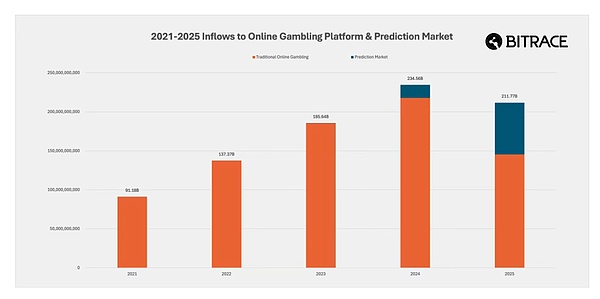
Over the past few years, this system has primarily operated stably on the Tron and Ethereum networks. Although lower than in previous years, high-risk gambling addresses still received $145.3 billion in 2025, down from $217.8 billion in 2024.
In the past few years, this system has primarily operated stably on the Tron and Ethereum networks.
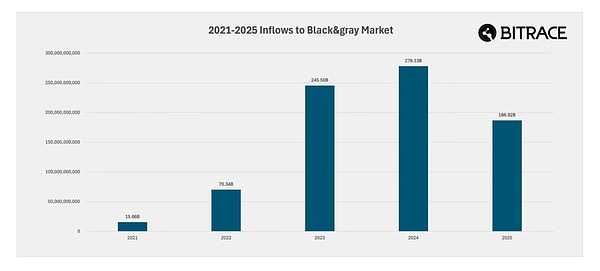
The adoption of these stablecoins almost entirely occurred on the Tron network. In 2025, addresses flagged as high-risk black market transactions received a total of $186.9 billion, of which $186.7 billion came from the Tron network.
Despite a slight decrease in the overall size of the black market compared to the previous year, cryptocurrency-based escrow platforms continue to grow despite strong crackdowns by law enforcement agencies in various countries. According to Bitrace, in 2025, escrow addresses on various escrow platforms collected a total of 10.9 billion USDT. Due to the different escrow rules of various platforms, this figure does not fully reflect the true scale of escrow transactions. Actual transactions occur at the business addresses of the escrow merchants, and the scale should far exceed the deposits. Due to sanctions imposed by the UK and the US on Cambodia's Prince Group and Huionepay Group, Huionepay Group was forced to temporarily suspend operations of its main business, Huionepay. According to Bitrace's statistics, Huionepay collected 52.4 billion USDT that year, but by December, its on-chain activity had almost completely ceased. This incident has disrupted the local black market, preventing some operators from withdrawing funds from Huiwang Payment. The industry has lost a stable and secure payment tool. Combined with ongoing law enforcement activities from various countries and the crackdown on Telegram, organized crime networks in East and Southeast Asia are currently in a state of chaos and disorder. Cryptocurrency fraud includes both direct financial deception targeting native crypto users and investment scams targeting non-crypto investors. Both types of illegal fraud are key targets of law enforcement agencies in various countries. In 2025, Bitrace tracked $30 billion in funds linked to addresses involved in real fraud cases, stablecoin freezes, and address poisoning activities, a significant decrease compared to 2024.
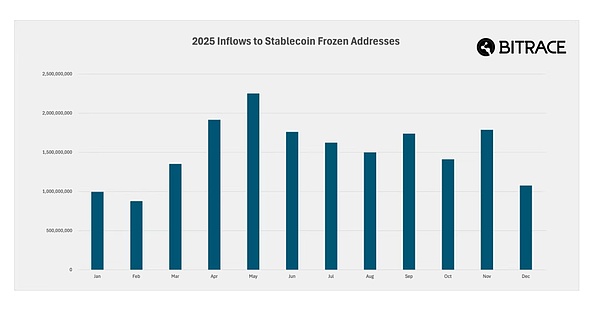
With the increase in law enforcement cooperation between Tether and Circle, the scale of stablecoin activity related to frozen addresses has reached an all-time high. In 2025, these addresses received a total of $18.3 billion worth of stablecoins.
As a result of the increased law enforcement cooperation between Tether and Circle, the scale of stablecoin activity related to frozen addresses has reached an all-time high. In 2025, these addresses received a total of $18.3 billion worth of stablecoins.
Bitrace primarily compiled statistics on national-level sanctions imposed by five countries: the United States, Japan, the United Kingdom, Israel, and France. Between 2021 and 2025, five countries (excluding centralized cryptocurrency exchange accounts) imposed sanctions on at least 1,683 blockchain addresses. The US-based OFAC had the most, followed by Israel's NBCTF. Most of Israel's sanctions occurred during the conflict and primarily targeted cryptocurrency addresses suspected of funding Hamas, Hezbollah, and Iranian-related entities. Further analysis of the sanctions activities of Israel's NBCTF between 2021 and 2025 reveals that Tron has a total of 585 network addresses, far exceeding other networks, indicating that terrorist financing is currently making extensive use of Tron network assets. Freezing access to USDT or USDC for specific blockchain addresses is the primary means of law enforcement cooperation between Tether and Circle, the two major stablecoin issuers. Even after excluding some contract addresses and abnormal addresses, the number of addresses frozen in 2025 still reached a record 4,059, exceeding the total of 3,199 frozen addresses in the previous four years. Among them, 653 Ethereum addresses were frozen and 3,406 Tron addresses were frozen, with the latter almost entirely executed by Tether. Further statistics on the amount of money frozen in addresses show that in 2025, Tether successfully froze over 1.1 billion USDT, and Circle successfully froze over 23 million USDC. Circle's law enforcement cooperation activities were significantly lower than Tether's.


 Miyuki


