Author: NoLimit, an early Bitcoin investor; Translated by: Jinse Finance
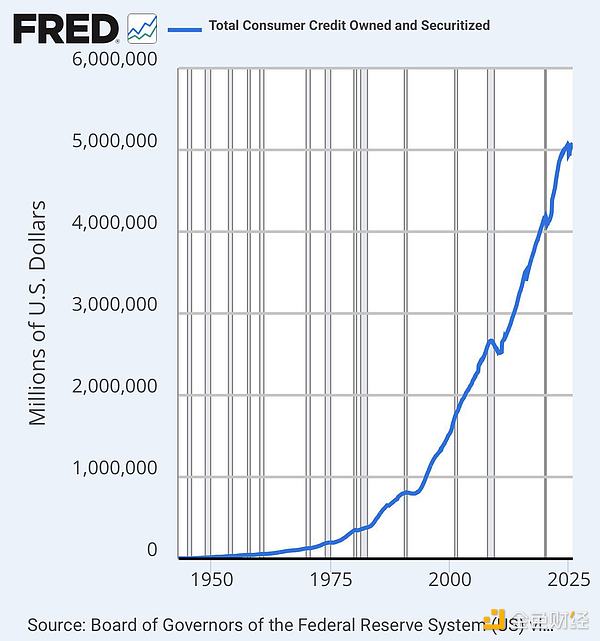 Something extremely terrible is happening in the US economy, and almost no one is talking about it publicly.
This chart isn't about the stock market, government bonds, or government spending; it's about consumer credit.
Money ordinary people borrow to survive.
It's skyrocketed.
For decades, consumer debt has grown slowly, almost "naturally."
Entering the 2000s… the curve began to bend. After 2008… the slope became steeper. After 2020… it became a straight line. Now we are sitting on over $5 trillion in consumer debt, the highest in U.S. history. The most crucial point that most people overlook is: Americans are no longer borrowing money to buy luxury goods; they are borrowing money to fight inflation and survive: Grocery shopping, rent, medical bills, car repairs, credit card interest, student loan reactivation, wages not keeping up with prices. People swipe their cards not because they want to buy, but because they have no other choice. Meanwhile, CNBC keeps repeating the same old line every day: "Consumers are incredibly strong," like gospel. But if consumers are really that strong… Why is the US household savings rate near a historic low? Why is credit card delinquency rate rising the fastest since the Great Financial Crisis? Why has "buy now, pay later" seen an explosive growth in everyday spending? The truth is simple: Consumers aren't strong; they're just highly leveraged. Even more dangerous is the fact that when consumer credit experiences this parabolic surge, there's never a good ending. People will keep borrowing until they can't borrow anymore. Then we will see: Demand collapse, massive layoffs, recession, wave of defaults, credit tightening, and the Fed's renewed "emergency bailout." This chart doesn't show growth at all; it shows the pressure accumulating. Pressure doesn't disappear on its own; it only releases. What we are seeing now is not rising prosperity, but accumulating despair. The US economy has never been driven by innovation, nor by productivity; it is driven by consumption—accounting for 70% of GDP. So here's the question: What will happen when consumers max out their credit cards, when they can no longer borrow money, when this consumer engine that has fueled America for 30 years suddenly stalls? This chart may be the most important warning sign for 2025. Most people won't notice it until it's too late. You must see it now.


 Brian
Brian

