SBF found guilty of Fraud, But Intends To Appeal Decision
The jury took less than five hours to reach their guilty verdicts.
 Clement

Author: Jack Inabinet, Senior Analyst, Bankless; Translation: @JinseFinancexz
Last week, the U.S. Securities and Exchange Commission (SEC) and the Commodity Futures Trading Commission (CFTC) jointly released a landmark guidance document, providing a long-awaited joint guidance document that details how and when federal securities laws apply to crypto assets.
While the cryptocurrency industry has long operated in a legal gray area, this new framework attempts to replace some of the uncertainty through a token classification system to help distinguish under what circumstances digital assets qualify as securities.
Today, we will analyze this joint guidance document and speculate on how it might ultimately classify mainstream digital assets.
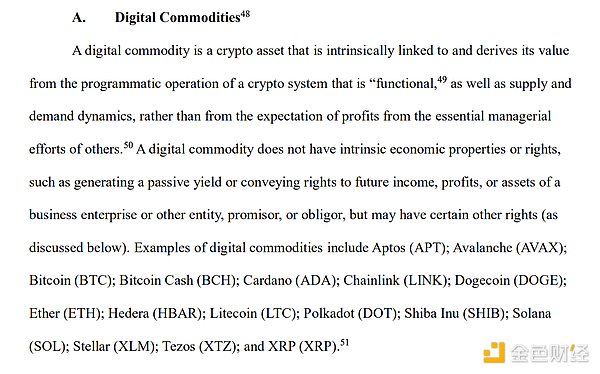
According to the SEC's interpretative guidance document, the "digital commodities" category covers crypto assets whose value derives from their "functional" role in the cryptocurrency ecosystem and supply and demand dynamics.
This broad definition has a clear intention to encompass utility tokens from numerous mature blockchain networks.
The U.S. Securities and Exchange Commission (SEC) has listed 16 crypto assets that fall into this category, as follows: Aptos (APT), Avalanche (AVAX), Bitcoin (BTC), Bitcoin Cash (BCH), Cardano (ADA), Chainlink (LINK), Dogecoin (DOGE), Ether (ETH), Hedera (HBAR), Litecoin (LTC), Polkadot (DOT), Shiba Inu (SHIB), Solana (SOL), Stellar (XLM), Tezos (XTZ), and XRP (XRP). While the SEC's guidance does not provide individual explanations for why these specific cryptocurrencies are classified as non-security digital commodities, it emphasizes that because they do not meet the legal definition of "security," they are not automatically considered securities. The U.S. Securities and Exchange Commission (SEC) claims that its use of the term "digital commodity" is strictly based on an economic meaning to describe the typical characteristics of a class of non-security digital assets. However, the guidance document also states that any crypto asset (excluding stablecoins compliant with the GENIUS Act) may be classified as a genuine "commodity" under the Commodity Exchange Act, subjecting it to independent oversight and regulation by the Commodity Futures Trading Commission (CFTC). Other popular crypto tokens not mentioned by the U.S. Securities and Exchange Commission (SEC) but potentially qualifying as "digital commodities" include: BONK: A meme coin on the Solana network, which has evolved to integrate diverse token governance and utility functions since its inception; CC: The native utility token of the Canton blockchain, used for trading, settling transactions, synchronizing data, and transferring assets; EIGEN: A utility token based on a restaking mechanism within the EigenLayer ecosystem, used to provide economic security; ETC: A proof-of-work version of Ethereum, designated by the SEC as a non-security digital commodity; HYPE: Hyperliquid, the native fuel and staking token of the Hyperliquid network, used to pay transaction fees and ensure network security; STX: Stacks, the native fuel and staking reward token of the Stacks Bitcoin Layer 2 network, used to pay transaction fees and ensure network security; SUI: Sui Sui The network's native fuel and staking tokens are used to pay transaction fees and ensure the network's secure operation; TAO: Bittensor, the native token of the Bittensor network, used to incentivize and reward machine learning contributions in the decentralized artificial intelligence market; TRX: Tron, the native fuel and staking token of the Tron network, used to pay transaction fees and ensure the network's secure operation; XMR: Monero, the native token of the privacy-focused Monero network, used to pay transaction fees and ensure the network's secure operation.
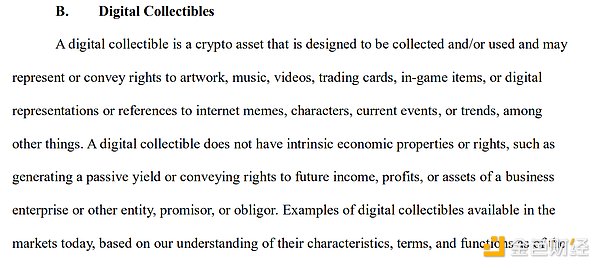
Former Chairman of the U.S. Securities and Exchange Commission, Gary Gensler, failed to clearly state at a congressional hearing whether tokenized Pokémon cards would be considered securities under federal law, stating that more information was needed to make a final judgment. Now, the cryptocurrency industry seems to have finally received the long-awaited answer.
Digital instruments are cryptographic assets designed to perform specific functions. While digital instruments may possess intrinsic functional value, many are also “soul-bound,” meaning they cannot be sold and are permanently owned by a single user.
Importantly, the U.S. Securities and Exchange Commission states that digital instruments must not possess “inherent economic attributes or rights, such as generating passive income or granting claims on future income, profits, or assets of a business, other entity, promisor, or debtor.”
The U.S. Securities and Exchange Commission (SEC) has listed a range of use cases for digital instruments, including memberships, tickets, credentials, ownership certificates, and identity tokens. Its guidance document classifies Ethereum domain name service domains and CoinDesk's "Microcosms" NFT consensus conference tickets as digital instruments. Other digital assets that may qualify as "digital instruments" include: FanDome NFT: A collection of NFTs inspired by comic books, distributed free to participants of the DC Comics FanDome virtual conference in 2021; POAP: Digital badges generated in NFT form, minted via blockchain to prove participation in online or offline events; Propy NFT: Digital certificates representing legal ownership of physical real estate, stored on the blockchain; VeeFriends: An NFT series created by Gary Vinerchuk, allowing holders to participate in exclusive events, including the VCON conference; World ID: A soul-bound "proof of identity" certificate issued by Sam Altman's World Coin project.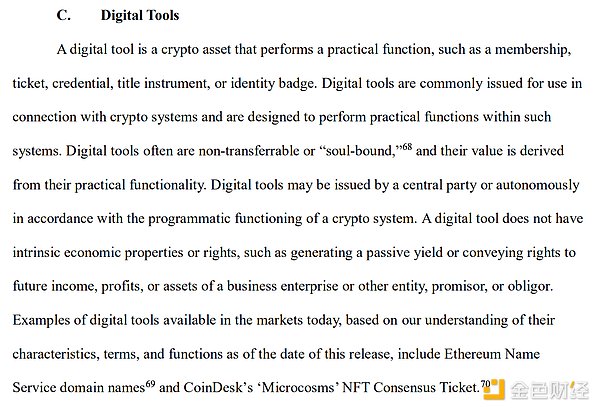
The U.S. Securities and Exchange Commission's interpretative guidance on non-security stablecoins intentionally maintains a concise and direct style, clearly stating that after it takes effect in January next year, it will treat payment-type stablecoins that conform to the description of the GENIUS Act as non-security.
Therefore, the U.S. Securities and Exchange Commission itself will not impose registration requirements on payment-type stablecoins that conform to the GENIUS Act during the issuance and redemption process (although these stablecoins themselves will still be subject to extensive supervision by other agencies within the U.S. regulatory system).
However, the guidance document clarifies that prior to the enactment of the GENIUS Act, previously defined "covered stablecoins" were still considered non-securities outside the agency's jurisdiction. For a stablecoin to meet this definition, its holders must not have the right to "receive any interest, profits, or other returns," and its reserves must consist entirely of "US dollars and/or other assets considered low-risk and readily liquid." While the U.S. Securities and Exchange Commission (SEC) does not specifically designate which stablecoins are considered non-securities, instruments pegged to the U.S. dollar that appear to fit its definition of "covered stablecoins" include: PYUSD: A stablecoin issued by Paxos Trust Company, a federally registered national trust bank, for PayPal; USAT: Tether's latest stablecoin pegged to the U.S. dollar, designed to comply with the GENIUS Act; USDC: A stablecoin issued by Circle, over-collateralized 1:1 with U.S. dollars and risk-free U.S. dollar investments; KlarnaUSD: A stablecoin sponsored by Klarna, a buy-now-pay-later giant, and issued by Stripe's Bridge.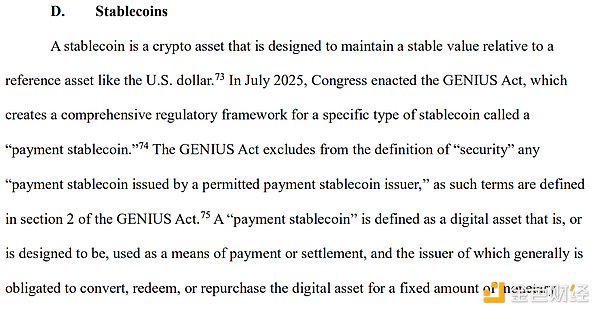
It can be said that the most influential guidance document from the U.S. Securities and Exchange Commission (SEC) is precisely its most ambiguous part.
The regulator maintains that any digital asset that fails the Howe test is considered a security, a determination that has historically involved difficult legal disputes.
The SEC also recognizes that encapsulated versions of financial instruments that are explicitly defined as securities under federal law (such as tokenized money market funds, stocks, and other types of structured investment products) are digital securities.
However, this does not mean that all "encapsulated" tokens are securities.
The guidance document explains that protocol mining, protocol staking, and the "packaging" of non-security crypto assets do not constitute the issuance or sale of securities. The document further clarifies that "certain" airdrops do not constitute "fund investment" under the Howe Test. However, the agency cannot provide a definitive answer as to when a digital asset becomes a digital security. In each case, determining whether an investment contract (i.e., a security) has been issued or sold must be based on the specific facts and circumstances of how the issuer marketed and promoted its asset. If a non-security crypto asset is issued through an investment contract that meets the Howe Test criteria, it will become a security. Furthermore, the initial issuance of a non-security crypto asset through an investment contract does not imply that it is permanently a security; once the original investment contract is fulfilled, or the issuer fails to fulfill its committed operational efforts, the crypto asset can become a non-security. While the SEC refuses to list examples of assets it deems securities, it is noteworthy that its guidance document classifies XRP as a non-security "digital commodity," although courts ultimately ruled that certain sales of the token constituted investment contracts that violated federal securities laws. While this is a step towards regulatory clarity, this aspect of the SEC guidance ultimately reinforces rather than resolves ambiguity. It merely extends existing federal securities laws to the digital asset space, while reigniting market concerns about projects that promise unfinished work or future functionality. Digital goods, digital collectibles, digital instruments, and stablecoins may be non-securities in nature, but they can still be issued or sold through investment contracts, which would subject issuers to federal securities laws.
The jury took less than five hours to reach their guilty verdicts.
ClementInstead of requiring users to write complex queries with programming skills, individuals can now ask questions in plain language using Dune's natural language engine.
 Davin
DavinThe security of Tellor's X account was compromised by a sophisticated phishing scam that enticed users with fraudulent airdrop offers.
 Kikyo
KikyoBRICS nations unveils plans for their collective currency, shaping the future of global finance.
 Hui Xin
This collaboration has a clear objective: an Ethereum-based marketplace that stands as a testament to its dedication to preserving the rightful royalties of NFT creators upon each sale.
 Catherine
Bitfinex encountered a minor phishing attack, reassuring users of their security measures while resolving the issue and collaborating with law enforcement for a comprehensive investigation.
Hui XinIn response to the discovery of a technical glitch, Aave has taken measures to safeguard user funds, momentarily suspending market operations while prioritising the security of assets.
CatherineNamed on the Microsoft store as "Ledger Live Web3," the deceptive application misled users into believing they were downloading "Ledger Live," an interface for Ledger hardware wallets used for offline cryptocurrency storage.
DavinThis move signifies OpenSea's shift towards adopting a more agile and innovative approach to its marketplace, as articulated by Devin Finzer, the co-founder and CEO of OpenSea.
KikyoThe breach was discovered by a developer the next day, after around half a million dollars had been lost.
Clement