Why are transaction fees charged? We all know that Polymarket previously didn't charge any fees for basic transactions. Why is a fee being charged only for the 15-minute cryptocurrency market? This requires explaining what a "delayed arbitrage" bot is. In a very short market cycle like 15 minutes, the outcome is determined by the prices on various exchanges. Without transaction fees, high-frequency trading bots would exploit millisecond-level time differences to place orders and profit before Polymarket prices have had time to update. For example, if the probability of BTC rising (UP) in the 15-minute timeframe on Polymarket is currently 90%, and suddenly the price of BTC on the exchange drops by 5%, the bot immediately buys in at a lower price (DOWN). After that, other bots or traders follow suit, gradually buying to push the price up, allowing the bot to profit and exit. What are the consequences of this behavior? Market makers are constantly being exploited by these high-frequency bots, making them unwilling to continue providing liquidity in such markets, ultimately leading to decreased liquidity in the 15-minute cryptocurrency market.
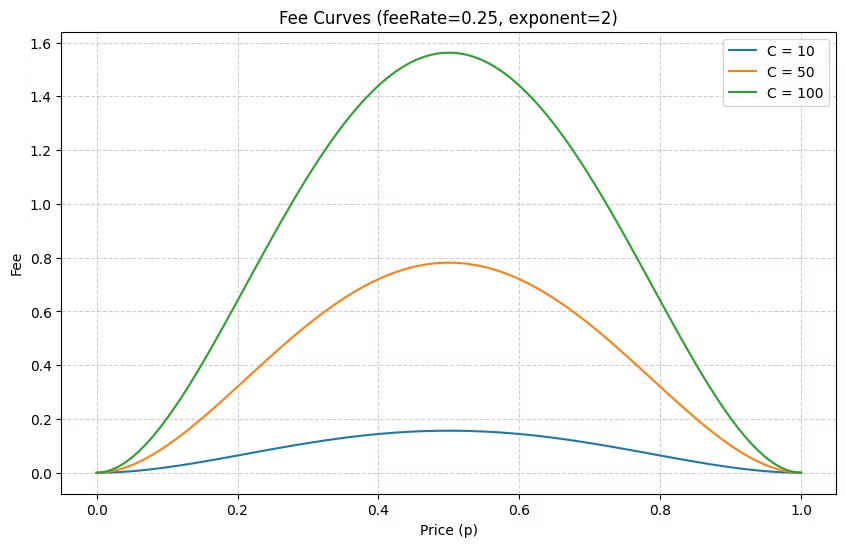
Therefore, the official platform introduced a transaction fee mechanism at this time, especially with the highest fees when the odds are 50:50 (as shown in the image). This directly caused the arbitrage costs of many bots to exceed their profits, and these bots naturally shut down.
Why subsidize market makers?
As mentioned earlier, market makers had previously had too much capital taken away. In order to retain market makers, the platform will share the transaction fees with those who place orders (market makers).
So why was the subsidy reduced from 100% to 20%? The detail lies in this sentence: "From the 12th to the 18th, 20% of the transaction fee will be refunded." This tells us that the refund percentage after the 18th is pending. When the platform initially implemented transaction fees, market makers were unsure whether it could stop bots. That's why the platform refunded 100% of the transaction fees to market makers, covering their risk and maintaining liquidity. Why is only 20% being returned now? Let's look at the data first: After enabling transaction fees, the total transaction fees dropped by half. What does this mean? It means that many high-frequency trading bots have indeed shut down. Seeing that the bots have left and the market maker risk has decreased, the official response is that a 100% transaction fee return may not be necessary. They're offering 20% first to see how the data performs. This is why they're piloting a 20% transaction fee return for a week first, observing the data performance, and then determining the subsequent return percentage. In fact, all of this is about balancing the interests of market makers, bots, and ordinary traders. "Money Printing Machine" Bots Polymarket has too many "money printing machines" in its market, and very few people truly know how they do it. The most popular post is probably an article by X user @the_smart_ape: [Image link: https://uploads.panewslab.com/2026z/69246520-265f-4add-873a-053429ec66c2](https://uploads.panewslab.com/2026z/69246520-265f-4add-873a-053429ec66c2) ... No, if you can crack their strategy, your "money-printing machine" won't be far off. But remember, don't tell anyone else, though you can tell me secretly. Finally, on Polymarket, since there are no third-party commissions or fees, we're essentially betting against each other. Therefore, as a platform, their responsibility is to provide a fair opportunity for both sides to compete. Players who enjoy PVP games know that absolute fairness doesn't exist; it can only be achieved through iterations version by version, striving for the best possible fairness. This also shows us that a "money-printing machine" does indeed exist on Polymarket, where success is built on technology and strategy.


 Weatherly


