Former Ethereum Miner CoreWeave Inks an AI Deal With Microsoft
Microsoft has repotedly signed a deal with former Ethereum miner – CoreWeave.
 cryptopotato

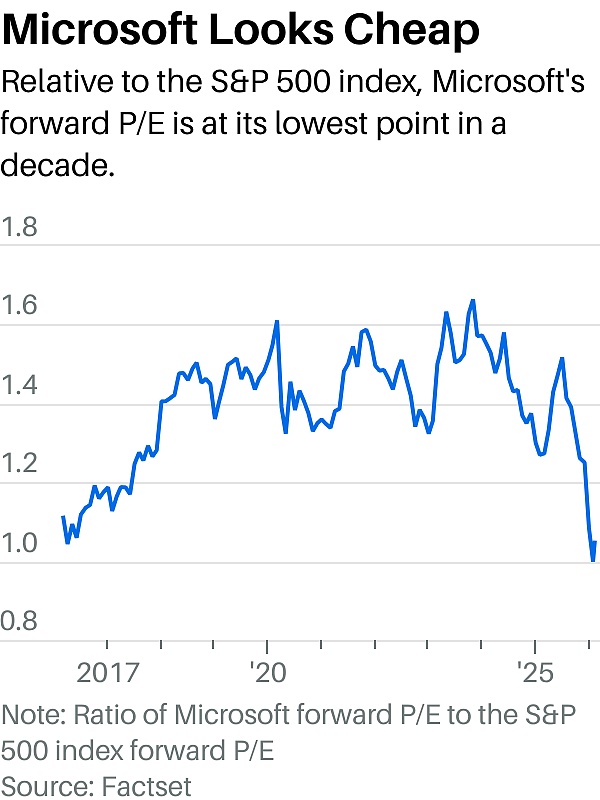
But the market overlooked a crucial point:Microsoft was already prepared.
Royal Bank of Canada (RBC) (Analyst Rishi Jaluria) Jaluria stated, "If I look at Microsoft's entire technology stack from top to bottom—not just Azure cloud, but also the data layer, developer layer, application layer, security layer, and even assets like LinkedIn and gaming—I think they could all be beneficiaries of AI. The stock's current earnings multiple is below the market average. So, all things considered, I do think this stock is significantly undervalued." In fact, when investors buy Microsoft stock now, its valuation level is almost identical to the S&P 500 index as a whole. But Microsoft is no ordinary company. According to Wall Street analysts, Microsoft's revenue is expected to grow 16% to $328 billion in the fiscal year ending in June. Earnings per share are projected to rise 21% to $16.48. But what the market may have overlooked most is Microsoft's hedging strategy in AI—perhaps the most solid in the industry. This is thanks to CEO Satya Nadella's visionary moves: investing heavily in cloud computing and betting early on OpenAI. Equally important and cannot be ignored is: Microsoft's foundation for its rise—its software business. The software remains sturdy. Is the end of the world approaching? Microsoft's product coverage spans multiple technology sectors: from office software to enterprise resource planning, and even game consoles. The most direct impact of AI is on its "productivity and business processes" departments, including Microsoft. 365 (formerly Office) and other business software and LinkedIn. This remains Microsoft's core business. In the first half of its fiscal year 2026, the Productivity and Business Processes segment generated $67 billion in sales, accounting for 42% of the company's revenue and contributing more than half of its operating profit. The segment's sales grew 16% year-over-year, a strong performance for a mature business. This performance also propelled Microsoft's stock price to a peak of $555 per share in July of last year, pushing the company's market capitalization above $4 trillion. But the situation took a sharp turn for the worse in the fall, with the market focusing more on AI as a threat to the software industry—many began to call this sell-off “the threat to the software industry.” style="font-family:Helvetica Neue">SoftwareDoomsday". Today, the narrative surrounding software argues that "productivity and business processes" and "departments" are being undermined in multiple ways. Market concerns stem from AI intelligent agents, which are software running on large language models and capable of completing a series of complex tasks through conversational commands. Last year, programming intelligent agents were the first to emerge, capable of writing a significant portion of code for an application at a speed far exceeding that of humans. The cost per line of code has decreased significantly. This poses a huge problem for currently successful commercial software companies: if the cost of developing off-the-shelf software drops rapidly, the barriers to entry for new competitors will be removed. Customers might even decide to develop custom software to replace existing products. The risks associated with intelligent agents extend far beyond programming. Newer, more general-purpose tools known as "desktop intelligent agents" are gaining popularity in the tech world. These robots, which use large language models to control computers, could potentially replace many business functions currently powered by commercial software with intelligent agents running on free, open-source alternatives. At that time, Microsoft will watch as human users are overwhelmed by machines. The subscription revenue model pioneered by cloud software will crumble, replaced by a pay-as-you-go model, which will be more beneficial to AI startups, chip companies, and cloud hyperscale service providers. Microsoft's consistently strong profit margins—its business software division converts 82% of sales revenue into gross profit—will have nowhere else to go but downwards. This is a pessimistic scenario envisioned by Melius Research analyst Ben Reitzes in April 2024. He wrote at the time, "We may be in the midst of a generational shift, with money flowing away from expensive application software companies and back into the hands of companies that operate the infrastructure needed to write that software." He titled his analysis, borrowing a famous quote from Anderson, "AI is eating software." In recent months, this pessimistic outlook has swept the market, even leading to talk of a "software apocalypse." But unlike its smaller competitors, Microsoft's foundation is strong enough to weather this storm. Cloud computing provides a buffer. Microsoft's cloud business (primarily Azure) is growing rapidly. Driven by the explosive growth in demand for AI computing power, revenue increased by nearly 40% in the second quarter. Microsoft stated that the growth rate could have been even faster had it not been for the data center shortage. This fiscal year, Microsoft will invest over $100 billion in capital expenditures to increase capacity in this area. Thanks to Azure, Microsoft's "Intelligent Cloud" business segment will soon surpass enterprise software to become its largest source of revenue. However, sales growth will be accompanied by lower profit margins, because no other business can rival software in terms of profitability. Ultimately, however, without the cloud, AI cannot function, because intelligent agents require extremely large amounts of computing power. In other words, even if a "software apocalypse" does occur, Azure will thrive. Microsoft is a winner no matter what. Azure is Microsoft's first line of defense against software disruption, and it comes at a high cost. Microsoft's second line of defense now appears to be extremely cost-effective. OpenAI, founded in 2015, was initially a non-profit organization dedicated to providing free and open-source AI models worldwide. It struggled to raise enough funds to pay for the massive cloud computing resources required to train AI models. In 2019, OpenAI established a new type of entity: one that could accept equity funding but remained overseen by the non-profit organization's board of directors. Microsoft was the first to enter the fray, investing $1 billion. OpenAI used this money to build ChatGPT, and less than two months after its launch, Microsoft invested an additional $10 billion. Most of these transactions were paid in the form of Azure credits, meaning that Microsoft not only preemptively invested in AI star companies but also simultaneously strengthened its own cloud business. Azure, together with OpenAI, explored how to scale up AI infrastructure, giving Microsoft a crucial first-mover advantage in this AI revolution. Ultimately, Microsoft invested a total of $13 billion in OpenAI. As OpenAI raised more funding, its valuation soared. Earlier this year, OpenAI announced the completion of an $110 billion funding round, with participants including Amazon, Nvidia, and SoftBank Group. This deal values OpenAI at $840 billion. Microsoft's stake was diluted in the process, but its OpenAI shares are now likely worth over $200 billion. If the AI revolution unfolds according to the current script, Microsoft will be the largest shareholder of the world's most important AI company. The software will endure. For the bearish view on Microsoft to hold true, multiple negative factors need to occur simultaneously: First, OpenAI must lose its leading position in the field of AI. Location (This is not impossible: the biggest winners in the early days of the internet were once thought to be AOL and Yahoo) Secondly, Microsoft Azure must lose influence within the industry. Currently, it is the second largest cloud service provider after Amazon AWS, and its growth rate is faster. Finally, AI must truly "devour" software. However, there is currently little evidence to suggest that this is happening. Early indications suggest that AI will work in conjunction with enterprise software, rather than replacing it. As a leader in the intelligent agent wave, Anthropic conducted a demonstration for enterprises last month, emphasizing the use of existing software. It positions the agent as a highly efficient assistant, particularly adept at using Excel, PowerPoint, and other Microsoft applications. This scene has prompted investors to reconsider the claim that "software is doomed to die." Since then, iShares Software ETFs have recovered some of their losses, and Microsoft's stock price has also risen by 5%.Microsoft has repotedly signed a deal with former Ethereum miner – CoreWeave.
cryptopotatoThe web browser may soon support Ethereum and other digital assets.
 CryptoSlate
Microsoft and Google are investing heavily in AI research and development.
 Beincrypto
Google CEO Sundar Pichai announced the company's latest foray into the world of conversational AI.
BeincryptoBinance’s Head of Product has a lot to share about his experience with the exchange, the challenges of 2022, and what’s to come.
cryptopotatoLive from CES 2023 in Las Vegas, Nevada, the tech giant is looking to transform the customer experience and believes the future will be based on a hybrid model.
 Coindesk
The threat actor appears to be well-versed in the inner workings of the crypto industry.
cryptopotatoStarting with Teams and Office, Microsoft said its Windows operating system would also be available through the headsets in the future.
BeincryptoMay 24 2022— Exciting news from the Astar ecosystem. The project AstridDAO being built on Astar has officially announced a ...
 Bitcoinist
Microsoft CEO Satya Nadella said: “The Metaverse allows us to embed computing in the real world, and the real world in computing. Bringing a sense of real presence to any digital realm.”
 Cointelegraph