This is an overview report on leverage mechanisms in prediction markets, covering current models under construction, their operation, and existing shortcomings. The report also discusses market size, fee revenue opportunities, and summarizes the market architecture. Introducing leverage into prediction markets is indeed a challenging task. Not all markets need leverage, and often its instability outweighs its usefulness. However, the opportunities are considerable in niche markets that can well support leverage. There are already some real-world examples: third-party projects within the Polymarket ecosystem have attempted to build leverage, and Kalshi recently gained access to margin trading through its regulated structure. Users use leverage for various reasons. For retail investors, the prospect of higher returns with less initial capital is emotionally appealing; while institutional investors value the economic utility of leverage—capital efficiency and hedging capabilities. However, leverage in prediction markets is not simply about adding margin functionality to existing platforms. Whether it can truly succeed depends on three points: First, market selection is crucial. The most suitable targets are markets with good liquidity, strong cyclicality, and that are not easily affected by sudden news and subject to constant repricing. Second, the leverage offered must be commensurate with the risk, and the pricing must be reasonable. Third, and often overlooked, the trading venue's structure is also very important. How the market matches orders, handles liquidity, and executes clearing directly affects the risk undertaken by the leverage provider when supplying leverage.
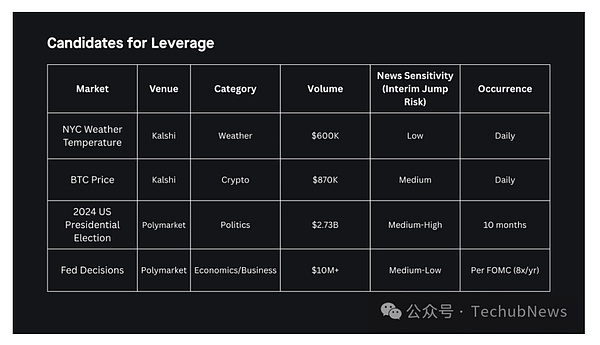
Take the weather market as an example. These markets have decent trading volume on Kalshi, occur daily, and the underlying variable, "temperature," is continuously and progressively updated, unlike some markets that depend on a single match result or ruling. However, in practice, Kalshi has made these markets binary range structures (e.g., "Will the high temperature fall between 84–85 degrees Fahrenheit?"), which reintroduces the risk of jumps in each contract upon expiration. A better design might be continuous settlement, where the payout changes proportionally to the actual temperature reading, but that's another topic altogether.
Leverage Supply Model
Currently, prediction markets are launching new features through internal development or ecosystem team building, and leverage is currently the most attention-grabbing core feature.
Lending Pool Model
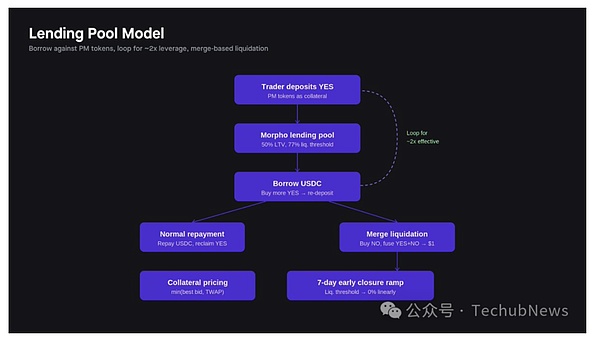
The lending pool model provides leverage in a way similar to on-chain lending markets. Just as Aave users deposit collateral and leverage through revolving lending, tokenized prediction market positions can, in principle, also be used as collateral in lending vaults. Polymarket positions are tokenized as ERC-1155 standard NFTs, thus easily integrating into lending vault systems like Morpho. Considering Kalshi's tokenization capabilities implemented through DFlow, a similar framework may eventually emerge in its ecosystem.
In this model, tokenized shares are considered collateral.
Traders deposit existing positions, borrow stablecoins, and then increase their exposure through a cyclical process. The lending pool itself acts as a financing party, while the risk of loss is shared among users. This structure enables scalable leverage, but also means that any mismanagement of risk is borne by everyone. Existing protocols (such as Gondor) manage jump risk (i.e., the risk of sudden changes in asset prices) by linearly reducing the liquidation threshold to zero over a fixed period before market expiration. This forces positions to be gradually closed as the market nears expiration. Several potential problems exist here: First, linearly reducing the threshold may not solve the risk of mid-term jumps; second, if a participant knows that the leverage of a series of markets will be artificially reduced over a fixed period, this could create a toxic order flow, thus creating arbitrage opportunities. The risk control engine in this model is essentially based on the loan-to-value ratio (LTV) and incorporates specific protection mechanisms for prediction markets. Its core consists of common lending parameters: borrowing cap and liquidation threshold. Building upon this, three additional control dimensions are needed: Gondor, the collateral oracle for the share, uses the lowest-optimal bid price and the time-weighted average price (TWAP); an exposure cap set by the market to limit concentration and cascading risk; and a mechanism that gradually tightens before maturity, pushing the liquidation threshold to zero as the outcome approaches; simultaneously, interest rates follow a standard DeFi utilization curve and are capped according to risk level.
Bulk Broker Model
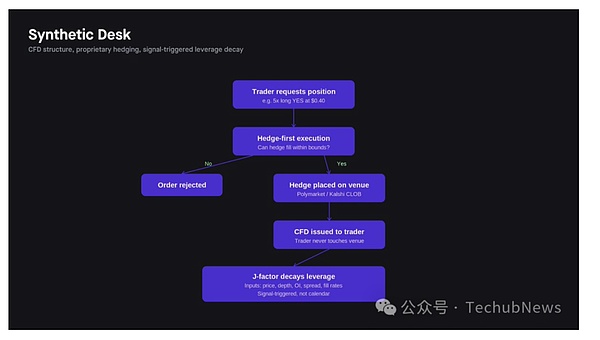
A key difference between the bulk broker model and the lending pool model is that leverage is natively managed by the trading venue, rather than being funded through a centralized credit pool. The platform does not treat the share of the prediction market as collateral in a socialized lending pool, but directly monitors the health of accounts, sets risk limits at the venue level, and proactively manages liquidation when positions encounter problems. Therefore, this should be understood as a venue-native margin model rather than a pure lending agreement. Ultramarkets is a good example of this design: positions are monitored using a health metric, and liquidation is triggered when the health falls below a fixed threshold. It differs from lending pools in three main ways: Leverage caps are set individually for each market based on liquidity depth, volatility, and time to maturity; position limits are divided into three tiers: single position, single user, and total open interest (OI) for a single market; and market selection criteria prioritize markets with predetermined outcome schedules. The biggest difference lies in the liquidation mechanism. Ultramarkets employs a two-stage system: small positions are sold directly on the market, while large positions use a Dutch auction. These two approaches, architecturally, address the same problem (minimizing risk during liquidation and avoiding cascading events) with drastically different strategies. Each method has its own slippage characteristics. Lending pooling has no market impact on sellers, but introduces slippage for buyers. Large brokerage Dutch auctions have the least impact on the order book, but rely on the participation of clearinghouses—and since prediction markets are still a relatively new tool, the clearinghouse ecosystem may not yet be fully developed. The Synthetic Desk model takes a different approach: traders do not directly interact with the prediction market. Conversely, the trading desk acts as the counterparty, bridging the trader and the underlying trading venue. The trader chooses the direction, leverage level, and collateral amount; the trading desk records a synthetic position and hedges it in the underlying market using its own funds. The trader's profit or loss becomes a leveraged function of probability changes, while the hedging operation offsets this risk exposure. Structurally, this is equivalent to a Contract for Difference (CFD): the trader holds a synthetic interest in price movements, not the underlying market position itself. Because the trading desk holds the hedging position, while the trader only holds the synthetic interest, the trading desk has complete control over the entire lifecycle of the position. It can reduce leverage, accelerate liquidation, net out risk exposure across users, and separate user liquidation operations from hedging execution on the underlying trading venue. This is the key difference between the synthetic trading desk model and other models: risk management is internalized within the trading desk, rather than embedded in the trader's on-chain position. Under this structure, the specific implementation can range from "indecisive" to "fully indecisive." A "indecisive" trading desk is essentially a matching layer: it provides the infrastructure for CFDs, but independent capital providers decide which markets to support, how much leverage to offer, and at what price. Risk assessment is in the hands of the providers, who compete with each other on underwriting and pricing. A "fully indecisive" trading desk, on the other hand, raises committed capital itself, runs its own risk control engine, decides which markets to support, and centrally sets all terms, thus providing traders with a single, unified counterparty. In a more "indecisive" version, the trading desk can combine the shell of CFDs with a more sophisticated risk control engine. First, it selectively underwrites markets based on their volatility characteristics, outcome reveal mechanisms, and microstructure, refusing to provide leverage in markets where binary settlement would make volatility losses uncontrollable. Second, it employs a dynamic leverage decay mechanism: as the time until outcome reveal decreases or liquidity deteriorates, the allowed leverage level decreases, and the trading platform automatically reduces synthetic positions and their hedging positions. Third, this decay can be asymmetrical: more leverage is retained on positions with a higher probability of winning, while risk is more aggressively reduced on positions with a higher probability of losing. Fourth, although the decay parameters may be set at the time of opening a position, the execution process can still react to real-time market conditions, not just a fixed calendar date, making closing actions more unpredictable and less prone to preemptive strikes. This trade-off lies in the choice between readability and sophisticated complexity. "Indecisive" trading desks are more transparent: pricing is observable, capital providers compete openly, and no single entity controls the risk model. However, their ability to manage complex portfolio-level risk is weaker. "Determined" trading desks, on the other hand, have a holistic view, enabling them to net risk exposure, adjust deleveraging in real time, and comprehensively manage their books. The cost is trust: traders rely on a "black box" counterparty, whose risk control engine is itself a product.
Perpetual Contract Exchange Model
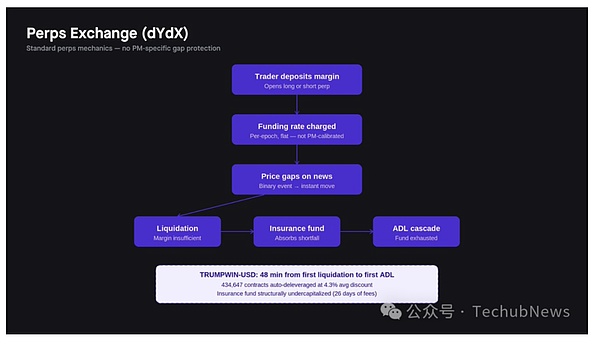
Perpetual contracts remove the expiration date from standard futures contracts and replace the calendar convergence mechanism with a funding rate—a periodic transfer of funds between long and short positions used to keep the contract price linked to the spot price. Since some traders simply cannot consistently pay these funds, this mechanism naturally self-corrects.
Leveraged Market Size Calculation: Taking the 2024 US Election as an Example
We can use the 2024 US election to calculate the potential size of leverage. The 2024 election market on Polymarket is a good example of what a leveraged prediction market would look like: the market is highly liquid, long-lasting, and only experiences heightened news sensitivity risk at two points in time—when Joe Biden withdraws from the race, and on the most important day, Election Day.
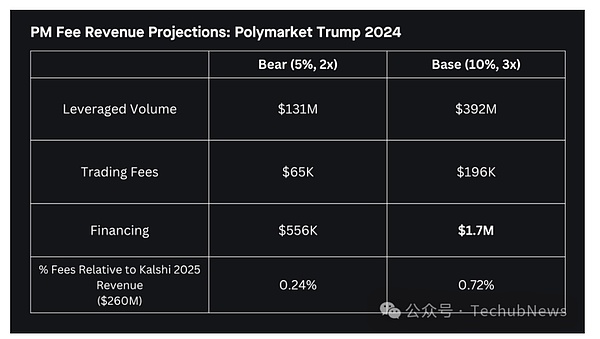
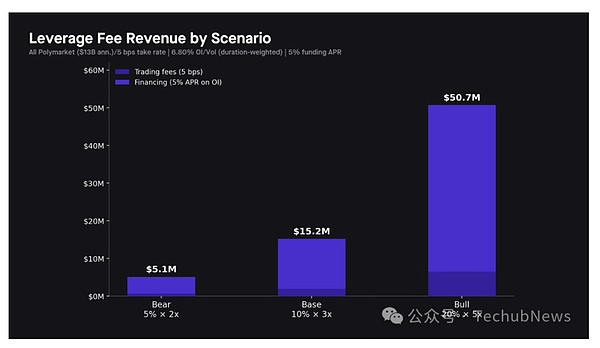
Under the baseline scenario, from the perspective of the platform as a whole, the annual transaction fee income is approximately $15 million. In a bull market scenario, this reaches $50.7 million. In both scenarios, financing income accounts for over 87% of total income. In other words, the economic benefit of leverage depends almost entirely on how much open interest it can maintain, rather than the trading volume itself. This has important implications for which model will outperform in the long run: the answer is the model that allows positions to be held the longest. In the baseline scenario, leverage fee revenue is equivalent to an additional 6 cents for every $1 Kalshi earns in 2025 (out of a total of $260 million in revenue that year), an increment on top of spot revenue. Polymarket's recent introduction of taker fees this month, projected to generate $290 million to $365 million in revenue annually based on current trading volume, further supports this assessment. However, the model remains very conservative, especially with its 5% annualized funding rate assumption, and other assumptions, such as the use of a uniform fixed funding rate across all markets. The model also doesn't attempt to construct mixed combinations of different leverage positions (e.g., 2x, 3x, etc.) and demonstrate their synergistic effects. Ultimately, prediction markets will always involve leverage in some form. The question is how scalable it can be, and to answer this, we need to confront the obvious yet often overlooked core issue: the architecture of the trading venue. Centralized Limit Order Books (CLOBs) are not the perfect structure for prediction market contracts. Currently, Kalshi and Polymarket largely treat all events the same, and the CLOB architecture used in different markets leaves loopholes for market makers. These loopholes propagate downstream, affecting every leverage protocol built upon them. Gondor clearly illustrates this point. Its collateral oracle uses the minimum of the optimal bid price and the time-weighted average price (TWAP) to price positions, a reasonable anti-manipulation choice, but its reliability depends entirely on the quality of the underlying order book. When a jump event occurs, market makers withdraw liquidity, and the optimal bid price either becomes outdated or disappears altogether, precisely when accurate collateral pricing is most needed, the oracle may fail. The seven-day early liquidation mechanism, which linearly reduces the liquidation threshold to zero before liquidation, is to some extent a calendar-based workaround designed to address microstructural problems that Gondor itself cannot solve. Each model in this paper incorporates this constraint in some form. Furthermore, outdated quotes are another problem arising from the trading venue structure. On November 22, 2025, there was a betting line on Kalshi for the Dallas Stars vs. Calgary Flames NHL game, with the live trading price around 60 cents, indicating some uncertainty. However, during the penalty shootout, some unsuspecting buyers pushed the price up to 99 cents. Within seconds, well-informed NO sellers spotted this price misalignment and quickly swept 37,239 contracts into the pending YES limit order. The largest single trade was 21,840 contracts executed at the 99-cent price. Twenty minutes later, the market closed with a NO result. This single trade resulted in an adverse selection loss of approximately $21,384. This is not a tail event. It is an inevitable consequence of operating a continuous limit order book in a market where information arrives discretely and not all participants see the information simultaneously. The four models examined in this paper—lending pools, block brokers, synthetic trading desks, and perpetual contract exchanges—are all serious attempts to address the leverage problem. They differ in how they price jump risks, manage liquidation, and access capital. None of them are entirely ineffective, but each circumvents a structural problem in its own way that it cannot fix on its own. The future opportunities are enormous. The 2024 US presidential election alone generated $2.73 billion in trading volume on Polymarket, with a leveraged tier operating in real-time on top of it. Gondor specifically raised $2.5 million in December 2025 to build lending and leverage infrastructure on Polymarket. As recurring high-volume markets in the political, economic, and sports spheres mature, the overall potential for leverage supply will also grow. In the baseline scenario, a well-functioning leveraged tier on Polymarket could generate approximately $15 million in fee revenue annually, and up to $50.7 million in a bull market scenario. Over 87% of this comes from financing revenue rather than transaction fees, meaning it is entirely driven by how much open interest the feature can sustain. However, to capture this opportunity on a large scale, a fundamental overhaul of the trading venue's architecture is necessary, rather than focusing on pricing strategies. What different designs are possible for a trading venue specifically tailored for prediction markets, and how the design of bulk auction mechanisms will change the break-even economics for financiers and market makers, will be the topics of our next report.


 Weatherly