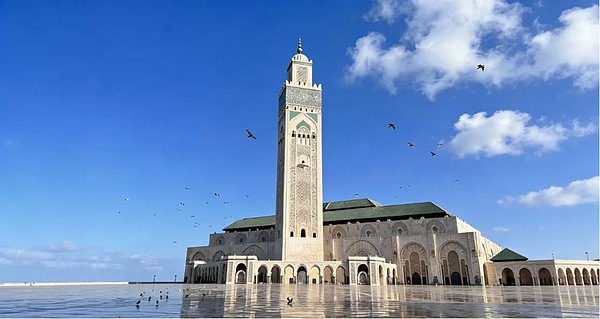
On the Atlantic coast of North Africa, Morocco is undergoing a unique financial experiment. It once had one of the world's strictest cryptocurrency bans, yet simultaneously boasts the highest cryptocurrency adoption rate in North Africa.
While official gates are closed, the doors of the people are wide open. From Casablanca's office buildings to Marrakech's markets, digital assets are becoming an invisible weapon for millions of Moroccans to combat inflation and circumvent foreign exchange controls. In 2025, with the easing of regulatory laws, it is necessary to re-examine this blue ocean with its enormous potential.
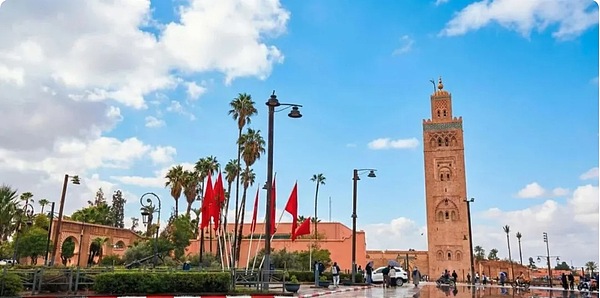
... (The author personally traveled to Morocco this month and obtained firsthand information through casual conversations with passersby and shopkeepers on the streets of Casablanca, Marrakech, Fez, Chefchaouen, and other cities.) The Paradox Behind the Data If you only look at the legal provisions, Morocco seems to be a cryptocurrency wasteland. As early as 2017, the Moroccan Foreign Exchange Authority (Office des Changes) and the Central Bank jointly issued a notice explicitly prohibiting the use of cryptocurrencies for transactions, with violators facing penalties for violating foreign exchange control regulations. However, the data tells a completely different story. According to the "Global Cryptocurrency Adoption Index" report released by blockchain data analytics company Chainalysis, Morocco has consistently ranked first in North Africa and among the top globally in recent years. Especially during the bear market period from 2022 to 2024, Morocco's ranking remained strong. Even more astonishing data comes from its holdings. According to estimates by TripleA and several local fintech institutions, the proportion of cryptocurrency holders in Morocco is approaching 10%-15% of the total population. This means that in this country of approximately 37 million people, millions have already or are in the process of accessing crypto assets in some form. This is not just a game for the wealthy. In Morocco, the popularity of cryptocurrency exhibits strong grassroots and youthful characteristics. This massive user base has grown naturally against the backdrop of the lack of formal exchanges, bank deposit and withdrawal channels, and even legal risks. What market logic lies behind this phenomenon of "the more it's banned, the more popular it becomes"? To understand the fervor of the Moroccan market, one must first understand Morocco's financial pain points. Morocco maintains strict foreign exchange controls. The Moroccan Dirham (MAD) is not a fully freely convertible currency. For ordinary citizens, transferring large sums of money overseas or receiving small business payments from abroad is not only cumbersome but also subject to strict limits. This creates a real demand scenario for cryptocurrencies, especially stablecoins (such as USDT). Morocco has a large pool of young talent fluent in French and English, who are active on global freelance platforms such as Upwork and Fiverr, working in programming, design, and translation. For these young people, receiving overseas remittances through traditional banks (SWIFT) is not only time-consuming (usually taking 3-5 business days) but also expensive, and may even result in funds being frozen by banks due to issues with the source of funds. Therefore, USDT has become the best alternative. In Moroccan tech communities and social media groups, "P2P trading" (peer-to-peer transactions) is extremely active. Freelancers receive USDT and then convert it into dirhams within minutes through platforms like Binance P2P, transferring it to local bank accounts, or directly exchanging it offline for cash. This process completely bypasses the various restrictions of the SWIFT system, becoming a crucial infrastructure for Morocco's gig economy. Besides receiving payments, making payments is also a major challenge. Many Moroccan merchants engaged in cross-border e-commerce (such as importing small commodities from China) find that applying for foreign exchange quotas through banks to pay suppliers is so slow that it can delay business opportunities. Cryptocurrency offers the possibility of "instant settlement." Although this practice exists in a gray area, in Casablanca's business district, using cryptocurrency to settle some payments has become an open secret. Real-world case: "Airdrop Aid" during an earthquake. If foreign exchange controls are a long-term driving force, then the devastating earthquake of 2023 served as a "stress test" for the entire society, showcasing the practicality of cryptocurrencies. In September 2023, a powerful earthquake struck the Al Haouz region of Morocco, causing severe casualties and property damage. During the critical relief period after the disaster, traditional bank branches were closed, ATMs lost power or were emptied of cash, and disaster victims urgently needed funds to purchase supplies. At this critical moment, Binance, the world's largest cryptocurrency exchange, announced an airdrop to its Moroccan users. This is not a fabricated marketing gimmick, but a real case: Binance identified users in the Marrakech-Safi region, the hardest-hit area, through Know Your Customer (KYC) addresses. $100 worth of BNB (Binance Coin) was directly airdropped to these users' accounts. Smaller amounts of tokens were also airdropped to active Moroccan users outside the epicenter. The total donation reached $3 million. While this money couldn't rebuild homes, at the time it demonstrated a core advantage of cryptocurrency: borderless, intermediary-free, and instant. Many users quickly cashed out these tokens through P2P channels and purchased much-needed tents and food. This event had a profound impact on the Moroccan public. It made many ordinary people who were previously skeptical of "cryptocurrencies" realize that it is not just a speculative tool, but a value transfer network that can operate in extreme environments.

Looking at 2025, the Moroccan market is undergoing a qualitative change
With the Central Bank of Morocco (Bank Al-Maghrib) formally drafting and submitting a bill to regulate crypto assets, this North African country is shifting from a "complete ban" to "embracing regulation."
What does this mean for companies and investors going global?
**The Opening of the Compliance Track:** As legislation progresses, exchange licenses and custody service licenses will become scarce resources. Whoever can establish a presence in the Casablanca Financial City (CFC) first will reap the rewards from millions of already market-educated users. **The Explosion of Payment Scenarios:** Morocco boasts an extremely high mobile phone penetration rate. Once compliance thresholds are lowered, stablecoin-based mobile payment and remittance applications will experience explosive growth, directly challenging traditional remittance companies (such as Western Union). **Talent Dividend:** Morocco possesses one of the best engineering reserves in North Africa. Web3 developer costs here are far lower than in Europe and America, but their technical capabilities are not inferior. **Morocco is not the next Dubai, nor is it the next Singapore. It bears the unique imprint of North Africa: a young population, a strong demand for cross-border payments, and an awakening regulatory awareness. The 6 million cryptocurrency users here weren't driven by advertising, but by the demands of daily life. This kind of market, based on real pain points, is often more vibrant than a purely speculative market. For Web3 practitioners, don't just focus on Silicon Valley and Hong Kong. Between the deserts and the sea in North Africa, Morocco, this undervalued piece of the puzzle, may be the missing piece on the global map. (Note: Data mentioned in this article is referenced from Chainalysis's 2022–2024 annual report, TripleA global adoption data, and public reports from Moroccan media outlet Hespress regarding earthquake relief efforts in 2023.)