Golden Web3.0 Daily | Open AI's GPT5 Trademark Application Rejected in China
Golden Finance has launched the "Golden Web3.0 Daily" to provide you with the latest and fastest MEME, DeFi, DAO, NFT and metaverse industry news.
 JinseFinance

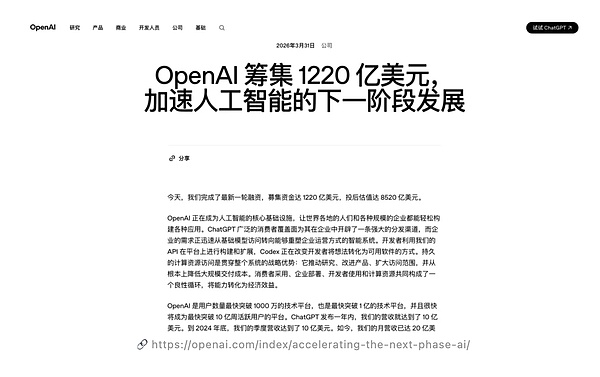
https://openai.com/index/accelerating-the-next-phase-ai/
The main investors in this round of financing are Amazon ($50 billion), Nvidia ($30 billion), and SoftBank ($30 billion). SoftBank also partnered with a16z and D.E. Shaw. The investment was co-led by several institutions. Microsoft, a long-time partner, continued to invest, but this time the specific amount was not disclosed; it is only known that as of the end of last year, Microsoft's cumulative investment in OpenAI had exceeded $13 billion. In addition, OpenAI also opened its doors to wealthy individual investors through banking channels for the first time, raising approximately $3 billion. ARK Invest's flagship innovation ETF, with a size of $6 billion, also announced the inclusion of OpenAI, holding approximately 3% of its portfolio; this is the fund's first investment in a non-public company. In fact, some funds managed by T. Rowe Price and Fidelity already held small amounts of OpenAI shares; ARK's involvement further opens up channels for ordinary people to participate. In short, almost the entire tech industry is supporting OpenAI. But upon closer examination, the logic is actually quite simple: OpenAI will use this money to buy Nvidia chips and rent servers from Amazon and Microsoft. By investing, these giants are essentially securing the world's largest computing power customers in advance. This round of financing is less about confidence in OpenAI and more about a sure-fire way to make money. For OpenAI, this money is more like a final major investment before its IPO. The financial figures are indeed impressive: nearly 900 million weekly active users, over 50 million paying users, $13.1 billion in revenue last year, and a peak monthly income of $2 billion, with a growth rate four times that of internet giants like Google and Meta at the same stage. However, OpenAI is not yet profitable, and its cash burn rate shows no signs of slowing down. Why shut down Sora? Before and after this round of financing, OpenAI's product development pace did not stagnate. They released GPT-5.4, the most powerful version to date, with significant improvements in multitasking and workflow performance. The code generation tool Codex has also been upgraded from a feature to an independent programming agent, currently boasting over 2 million weekly active users, a fivefold increase in the past three months, with a monthly growth rate maintained at around 70%. The performance on the enterprise side is also noteworthy. Currently, enterprise services account for over 40% of OpenAI's total revenue, and it is expected to reach parity with consumer services by the end of 2026. The API processes over 15 billion tokens per minute, search usage has nearly tripled in the past year, and the advertising pilot project achieved annualized revenue exceeding $100 million within six weeks of its launch. This is also the signal OpenAI hopes to send to the outside world: Revenue streams are becoming increasingly diversified, with ChatGPT subscription fees being just one part of it. However, right next to this sea of positive data, Sora quietly went offline. When Sora was first released, it certainly caused quite a stir in the film and creative industries. Generating videos with just one sentence, and the image quality was quite realistic, many people felt this was the most exciting aspect of AI technology. However, the computational cost of video generation is far higher than that of text generation. Every AI inference, every piece of text generation, and every frame of video rendering consumes expensive GPU computing cycles and electricity. There is no free intelligence; every use is a real drain on resources. While users may find it fun, few are willing to pay a high price for it. According to the Wall Street Journal, one of the reasons OpenAI chose to shut down Sora was that it was burning through approximately $1 million per day, while its user base plummeted from 1 million at launch to less than 500,000. When retention data is poor and the commercialization path is unclear, there's naturally no reason to continue this money-burning venture. Thus, before reality was even disrupted, Sora was already gone. Shutting down Sora was just the beginning. OpenAI is also examining other expensive, slow-return areas, preparing for further contraction; concentrating computing power on text models, code generation, and enterprise services—areas with stable cash flow—is also OpenAI's way of telling Wall Street: we know, and need to know, how to make money. From "Changing the World" to "Utilities" OpenAI was founded in 2015 with the initial vision of ensuring that general artificial intelligence benefits all of humanity. In 2019, to raise sufficient R&D funds, the company transitioned to a "limited-profit" model, establishing a for-profit subsidiary and accepting a $1 billion investment from Microsoft. While the operating entity became commercialized, the non-profit OpenAI Foundation still holds approximately 26% of the equity, nominally continuing its original philanthropic mission. One sentence in OpenAI's official fundraising statement is noteworthy: "Building the infrastructure layer of intelligence itself." These few words reveal OpenAI's shift in self-positioning. Previously, they focused on refreshing the outside world's understanding of AI with stunning demos; now, they aim to step back and become an indispensable underlying tool for businesses and individuals. They call this direction "super app," planning to integrate ChatGPT, Codex, search, browser capabilities, and more into a unified entry point, primarily targeting developers and enterprise users, eliminating the need to switch between multiple tools. The underlying logic is to let consumer habits naturally drive enterprise purchasing, with the two businesses mutually reinforcing each other. An average user might find it novel today and unsubscribe tomorrow, but a company whose core business runs on OpenAI models is unlikely to cut ties so easily; the latter is the kind of customer loyalty Wall Street truly wants to see. Over the past few years, OpenAI has consistently delivered groundbreaking innovations—new models, new products, new possibilities—one after another. But judging from this round of financing and the shutdown of Sora, that exciting phase may truly be coming to an end. What follows is likely to be more like a mature business: some manage computing power, some manage data, and some manage sales; everyone focuses on their own area, emphasizing cost control and commercialization. OpenAI can never go back to what it was before, but perhaps it never intended to.
Golden Finance has launched the "Golden Web3.0 Daily" to provide you with the latest and fastest MEME, DeFi, DAO, NFT and metaverse industry news.
JinseFinanceNEAR’s continued expansion in the AI space has the potential to become the go-to platform for decentralized AI development, paving the way for the next generation of AI-based DApps.
JinseFinanceElon Musk has sued OpenAI's co-founders, Sam Altman and Greg Brockman, for prioritising commercial interests over their mission of public good. Ironically, this comes as Musk expands his own for-profit AI startup, xAI. Is this a case of the pot calling the kettle black?
 Kikyo
KikyoSentient raises $85M seed funding to revolutionize open AI, aiming to empower developers monetize their models and data, enhancing AI innovation.
 ZeZheng
I spend a lot of time researching the intersection of AI and cryptocurrency. I believe that the combination of the two is critical to making AI more fair and user-owned.
JinseFinanceOpenAI won a legal battle against Open Artificial Intelligence over the "Open AI" trademark, with a court injunction prohibiting the latter's use of the term. The ruling highlights the importance of protecting intellectual property in the AI industry and raises questions about branding strategies for both companies.
 Joy
JoyDive into the world of Gitcoin Grants, a decentralized platform revolutionizing the funding landscape for open-source software and public goods projects. Learn about the innovative quadratic funding mechanism employed by Gitcoin Grants, where community engagement plays a pivotal role in determining funding allocations. Explore the benefits of this decentralized platform, including transparency, accountability, and resistance to censorship. Delve into the investment potential of Gitcoin Grants, highlighted by a significant $70 million funding round in 2022 led by Andreessen Horowitz. Assess the platform's role in accelerating technological development and its standing in the larger cryptocurrency ecosystem. This article provides insights into whether Gitcoin Grants is poised to become a game-changer in public goods funding or if it's merely a product of hype.
 Sanya
SanyaWhile the publication of technical papers will help, OMA3 leaders say consumer adoption will be key.
 Others
Bitcoin funding rates have been on a bearish trend in recent months. It has now spent one of its longest ...
 Bitcoinist
OMA3 will focus on proposing standards and facilitating collaboration between various stakeholders of Web3 and other industries.
 Cointelegraph