Circle and Coinbase: Compasses
Circle and Coinbase have formed a symbiosis around USDC.
 JinseFinance

Source: Artemis & Fintech Architects; Compiled by: BitpushNews
Foreword:
Fintech Architects, in collaboration with the digital finance think tank Artemis, has released its first comparative analysis report on Key Performance Indicators (KPIs) of Fintech and Decentralized Finance (DeFi). If you've ever struggled with whether Robinhood or Uniswap is a more worthwhile investment, then you've come to the right place.
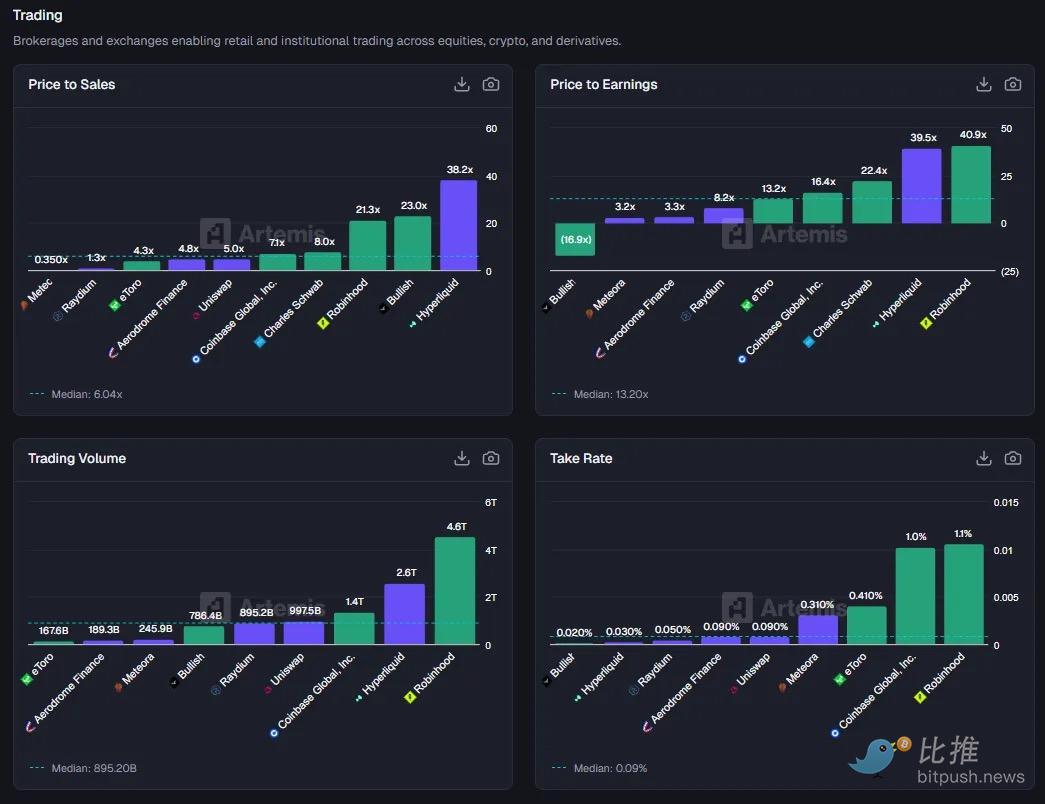
Comparison Chart Explanation: In our chart, purple represents cryptocurrencies, and green represents equity companies.
We decided to conduct this experiment: selecting well-known fintech companies in areas such as payments, digital banking, Buy Now Pay Later (BNPL), and retail brokerage, and stacking them against crypto-native counterparts for comparison. We used the same metrics (P/S ratio, ARPU, TPV, number of users, etc.), with green bars representing US stocks and purple bars representing token protocols.
A panoramic view of these two financial systems emerges: on-chain financial protocols often match or even surpass their fintech counterparts in transaction volume and asset size, but they capture only a fraction of the economic benefits. In contrast, crypto asset valuations are either extremely high or extremely low, with very little middle ground. Moreover, their growth rates are completely different.
Payments: The Pipeline for Funds Flows Starting with the largest category in fintech—money transfers. The Green Camp (Giants Abound): PayPal handles $1.76 trillion in transactions annually. Adyen processes $1.5 trillion. Fiserv (the almost forgotten infrastructure layer) processes $320 billion. Block (formerly Square) drives $255 billion through its Cash App and merchant network.
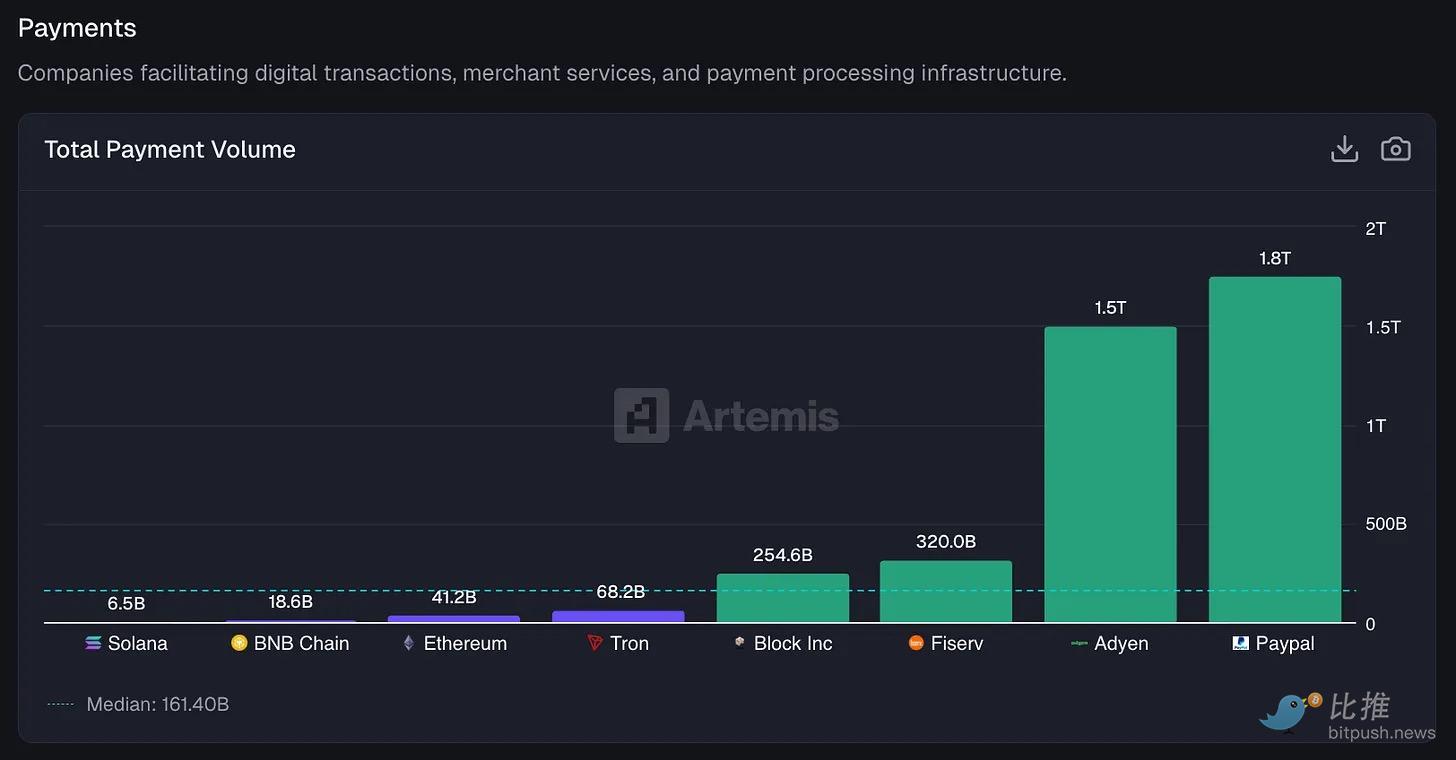
Purple Camp (Artemis' estimated annualized B2B payment volume):
Tron moved $68 billion in stablecoins.
Ethereum reached $41.2 billion.
BNB was $18.6 billion.
Solana is valued at approximately $6.5 billion. In absolute terms, the two are not even in the same league. The total stablecoin transaction volume of all major public blockchains is only about 2% of that of traditional fintech payment processors. On the market share chart, the purple bars are almost negligible. But what's interesting is the growth rate: Last year, PayPal's total payment volume grew by only 6%, Block grew by 8%, and European darling Adyen achieved 43% growth (which is very strong by fintech standards). Looking at the blockchains themselves: Tron grew by 493%, Ethereum by 652%, BNB by 648%, while Solana was the fastest, reaching a year-on-year growth rate of 755%. It's important to emphasize that this is an estimate of B2B payment volume based on McKinsey research by the Artemis data team. Conclusion: The growth rate of stablecoins far exceeds that of traditional payment methods, despite their much smaller starting point. Next, let's see who profits the most. Fiserv takes 3.16% of each transaction, Block takes 2.62%, and PayPal takes 1.68%. Even Adyen, which operates on a low-margin business model, takes a 15 basis point cut. As for blockchains, their take rate for stablecoins and asset transfers is extremely low, ranging from approximately 1 to 9 basis points. Blockchains operate by charging gas fees, achieving a significant efficiency advantage over traditional channels by avoiding interchange fees and merchant fees. While this limits the revenue of the underlying protocol, it creates profit margins for payment orchestrators at the upper layers by adding fees. Digital Banks: Wallets Become the New Type of Bank Accounts On the fintech side, we have real licensed banks: Revolut, Nubank, SoFi, Chime, Wise. On the crypto side, we see wallets and yield protocols: MetaMask, Phantom, Ethena, EtherFi. Although they don't have the name "bank," tens of millions of people deposit their assets there and earn interest. User Comparison: Nubank has 93.5 million monthly active users (MAU), making it the world's largest digital bank. Revolut has 70 million users. MetaMask follows closely with 30 million monthly active users, surpassing Wise, SoFi, and Chime in scale. Phantom boasts 16 million monthly active users and has expanded to multiple chains, even launching its own debit card and tokenized shares.
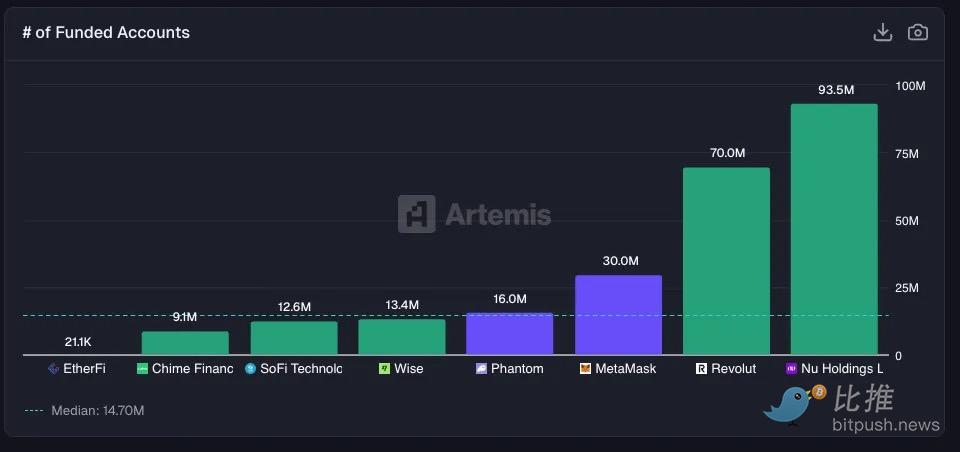
Deposit Scale (Funds Held):
Revolut holds $40.8 billion in customer balances.
Nubank holds $38.8 billion.
SoFi holds $32.9 billion.
SoFi holds $32.9 billion.
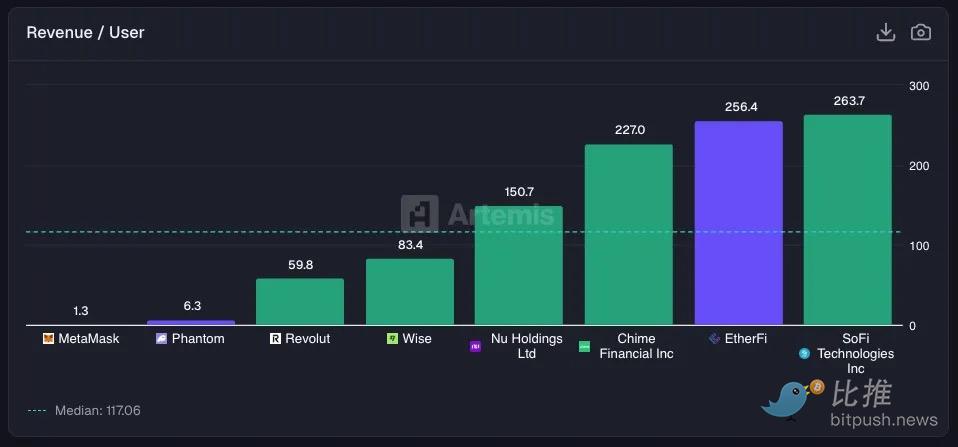
Valuation Logic:
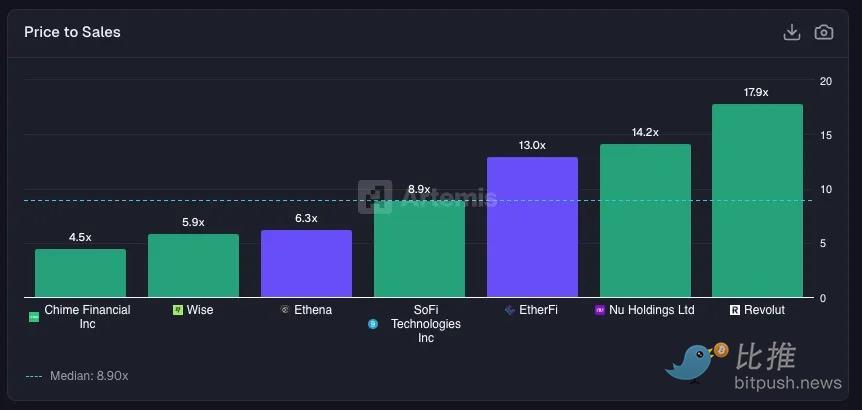
The market's valuation of the two is surprisingly consistent. Revolut's price-to-sales ratio is 18x, while EtherFi's is 13x and Ethena's is 6.3x. The current trend of convergence is "wallet banking": MetaMask adds debit cards, and Phantom integrates fiat currency channels.
In the capital markets, the scale of on-chain exchanges is astonishing.
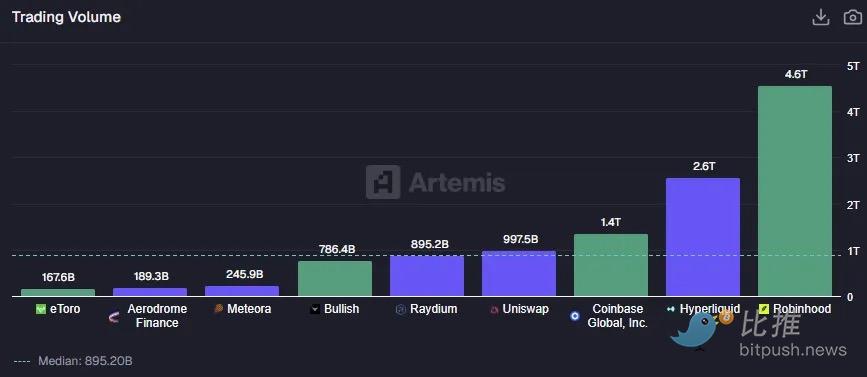
Robinhood processed $4.6 trillion in trading volume over the past 12 months.
Hyperliquid (decentralized perpetual contracts) processed approximately $2.6 trillion.
Coinbase has processed $1.4 trillion. The aggregated trading volume of major DEXs like Uniswap and Raydium is now on par with Coinbase. This was unimaginable three years ago.
However, the "DEX paradox" lies in the commission rates:
Robinhood's overall commission rate is 1.06%, and Coinbase's is 1.03%.
The commission rates of the DEX camp are between 3 and 9 basis points.
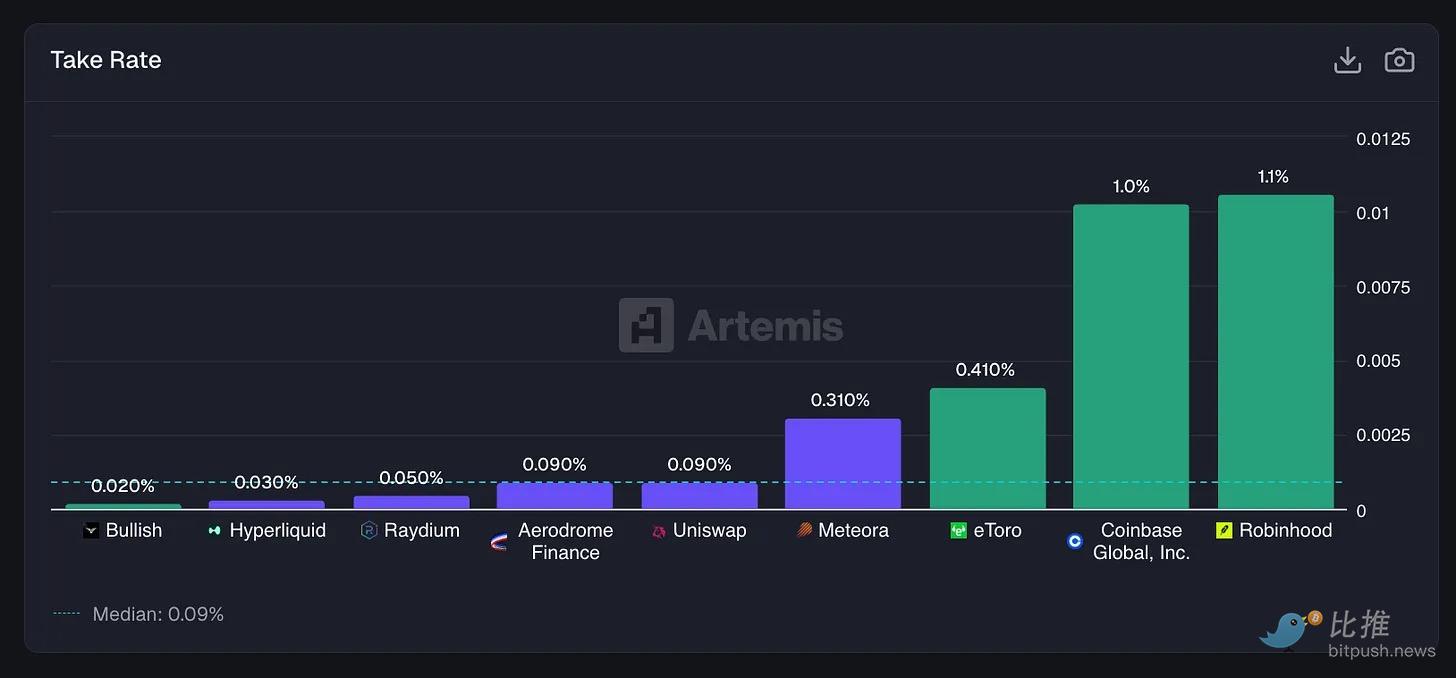
Rate of commission = LTM revenue / trading volume. eToro, Coinbase, Robinhood, and Bullish's revenue comes from financial statements. Raydium, Aerodrome, Uniswap, and Meteora's revenue comes from Artemis.
This means that Uniswap generates only about $29 million in protocol revenue with $1 trillion in trading volume; while Coinbase generates $14 billion in revenue with $1.4 trillion in trading volume.
This means that Uniswap generates only about $29 million in protocol revenue with $1 trillion in trading volume; while Coinbase generates $14 billion in revenue with $1.4 trillion in trading volume.
Regarding market valuation, the results are consistent with these issues. Coinbase trades at 7.1x sales. Robinhood trades at 21.3x, high for a broker, but supported by growth. Schwab trades at 8.0x, a mature multiple for mature businesses. Uniswap trades at 5.0x fees. Aerodrome trades at 4.8x fees. Raydium trades at 1.3x fees. The market hasn't valued these protocols like it would high-growth tech companies, partly because they generate lower commission rates compared to traditional brokerages. Market capitalization / LTM revenue. Publicly reported market capitalization for the stock is from Yahoo Finance, and the token is from Artemis. The stock price chart shows the direction of sentiment. Since the end of 2024, Robinhood has risen approximately 5.7 times, riding the wave of the retail investment and cryptocurrency recovery. Coinbase has risen 20% over the same period. Uniswap has fallen 40%. Despite a large influx of trading volume into their DEX, the tokens haven't captured much value, partly due to their unclear use as investment vehicles. The only exception is Hyperliquid, which, due to its massive rise, saw gains almost identical to Robinhood's during the same period. While historically DEXs have failed to capture value and be considered public goods, projects like Uniswap are turning on their "fee switch," using fees to burn UNI tokens, now generating $32 million in annualized revenue. We hope that as more trading volume moves on-chain, value will flow back to DEX tokens, with Hyperliquid being a prime example of success. However, until a token holder value capture mechanism like Hyperliquid emerges, DEX tokens will underperform their CEX stock counterparts. Lending: Underwriting the Next Generation Lending is where the contrast becomes more interesting. On one side, you have the core lending product of fintech: unsecured consumer credit. Affirm lets you pay for a Peloton bike in four installments. Klarna does the same for fast fashion. Lending Club pioneered peer-to-peer (P2P) lending before transforming into a true bank. Funding Circle underwrites loans for small and micro businesses. These companies make money by charging borrowers higher fees than they pay depositors, hoping that defaults won't erode the spread. On the other hand, you have collateralized DeFi lending. Aave, Morpho, Euler. Borrowers deposit ETH, lend USDC, and pay an algorithmically determined interest rate. If the collateral drops too much, the protocol automatically sells it. No collection calls or write-offs.
These are businesses with the same name but completely different natures.
Start with the loan ledger. Aave has $22.6 billion in outstanding loans. That's more than Klarna ($10.1 billion), Affirm ($7.2 billion), Funding Circle ($2.8 billion), and Lending Club ($2.6 billion) combined. The largest DeFi lending protocol has a larger loan ledger than the largest BNPL player. Let this fact settle.
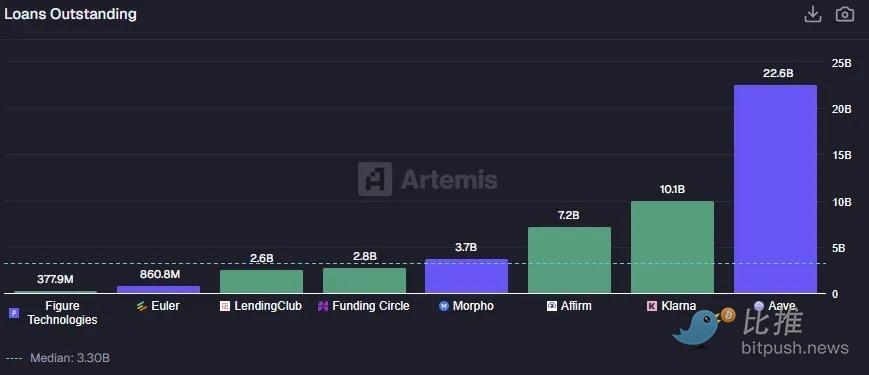
Total loan amounts for Lending Club, Funding Circle, Affirm, Klarna, and Figure come from financial reports. Loan deposits for Euler, Morpho, and Aave come from Artemis.
Morpho added another $3.7 billion. Euler, relaunched after its 2023 hack, has $861 million. The DeFi lending stack has grown in total size to rival the entire listed digital lending sector in about four years. But the economic model is inverted.
Funding Circle's Net Interest Margin (NIM) is 9.35% (due to its business model, which resembles private lending). Lending Club's is 6.18%. Affirm, despite being a BNPL company rather than a traditional lender, also achieves 5.25%. These are substantial spreads that compensate for the credit risk these companies absorb through actual execution of underwriting. On the cryptocurrency side, Aave's NIM is only 0.98%. Morpho's is 1.51%. Euler's is 1.30%. Despite having larger loan ledgers, DeFi protocols typically offer lower yields than fintech lenders.
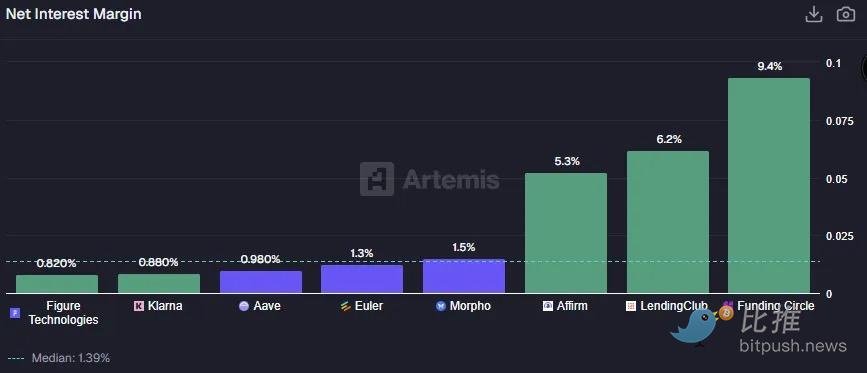
Aave, Euler, Morpho's net interest margin = revenue / loan deposits. Equity net interest margins are derived from financial statements.
DeFi lending is by design overcollateralized. To borrow $100 on Aave, you typically need to deposit $150 or more in collateral. The protocol does not assume credit risk. It assumes liquidation risk; borrowers are paying for leverage and liquidity, not for a privilege of credit access they wouldn't otherwise have access to.
Fintech lenders are doing the opposite. They offer unsecured credit to consumers who want to buy now and pay later. The interest rate spread compensates those who never repay. This is reflected in the actual loss figures from defaults, and managing these losses is a core part of underwriting. Credit loss ratios for stocks come from publicly available financial reports. So which model is better? It depends on what you're optimizing. Fintech lending serves borrowers who need money they don't currently have and assumes real underwriting risk. It's also brutal. Early digital lending institutions (OnDeck, Lending Club, Prosper) have all teetered on the brink of collapse multiple times. Despite its business actually performing well, Affirm's stock price is still down about 60% from its peak, often because underwriting revenue is priced at SaaS multiples without adequately accounting for inevitable later losses. DeFi lending is a leveraged business. It serves those who already own assets but want liquidity and don't want to sell, similar to a margin account. There are no credit decisions here except for the quality of the collateral. It's capital efficient, scalable, and earns a small profit on huge trading volumes. It's also only useful for those who already have a significant amount of assets on-chain and want to earn yield or additional leverage. Prediction Markets: Who Knows? Finally, let's look at prediction markets. These projects represent the latest and most peculiar battleground between Fintech and Decentralized Finance (DeFi). For decades, they were largely academic esoteric, favored by economists but disliked by regulators. The Iowa Electronic Markets once ran small-scale election predictions. Intrade experienced a brief boom before shutting down. Most of these projects were labeled “gambling” or “sports betting.” The idea that you could trade on real-world outcomes and that these markets could produce more accurate predictions than polls or authoritative experts was largely theoretical in the past. This changed in 2024 and accelerated further during the second Trump administration. Polymarket processed over $1 billion in election betting. Kalshi won its lawsuit against the U.S. Commodity Futures Trading Commission (CFTC) and launched political contracts to U.S. users. Robinhood, never missing a trend, also added event contracts. Meanwhile, DraftKings, the giant that already runs the de facto prediction market through Daily Fantasy Sports, quietly made a fortune with a market capitalization of $15.7 billion and revenue of $5.5 billion.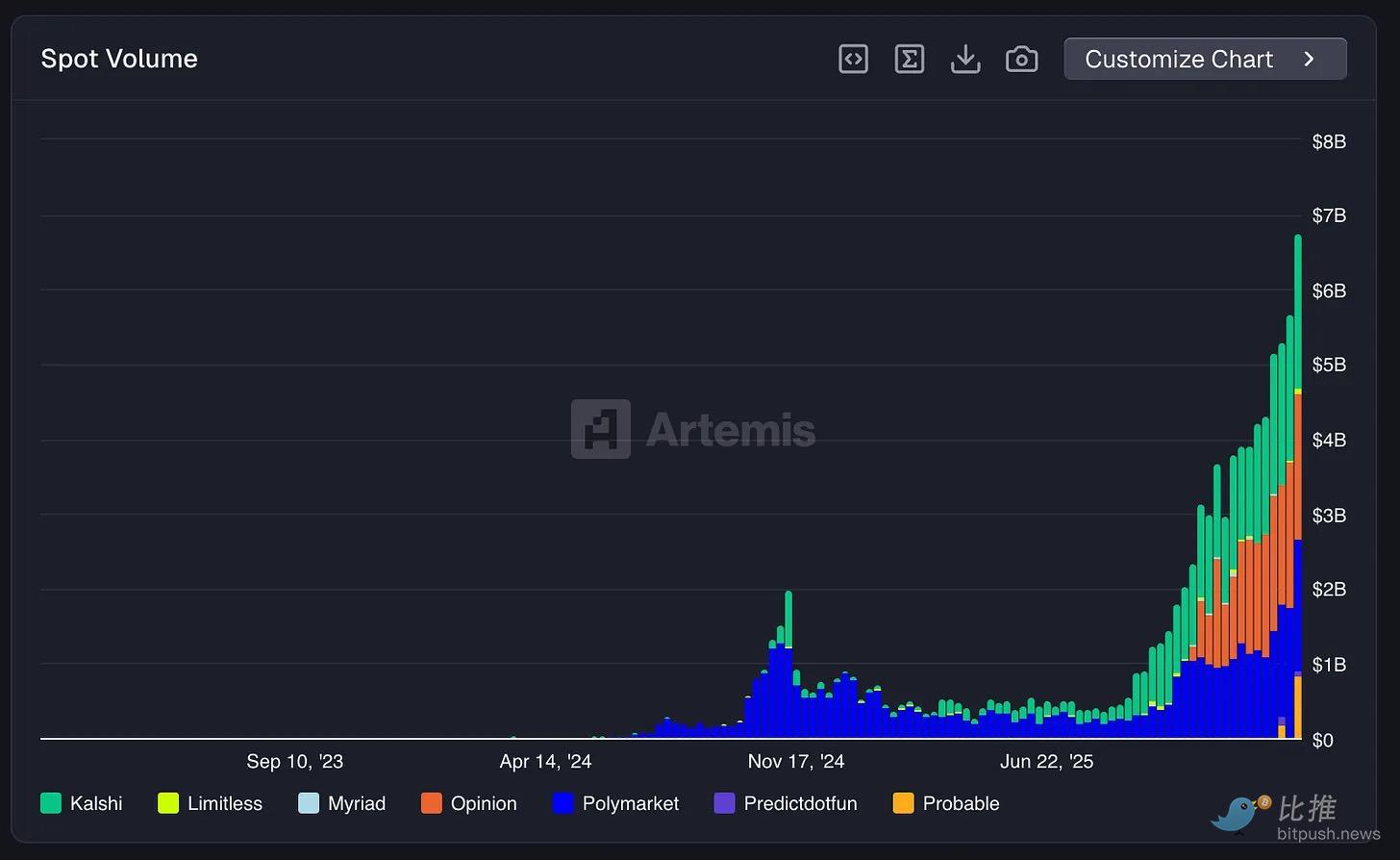
Artemis Forecasting Markets Dashboard
(Chart description: Spot trading volume data for Kalshi and Polymarket comes from Artemis. For DraftKings, trading volume uses "Sportsbook Handle," which is the total amount of settled customer bets in its sports betting products.)
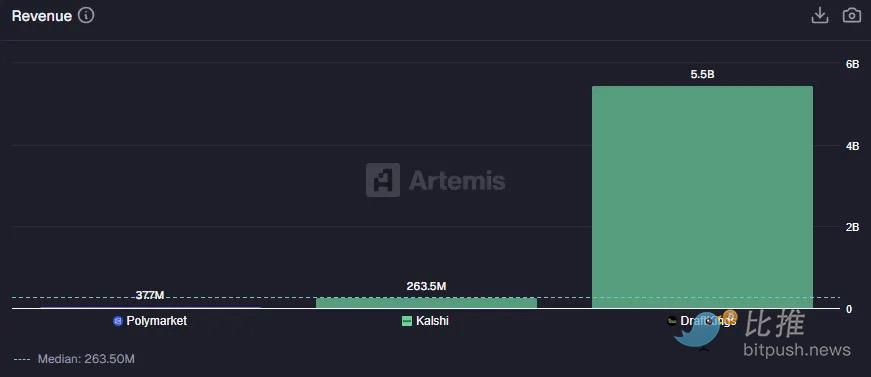
Comparison of revenue for prediction markets (Chart description: Polymarket revenue data comes from Artemis, Kalshi revenue data can be found at the cited link, DraftKings' past 12 months (LTM) revenue data comes from financial reports.)
The huge gap lies in take rates, or in sports betting jargon, "hold".
DraftKings retains 10.57% of every $1 wagered. This is typical of sports betting: the bookmaker takes a cut, provides odds, and manages the risk. Kalshi takes 2.91%, a thinner profit margin more suited to financial exchanges. Crypto-native Polymarket takes only 0.15%. Of its $24.6 billion trading volume, it currently captures a negligible amount of value. This is yet another replay of the dynamics of decentralized exchanges (DEXs). Polymarket's focus is not on value capture, but rather on providing the infrastructure for the existence of prediction markets, matching buyers and sellers, and settling contracts on-chain. It does not employ odds setters, manage balance sheets, or act as your counterparty. While its efficiency is astonishing, monetization is not its core focus. However, investors clearly believe Polymarket can eventually monetize: Polymarket is valued at $9 billion, with a price-to-sales ratio (P/S) of 240. Kalshi is valued at $11 billion, corresponding to $264 million in revenue, with a trading multiple of 42. DraftKings has a trading multiple of only 2.9. Venture capital (VC) simply can't stop pouring money into these platforms, while "traditional" operators like DraftKings and Flutter (FanDuel) watch their stock prices plummet.
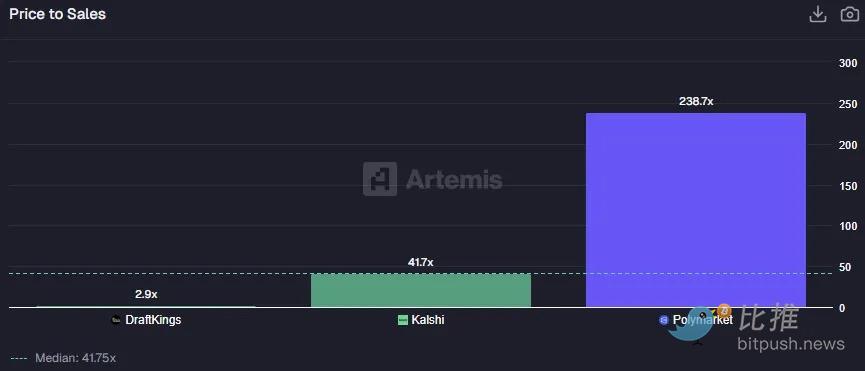
Predicted Market Cap Comparison
(Chart description: Kalshi and Polymarket's market caps use the latest private equity valuations. DraftKings' market cap is from Yahoo Finance.)
Polymarket The valuation logic assumes it will either begin monetization in some grand way or evolve into something far larger than the predicted market size. With a price-to-sales ratio exceeding 200, you're not buying a company, but a call option on a completely new financial primitive. Perhaps Polymarket will become the default venue for hedging any real-world event. Perhaps it will add more sports, financial reports, weather, or anything with binary outcomes. Perhaps it will capture a much larger percentage instead of 0.15%, suddenly generating billions of dollars in returns. This is the purest form of the "convergence" problem: will the future belong to regulated exchanges with commission rates and compliance departments, or to permissionless protocols that allow anyone, anywhere, to bet on anything without leaving any profit for the house? The Final Convergence A few years ago, we couldn't compare DeFi and Fintech. But now, the data is there. Cryptocurrencies have built a financial infrastructure that rivals fintech in terms of trading volume, user base, and asset size. Stablecoin tracks are more global than traditional payments, Aave's ledger is larger than Klarna's, and Polymarket is eroding the gaming market share. The technology is working, and products have found their audience. But there's a key "trap": the crypto industry is **far** less adept at capturing economic value (commission rates) than traditional fintech. You can view this as a "feature": it represents the ultimate democratization and efficiency maximization of financial services, benefiting users by destroying profit margins. You can also view it as a "bug": if a protocol cannot generate sufficient revenue, the sustainability of its token value will be challenged. Convergence is happening. Banks are piloting tokenized deposits, the NYSE is researching tokenized stocks, and the total market capitalization of stablecoins has surpassed $300 billion. Fintech giants have seen the future—they won't sit idly by; they will absorb and assimilate it. The question for the next decade is simple: will the crypto world learn to build tollbooths, or will traditional finance learn to utilize the crypto world's path? We bet that both will happen.
Circle and Coinbase have formed a symbiosis around USDC.
JinseFinanceFew crypto industry observers or traditional finance professionals foresaw the CRCL IPO would be so popular, and Circle has a lot of uphill battles to fight if it wants to maintain its $20 billion valuation.
JinseFinanceThe United States is vigorously promoting stablecoins, and people from all sides have gathered together, but the first to take the plunge was the veteran Circle.
JinseFinanceTwenty blockchain startups raised a total of $72.8 million in funding this week. Gnosis HQ (formerly Headquarters) received $15 million from Gnosis in an acquisition round — the largest funding round of the week.
JinseFinanceAt the beginning of Q2, Trump’s tariff policy was first implemented and then suspended, causing significant fluctuations in global stock markets and crypto assets.
JinseFinanceThis week, 27 blockchain startups raised $160.7 million in funding. Blockaid closed a $50 million Series B round, the largest round of the week.
JinseFinanceFourteen blockchain startups raised a total of $130.6 million in funding this week. Biggest funding round of the week: Beam raised $72 million in a public funding round.
JinseFinanceThis week, 29 blockchain startups raised a total of $752.2 million in funding. Bitcoin mining and hosting company Riot received $594.4 million in funding.
JinseFinanceThirty-two blockchain startups raised a total of $202.3 million in funding this week.
JinseFinanceOptimism, ETH, Exploring ways to break through the circle of public goods funding: Why establish a "profit sharing" commitment? Golden Finance, Start by solving problems at home and then expand outward.
JinseFinance