Author: Diego, Crypto Analyst; Translated by: Jinse Finance
>
Initially, I was skeptical.
Then I did some research (over 20 hours of study) and realized that robotics will be the biggest economic opportunity of our time.
This industry combines the most powerful technologies we have today: artificial intelligence, machines, and cryptocurrencies, which is why investors are pouring billions of dollars into it.
Robots (whether humanoid or not) will soon be a part of our daily lives, but people haven't realized it yet.
Meanwhile, Nvidia is telling us that the next wave of hype won't revolve around LLM, but around physical AI, which is to say, around robotics.
In 2026, the market will see phenomenal growth; all the conditions are in place, and cryptocurrency-related projects will take center stage.
In this article, we'll explore the development trends of robotics and identify the top cryptocurrency projects in the field.
If you want to know how to get my table (which tracks all the major robotics projects in the cryptocurrency space), please read to the end.
2026 is the Year of Robotics
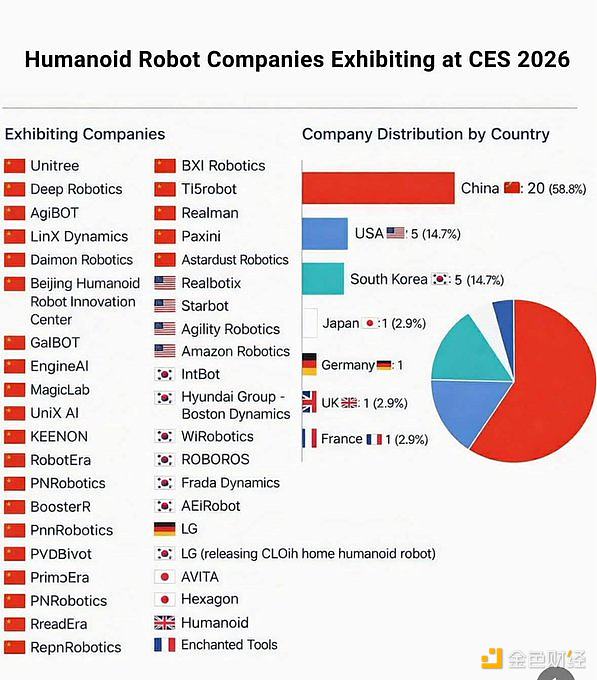
CES is the world's most important technology exhibition, and guess what? Robotics is the theme of this year's show.
Most companies are from China, but the US is closing the gap.
In short, it's worth noting that, depending on the situation in different countries, robotics is finally going mainstream and will become a core part of our daily lives much faster than we imagine.
It's still early, but I think the time left is running out.
2026 will be the Year of the Robot, for Three Reasons
More interestingly, it's about understanding why now is the time for robots to finally go mainstream.
Understanding this also helps explain why the robotics narrative in the cryptocurrency space has gained rapid attention on CT.
@KaitoAI: Attention to robotics on CT is on the rise. But on average, it's still 6 times lower than that for artificial intelligence.

LLM has finally evolved into sufficiently intelligent artificial intelligence, acting as the brain of physical machines, now capable of performing real actions and "controlling" robots. ChatGPT 3 is a turning point.
Hardware is becoming increasingly accessible.
Production costs are dropping dramatically. Humanoid robots that cost over $100,000 a few years ago will soon cost around $20,000.
Hardware is becoming increasingly accessible.
Production costs are dropping dramatically. Humanoid robots that cost over $100,000 a few years ago will soon cost around $20,000.
Cryptocurrency × Robots: A Perfect Combination
What most people don't realize is that robots will be using cryptographic tracks in their daily operations.
That's why cryptocurrency and robotics are poised to be one of the hottest sectors this year.
Robots will naturally prefer to use cryptographic infrastructure rather than centralized, opaque systems. That's undeniable.
Why?
Because today's financial and digital infrastructure was built for humans, not robots. For example?
When opening a bank account, you need to provide the following information: name, address, place of residence, and job.
If that's all there is to it, then humanoid robots would never be able to open a bank account.
Blockchain simplifies this process. In our example, humanoid robots will be able to use Web3 wallets, which don't require any of the above data and allow them to spend money freely and quickly.
For robots, using a Web3 wallet is far more logical than opening an account at JPMorgan Chase.
Top Projects in the Robot Narrative
It's time to reveal the top 7 cryptocurrency projects in the robotics field.
This isn't a list of all projects, but rather a list of what I believe are currently the best-performing projects.
1. PEAQ — Robot Blockchain
PEAQ is a Layer-1 blockchain positioned as a coordinating layer for the machine economy. In fact, Peaq enables the creation of DePIN applications built on its blockchain (e.g., Silencio Network, which will be discussed in detail later). Users can interact with applications built on Peaq and earn money through devices, bots, and machines that generate real economic value. The PEAQ token launched in November 2024 and currently has a market capitalization of approximately $55 million. It serves as an on-chain fuel token and an incentive mechanism for the ecosystem. Peaq: The first tokenized bot has just paid out to its token holders. → Tokenized bot farm grows fresh vegetables → Ordinary people will buy them → A portion of the profits will be distributed to token holders on Peaq. This is not just a matter of converting Web2 liquidity into Web3 rewards. This is Peaq's vision—robots working. [Image of Peaq with images: https://img.jinse.com.cn/7427279_watermarknone.png] [Image of Peaq with images: https://x.com/peaq/status/2005960139841356047/photo/1] [Image of XMAQUINA—an investment DAO in the robotics field] [XMAQUINA is a DAO that allows anyone to invest in early-stage robotics companies that are not yet publicly listed on a stock exchange.] Most robotics companies are still privately held, meaning that even if you are bullish on the robotics industry, you usually cannot invest in them. With its funding (currently around $35 million), the XMAQUINA community can participate in private transactions in the robotics market. The proceeds from these investments will be distributed to DAO members. Its token, DEUS, represents the DAO's distribution mechanism. To date, the DAO has invested in companies such as Figure, Apptronik, Agility Robotics, NEURA Robotics, and 1X. 3. GEODNET — The Data Infrastructure for the Robotics Revolution GEODNET is building an RTK network, which will be invaluable for future robots. The RTK (Real-Time Kinematic) network provides centimeter-level positioning accuracy. GEODNET is building this infrastructure using physical base stations and a decentralized network designed around the DePIN principle. Users who install these base stations will receive GEOD rewards. This incentive mechanism works well, enabling GEODNET to build the world's largest RTK network, usable by robots, drones, autonomous vehicles, and more. 4. AUKI — Building a Real-World Network Auki's mission is to enable artificial intelligence to access the physical world by building a "real-world network" for robots and intelligent machines. In essence, AUKI is building a network designed to enable digital devices to exchange spatial data and computing power. This is crucial for robotics, as it allows robots to move in our world, understand it, and interact with it effectively. Using these services requires payment, while providing resources is rewarded. In short, machines pay each other to collectively understand the real world. The token AUKI incentivizes contributors and serves as a value accumulation mechanism as users pay to access the services offered by the network. 5. PrismaX — Massive Remote Operations PrismaX is building an open coordination layer connecting remote operators, robot users, fleet owners, and robotics companies. In fact, PrismaX allows ordinary users like us to remotely operate autonomous robots around the world and earn money from this activity. Operators can connect with users, remotely operate robots to complete real-world tasks, and generate highly valuable data in the process. Robotics companies can connect with fleet owners interested in deploying robot fleets specifically for data collection. The token has not yet been officially issued, but a points reward program for early users is underway. An airdrop is expected soon. 6. CodecFlow – Robotics Execution Engine CodecFlow is a platform that provides a fully isolated, on-demand computing environment for building and testing robots. Imagine you want to build your own humanoid robot. Where would you start? What kind of environment would you use to safely test, train, and improve it? CodecFlow was created for this purpose; it's an all-in-one platform that helps robotics teams create, test, and iterate their products in a secure and reliable digital environment. This product is currently being tested in multiple robotics teams. Once fully launched, protocol fees will be used to buy back CODEC tokens. The token, launched in May 2025, is already listed on Solana and currently has a market capitalization of approximately $7 million. 7. Silencio — The Ear of the Global AI and Robotics Industry Built on the PeaQ blockchain, Silencio Network focuses on collecting real-world audio and voice data. AI systems and robots need high-quality audio data to understand and interact with the physical world, and Silencio is building the infrastructure to provide this data. To date, Silencio has distributed over $3 million in rewards to participants who collect and share audio data. Getting started is simple. Users simply download the Silencio app on their smartphones, collect audio data, and earn rewards for their contributions. The SLC token, launched in February 2025, currently has a market capitalization of approximately $3 million. This token is used as an incentive mechanism for participants.


 Joy
Joy


