Author: Bitcoin Kernel; Translator: @Jinse Finance xz
Recently, the Bitcoin developer community has been engaged in heated discussions regarding the Cat BIP proposal. The core of the discussion is not about NFTs or spam transactions, but rather exploring what kind of judgments the consensus layer should be allowed to make.
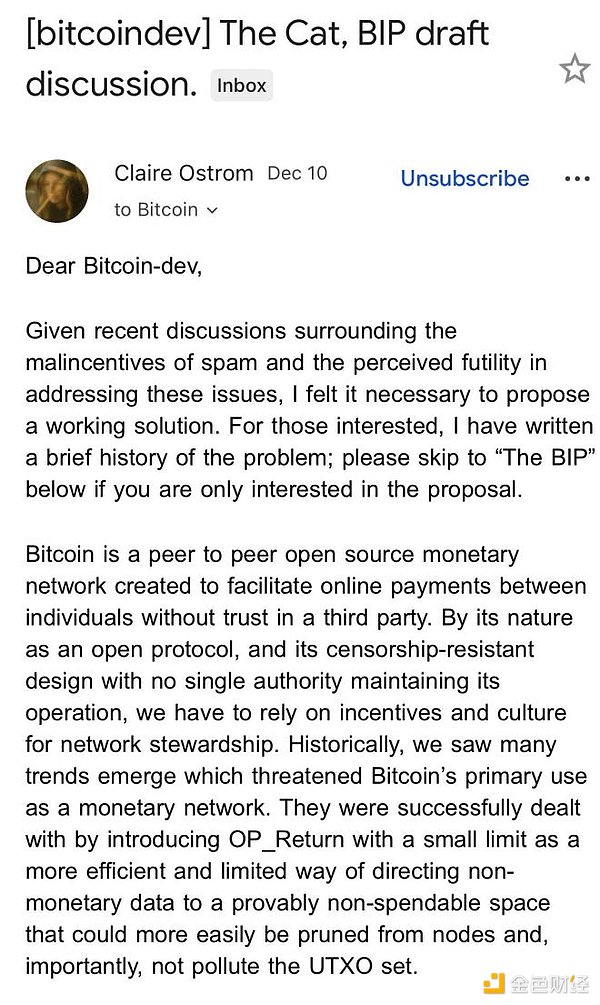
1、What is the core content of the Catproposal? Classifying specific "dust" UTXOs as "non-monetary" outputs; permanently marking them as unspendable via consensus rules; removing these outputs from the UTXO set; claimed benefits: a one-time reduction of approximately 30%-50% in UTXO storage. Key detail: This classification relies on external indexer logic (e.g., Ordinals/Stamps). 2. Core Opposing Viewpoints (Based on Engineering Logic, Not Personal Preference) As Greg Maxwell argues: The "dust" threshold is not a consensus parameter, but merely a strategic empirical judgment; "Economically meaningless expenditure" ≠ "Protocol-level unspendable"; Deleting UTXOs does not delete tokens; indexers can be easily adapted. Conclusion: This proposal encodes subjective judgment into the consensus layer. 3. Important Distinction Between Consensus Rules and Implementation Details The key difference lies in: Not storing outputs that can be proven unspendable → This is an implementation detail (no BIP proposal required); Changing whether an output is spendable at the consensus level → This is a hard protocol rule. Bitcoin Core has removed the OP_RETURN output from the UTXO set. The Cat proposal goes further than that. 4. Why Does the Controversy Over “Confiscation” Recur? Opponents argue that: even dust output is a valid UTXO; it is made unspendable through consensus rules; and it essentially constitutes a forfeiture at the protocol level. Supporters, on the other hand, believe this is merely cleaning up abandoned states. This is not a technical disagreement, but rather a question of defining the boundaries of property rights. 5. The essence of this debate: UTXO growth is indeed a practical engineering problem; however, consensus mechanisms are not cleanup tools; once spendability depends on subjective judgments of "acceptable uses," Bitcoin's neutrality is weakened. Bitcoin's security model relies on both its code and restraint.


 Joy
Joy

