Coinbase's final defection caused the subsequent Clarity Act, a follow-up to the Genius Act, to stall in Congress, bringing the "passive interest-earning" mechanism of stablecoins into focus. The banking industry believes that up to $6 trillion in deposits will flow into stablecoins, especially USDC, for which Coinbase receives 50% of the profits, which will steal deposits from small local and community banks, further hindering financing for small businesses and ordinary people. Coinbase counters that interest-earning is merely an operational and reward mechanism; given sufficient asset reserves, stablecoins will not cause a systemic crisis. Instead, they will allow more people to escape the "exploitation" of the 0.01% demand deposit interest rate imposed by the banking industry. Interest-earning mechanisms, after three rounds of development in on-chain interest-earning stablecoins, remain a hot topic that the real-world financial industry needs to catch up with. We live in a huge gap; the crypto world is moving fast, and TradeFi has a large scale. Interest-earning capitalism is happening simultaneously with the reduction in purchases of US Treasury bonds and the purchase of gold. US Treasury bonds need new buyers, and Tether and Circle are taking on this responsibility.
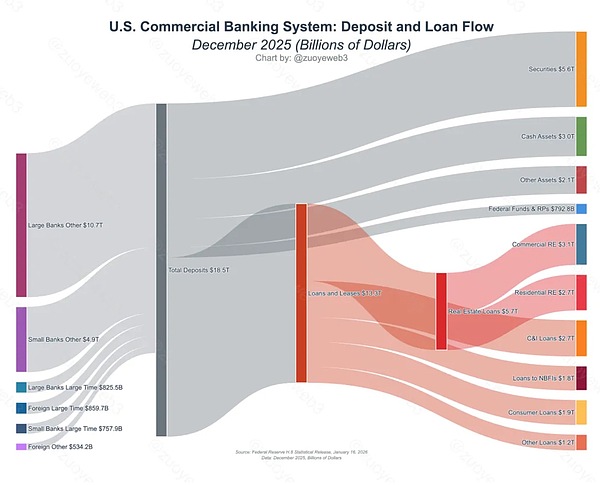
Faced with Coinbase USDC's annualized return of up to 3.35%, the banking industry has two defense arguments. One is that the US banking industry has a deposit scale of up to $18 trillion. If the interest rate on demand deposits is too high, the banking industry will further increase loan interest rates, ultimately increasing the cost of corporate financing and personal credit.
Image caption: Flow of deposits and loans in US commercial banks
Image source: @NewYorkFed
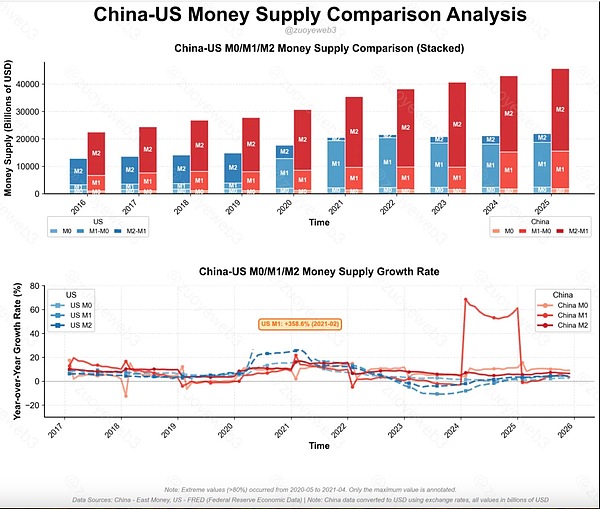
Image description: Comparison of M0/M1/M2 between China and the US
Image source: @zuoyeweb3
To answer these two questions specifically, the current issuance of USDC is 75 billion USD, purchased Of the $40 billion in US Treasury bonds, Tether issued $180 billion and purchased $130 billion. Stablecoins based on US Treasury bonds alone amount to $170 billion, representing 3%/0.8%/0.7% of US M0/M1/M2. However, according to Ark Invest's statistics, the share of the three largest foreign buyers of US Treasury bonds has decreased from 23% in 2011 to 6% in 2024. With the tariff war now spreading to Europe, US Treasury bonds need more external buyers to maintain their global status. Fundamentally, the US has no reason to reject stablecoins. Just as the Genius Act prohibits the use of interest to acquire customers, GUSD, issued by Paxos in partnership with Kraken, and PYUSD, issued in partnership with PayPal, can still bypass this channel. This is achieved either through third-party operators like Paxos or through custodians like Anchorage, which distribute interest to institutional clients. In fact, crypto peers, including Ripple and a16z, hope to pass this legislation as soon as possible, rejecting passive income while allowing active income; only Coinbase is stubbornly resisting. The core issue lies in scale expansion. Currently, the total issuance of various stablecoins is $300 billion, and strictly speaking, on-chain interest-bearing stablecoins are $30 billion. Compared to the two major real obstacles, the real impact that the banking industry is worried about is still a long way off. Within the cryptocurrency world, since the collapse of UST in 2022, the only bright spot has been USDe and sUSDe issued by Ethena, forming the main model of on-chain interest-bearing stablecoins. However, after the surge in popularity in 2025, it has rapidly gone through three stages: On July 29, 2025, USDe, in conjunction with Aave, launched a revolving loan arbitrage scheme. Following the massive liquidation on October 11, its size rapidly plummeted from $10 billion to $6.5 billion, and it abandoned building its own public chain, effectively transforming into a white-label platform; On November 3, the xUSD de-pegging incident, along with many Morpho/Euler stablecoins... The vault manager encountered a FUD crisis, and the issuance and scale of on-chain stablecoins have both plateaued, no longer maintaining the increasing trend since July; and Plasma deposit activity, which was only remembered in December, along with stablecoin public chains such as Tempo supported by Paradigm and Stripe, and Stable and Plasama supported by Tether, all lacked momentum and failed to achieve breakthroughs in P2P payments and off-chain enterprise adoption. Outside the crypto world, as mentioned earlier, the banking industry's strict prevention of stablecoin interest-bearing has made the stablecoinization of the payment industry unstoppable, but it remains strangely disconnected from DeFi. Firstly, the three crises did not affect the payment industry's enthusiasm for stablecoins; secondly, interest-bearing mechanisms can indeed improve overall economic efficiency. Payment onboard, on-chain vault. It's not capital that creates interest, but interest that creates capital. Ethena's decline has faded, but it has at least left stablecoins with a chance to be reborn, a true case of "one whale falls, many things are born." The Yield mechanism has become widespread, extending from stablecoins to all assets, such as Perp DEX and Binance's RWUSD product line. Vault... The process is basically mature, for example, the Generic yield stablecoin white-label platform based on Morpho's founder Stakehouse's earnings. If we observe the current stablecoin operation process, it differs significantly from traditional USDT, especially in the embedded presence of interest-bearing products. [Image caption: Stablecoin issuance paradigm] Image source: @zuoyeweb3 (Image caption: figure) USDC/USDT, based on US Treasury bonds, is not only the foundation for stablecoins like Ethena, but USDC can also be used in lending pools as the underlying source of interest-bearing mechanisms. This is the current reality of stablecoin blockchains. Aside from TRC-20 USDT on Tron, most stablecoins end up in DeFi. This not only disproves the banking industry's concerns that interest-bearing stablecoins will harm the financial system, but also refutes Coinbase's insistence on the sanctity of "passive interest-bearing." Coinbase's Morpho interest-bearing vault is also a product operated by Stakehouse. This involves a double drain on liquidity: extracting profits from both USDC's issuance and Morpho's operations—more like Meituan than Meituan itself, more like Didi than Didi. Outside of Coinbase, on-chain stablecoins have already escaped the excessive commissions taken by issuers and distribution channels, but the gap between interest generation, stablecoins, and payments still requires innovative mechanisms to bridge. In other words, if interest-bearing stablecoins can only extract liquidity from the banking sector to DeFi Vaults, becoming an unproductive speculative bubble, ultimately a self-fulfilling prophecy, then $6 trillion in stablecoins could trigger a systemic crisis. To simultaneously promote the growth of stablecoins in scale, increase their real-world uses, and retain interest-bearing mechanisms, the only way is to make interest-bearing a universal standard in the payment industry. Taking Airwallex's Yield product as an example, it not only offers higher annualized returns than Coinbase USDC deposits but also supports merchants' yield products in multiple currencies, with the underlying fund backed by a money market fund. Image caption: Airwallex yield products. Image source: @airwallex. Comparing it to Stakehouse's on-chain vault, the only difference is that Airwallex and others have real-world business scenarios and can efficiently utilize idle corporate funds. However, if combined with on-chain vaults, not only will the returns be higher, but the interest-bearing stablecoins can also be used normally. Unlike USDC's interest-bearing on holding and Airwallex's interest-bearing on idle funds, interest-bearing stablecoins "earn interest when available," embedding the interest-bearing mechanism into the entire process before, during, and after use. Even after consumption, a Points mechanism can be added. Compared to the difficult customer acquisition process for U-cards through C-end channels, payment channels need more financial innovation through stablecoins. Ctrip's overseas version supports U-card deposits, backed by the Singapore-licensed gateway Triple-A. For Ctrip, this is simply integrating a new third-party payment platform; for Triple-A, the choice of stablecoin is merely a matter of code selection. Following the Morpho/Aave/Sonic controversy, no one believes in "Code is Law" anymore, and the decentralized concept has suffered a major blow. However, "Money is Code" is becoming increasingly clear, and from a legal perspective, many interest-bearing stablecoins are even more compliant than USDT. In this way, users, merchants, and distributors can all get what they want: users get interest, merchants get customers, and distributors get benefits. This is also the most feasible path that is most embedded in the business scenario at present. Conclusion: The deposit-like nature of funds and the interest-earning nature of deposits. The crypto industry is reaching a turning point. Selling one's assets to outsiders is becoming increasingly unfeasible. Altcoins and Meme coins are not up to the task. The path for stablecoins to go mainstream is too far from retail investors. The problem is that retail investors cannot profit from the real adoption of stablecoins. Six months ago, stablecoins were a form of asset issuance; now, they need potential for appreciation. After the decline of leveraged stablecoins like USDe and xUSD, expanding their uses and holders, with retail investors acting as limited partners (LPs) to manage on-chain treasury liquidity, is currently a viable strategy. However, this creates new problems, such as treasury manipulation. Previously, this only affected the cryptocurrency market, and the effects were relatively controllable. But if it impacts real businesses and users, the entire stablecoin market will be rejected. We need new methods to control the treasury, which is the theme of the next article: Everyone is a Manager – Understanding the Manager's Treasury.
Preview
Gain a broader understanding of the crypto industry through informative reports, and engage in in-depth discussions with other like-minded authors and readers. You are welcome to join us in our growing Coinlive community:https://t.me/CoinliveSG


 Anais
Anais
