Source: Enterprise Onchain; Author: James; Translation: BitpushNews
Autonomous AI agents will need to discover each other, make payments to each other, and decide whether to trust each other—all without human intervention.
Ethereum Foundation AI Director Davide Crapis recently discussed this on the DeFi Dad podcast. One question Crapis repeatedly raised is one that most people in the payments space haven't fully grasped:
If AI agents need to transfer funds, discover services, and trust counterparties without requesting human permission, on what kind of infrastructure will they operate on?

The Rational Agent Problem
Crapis's core claim is simple: AI agents are rational economic actors. They always choose the tools and infrastructure that allow them to perform tasks most efficiently. If you accept this premise, you can deduce most of the following conclusions.
Today's agents are still very limited. An autonomous agent instance wakes up once an hour to run API calls and make micro-decision-making. Early experiments of this kind failed not because of flawed reasoning, but because the agents consumed API tokens too quickly, making them economically unsustainable. The bottleneck is not intelligence, but payment infrastructure.
Credit cards don't work in this regard. An AI agent executing 10,000 microtransactions daily in 50 countries can't maintain bank accounts, process refunds, or handle the individual setup processes required by traditional payment systems for each merchant. Existing architectures assume a human is involved in every transaction, an assumption that's outdated. This is where Crapis's framework is interesting. He breaks down the vague concept of "agent economics" into three solvable engineering problems: payment, discovery, and trust. Payment: How do agents pay each other for services? Discovery: How did agent A initially find agent B? Trust: Once established, how does agent A know that agent B won't take the money and deliver substandard results? Solutions to each of these questions are currently under active development. Payments: x402 Protocol In the payments field, the most prominent open protocol is x402. Coinbase launched this protocol in May 2025, reviving the long-dormant HTTP status code 402 ("Payment Required") as a machine-readable payment gateway directly embedded in web requests. The server returns a 402 status code and payment terms. The client constructs a stablecoin payment, resends the request with the payment header, and the server verifies the settlement on-chain. No subscription tiers, billing cycles, or merchant onboarding are required. By December 2025, Coinbase reported that x402 had processed over 100 million payments. Cloudflare co-launched the x402 Foundation in September. Stripe began testing machine payments using x402 on the Base chain in February 2026. Google Cloud's Proxy Payments Protocol (AP2) also uses x402 as an extension for on-chain settlement, although AP2 itself remains neutral on payment methods, supporting card payments, bank transfers, and stablecoins. However, the data needs to be treated honestly. A CoinDesk analysis report released today shows that x402's daily transaction volume is approximately $28,000, with an average payment of only about $0.20. In February, an Artemis analyst stated that the agent payment boom is "mostly an illusion at present," estimating that about half of the observed x402 transactions reflect testing or gamification activities rather than genuine commercial activity. There is a huge gap between the backers of the protocol (Coinbase, Cloudflare, Stripe, Google) and its current actual throughput. While this is still in a very early stage, it seems to me that it's not very clear from the transaction volume at this point. x402 solves a structural problem that card networks were never designed to address: high-frequency payments below 1 cent. Even if agent commerce only grows modestly, the infrastructure needs to be in place. You can't wait until the traffic starts to appear before you start building the highway. Identity and Trust: ERC-8004 For identity and trust, the answer is ERC-8004. This standard was jointly proposed in August 2025 by authors from MetaMask, the Ethereum Foundation, Google, and Coinbase. Its registry contract was deployed to the Ethereum mainnet on January 29, 2026 (the standard itself is still in draft stage and undergoing peer review). It defines three lightweight on-chain registries: Identity: Each agent receives an ERC-721 token as a portable, censorship-resistant ID. Reputation: A standard interface for posting and receiving feedback. Validation: Hooks used by third parties to independently verify the work of an agent. Crapis describes it as a "passport system" for machines. ERC-8004 is not just for agents. The registry also covers agentic services, APIs and tools specifically built for agent consumption, such as price feeds, computing terminals, and data verification services. While these do not make decisions on their own, they are essential infrastructure for agent discovery and evaluation. The registry treats both equally: by registering, demonstrating capabilities, and building records. An agent registers, demonstrates its capabilities and terminals, and accumulates records over time. Other agents can consult these records before transacting. The registry can be deployed on any L2 or mainnet, with the vision of more sophisticated scoring and cross-chain aggregation enabled by ecosystem services built upon it. The payment history of x402 can be fed back into reputation in the future, although the two protocols are designed as complementary layers, not tightly coupled systems. On the Ethereum Magicians forum, over 2,000 community members discussed the proposal over three weeks, involving more than 75 projects. In the first two or three days after registry deployment, over 20,000 agent registrations appeared (Crapis admitted in the Bankless podcast that many of these were test cases). Since the specification release, 1,000 to 2,000 developers have joined the development team. ERC-8004 has now been confirmed to extend to Coinbase's Layer 2 network, Base, and BNB Chain also announced support in February 2026.
Why choose Ethereum?
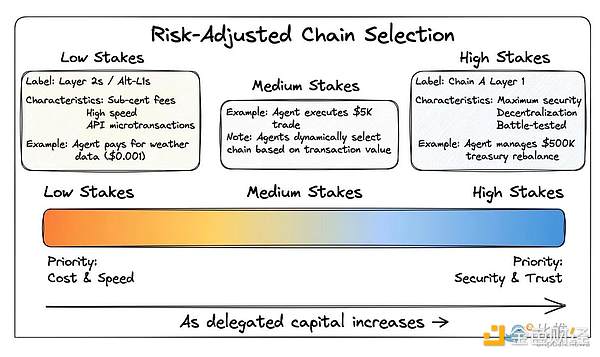
Crapis's argument that the AI agent will choose Ethereum (rather than any blockchain) depends on a framework he calls risk-adjusted chain selection.
Currently, the agent prioritizes low fees. If an agent needs to make ten transactions per minute, it will stay on Solana or Base because the cost per transaction is negligible. This is fine for small amounts of money (e.g., having the agent manage a $200 API call budget).
However, Crapis argues that as agents are entrusted with meaningful capital (thousands or even ultimately millions of dollars), the computational logic changes. Agents will consider counterparty risk, security guarantees, and decentralization. High-value agency businesses will require the kind of battle-tested, highly decentralized settlement offered by Ethereum Layer 1. This is like a startup choosing between a digital bank's checking account and a prime broker's escrow account. For pocket money, you prioritize convenience; for institutional capital, you prioritize security. Chain selection follows the same logic. Crapis has built this strategy defensively: Ethereum doesn't focus on building larger models, but rather on cryptographic guarantees, zero-knowledge proofs, and sovereign environments that allow users to interact with highly capable AI without relinquishing control of their assets or data. Heavy computation remains on traditional off-chain servers. But the identity, reputation, payments, and cryptographic proofs that serve as anchors of trust between agents remain on Ethereum. As Crapis said in a recent CoinDesk interview, “In a world where AI reigns supreme, we want Ethereum to be the place with the big lock.” This is both a technological and a philosophical bet. If the AI economy operates through centralized chokepoints (OpenAI’s infrastructure, Google’s agent registry, a company’s payment track), then whoever controls the chokepoint can make the rules. Ethereum’s bet is that neutral, permissionless infrastructure will attract AI agents in the same way the open internet attracts developers: not because it’s the easiest, but because no one can unilaterally change the rules. Agent data. If you only focus on token prices, it’s easy to miss the scale that’s happening.
“2026 State of the Agency” Report: This is the most comprehensive report on the on-chain agency economy. Statistics show that AI agents running on the blockchain have completed over 140 million transactions, totaling $43 million. While these figures are insignificant compared to traditional payments, they represent a category that was virtually non-existent 18 months ago.
Market Expansion: The broad AI-crypto market has grown from approximately $14 billion at the end of 2024 to an estimated $20-39 billion by mid-2025, and is projected to reach $47 billion by 2034. In 2024-2025, AI-related crypto transactions accounted for 37% of total VC crypto investment.
Task Completion Time Span: This metric, tracked by METR (a nonprofit focused on measuring the capabilities of autonomous AI), shows that since 2019, the time it takes for AI agents to complete tasks with 50% reliability has roughly doubled every seven months. By early 2025, the 50% time span for cutting-edge models will be approximately 50 minutes. If this trend continues, agents capable of autonomously working for hours or even days are just around the corner. The impact on financial infrastructure is direct: agents capable of working for days or hours without human supervision will generate orders of magnitude more transaction volume than today's supervised systems. Competitive Landscape: Every transaction requires settlement. According to LangChain's "Status of Agent Engineering Survey" of 1,300 professionals, 57% of respondents already have agents in production environments. The challenge has shifted from "Should we build proxies?" to "How can we reliably deploy them at scale?" Meanwhile, the competitive landscape for proxy payment infrastructure is becoming increasingly crowded: Chainlink has built the CRE (Chainlink Runtime Environment) as an orchestration layer connecting proxies to external APIs and on-chain smart contracts. Visa has launched a "Trusted Proxy Protocol" for cryptographic proxy identification. PayPal has partnered with OpenAI to implement proxy-initiated checkout in ChatGPT. Stripe's machine payment preview uses x402 for USDC settlement on Base. The choice of which blockchain an AI agent ultimately selects may not be a binary one, as the podcast title suggests. Agents may default to supporting multiple chains: using inexpensive L2 for high-frequency microtransactions and Ethereum L1 for high-value settlements, much like how companies today use different banks for different purposes. Despite x402's strong backing and elegant design, its daily transaction volume is barely worth a rounding error by Visa. While the ERC-8004 registry is deployed, most of the 20,000+ registrations are test-based. The stablecoin industry sees agent payments as a core use case justifying the entire infrastructure, but as one payments analyst told Bloomberg, predictions that agent commerce will reach 20% of e-commerce are "a bit too aggressive." Crapis, in his DeFi Dad podcast, also acknowledges that the current proxy economy is still in the infrastructure building phase, having just graduated from the first phase of "meme hype" and entered the second. Legitimate teams (Eliza OS, Virtuals, and projects built on ERC-8004) survived the speculative frenzy and are building. However, revenue-generating applications that use proxies for large-scale real-world business activities have not yet truly arrived. The counter-argument remains simple: centralized AI giants may build "walled garden" proxy economies, which might be more user-friendly for most. If OpenAI builds internal fiat payment tracks and proxy app stores, this smooth user experience could potentially beat decentralized alternatives in the competition, no matter how noble their philosophical considerations. Most businesses will choose "useful things" over "ideologically correct infrastructure." But the market has already begun pricing in this prospect, albeit somewhat clumsily. In late February, a speculative Substack article by Citrini Research simulated a scenario where AI agents bypassed bank card exchange fees and instead used stablecoins for settlement. This became one of the catalysts that triggered a 4-7% drop in Visa, Mastercard, and AmEx in a single trading day. Although the article was explicitly labeled as a thought experiment rather than a prediction, and other factors contributed to the decline (such as the release of Anthropic's Claude Code and Nassim Taleb's warning), its underlying logic resonated: "If software controls transactions, it optimizes costs. And the cost of stablecoin tracks is far lower than bank card exchange fees." Circle's CEO stated in the company's February earnings call that stablecoins could become the native currency for machine-to-machine commerce. Stripe, together with Paradigm, has raised $500 million to build Tempo, a blockchain specifically designed for stablecoin payments. Bloomberg reported this month that the two companies are racing to build a payment system for a world that doesn't yet exist. Whether Ethereum will ultimately win this race, or whether a hybrid of dedicated chains like L2, Solana, and Stripe's Tempo will absorb these transaction volumes, remains to be seen. The only increasingly undeniable argument is that the architecture of internet payments cannot remain unchanged in a world where buyers are no longer human.


 Joy
Joy


