The past two years have witnessed the transformation of the crypto industry. Bitcoin has evolved from a speculative asset and cyclical benchmark, a reservoir for liquidity during periods of monetary easing, to a non-sovereign macroeconomic anchor asset and strategic reserve option. Stablecoins have also evolved from a speculative medium to a healthy on-chain dollar, facilitating cross-border on-chain payments and providing a low-barrier channel for obtaining US dollars worldwide.
In stark contrast, the altcoin market has seen the vast majority of crypto projects proven false. The past glory of some projects is highly unlikely to be repeated, and more often than not, projects have perished during the planning stages due to the industry's downturn.
The tide of liquidity has receded, and speculative narratives have become increasingly scarce and dull. However, I believe this is a normal transitional cycle in the blockchain industry, a healthy liquidation of crypto bubbles and illusions. After hitting bottom, the crypto industry will slowly emerge from the shadows.
Institutional investors have significantly increased their confidence in the crypto industry in 2026. According to a 2025 survey by EY, nearly 80% of respondents expected cryptocurrency prices to rise, and nearly 70% saw it as the greatest opportunity to obtain attractive risk-adjusted returns. 1. The Emergence of Blockchain-Native Finance 1.1 Beyond RWA: From "Assistant Tool" to the Core of "Credit Efficiency" Currently, the essence of RWA is still packaging assets and liabilities from the traditional financial system onto the blockchain. This model can only serve as an auxiliary tool for traditional finance, while the actual function of blockchain goes far beyond this. The essence of current financial competition is not the scale of funds, but "credit efficiency." On the surface, the competition in the financial system is: (1) the amount of capital; (2) the level of interest rates; and (3) the market size. But the underlying logic is: a system can organize credit with lower costs, less friction, and less abuse. Whoever can produce, price, and clear credit more efficiently will have a long-term advantage.
1.2 Defects of Traditional Finance: The "Personalized + Power-Based" Credit Model
In the traditional system, credit depends on:
(1) Central Bank
(2) Commercial Banks
(3) Government backing
(4) Law and violent enforcement.
This leads to a fundamental problem: credit is not neutral, but can be manipulated. Whoever holds power can decide the flow of funds, enjoy funding, and socialize losses.
1.3 "Trustless" Collaboration that Locks Power into Rules
The spirit of blockchain is to establish a system that allows people to collaborate without the need for trust.
Blockchain constructs a completely new trust model through:
(1) Cryptography
(2) Consensus Mechanism
(3) Immutable Ledger
It locks power into rules and turns ownership from permission into fact. For the first time, it embeds the "worst assumptions about human nature" into the system itself. Even if human nature problems exist, it still builds a credible order. This is a dimensional reduction attack on the traditional credit system.
The real advantage of blockchain lies in the reconstruction of credit organization methods by its underlying system. The spirit of blockchain determines the form of the system, the form of the system determines the efficiency of the mechanism, and the efficiency of the mechanism is ultimately manifested in the cost, speed and accessibility advantages at the user level. (1) Lower financial service costs (2) More efficient financial service speed (3) Elimination of geographical access and some barriers 1.4 Path: From the starting point of DeFi to the compliance path of legislative explosion Cryptocurrency has gone from being a "scam" to the large-scale participation of mainstream traditional financial institutions in the crypto industry. During this period, the attempts at on-chain native finance and the promotion of legal supervision have continued. The rise of DeFi products in the summer of 2021, the earliest legislative attempts on cryptocurrency assets at the congressional level starting in 2023, the entry of RWA into the mainstream narrative in 2024, the "legislative explosion year" of 2025, and the hope that 2026 will see the first time that on-chain as the true starting point of finance.
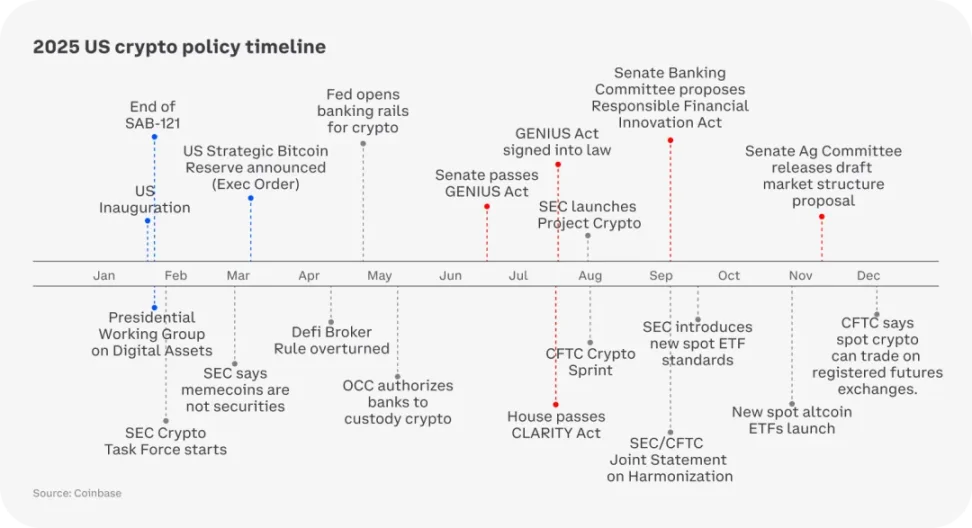
https://transak.com/blog/the-clarity-act#the-clarity-act-timeline
Timeline of US Government Legislation on the Cryptocurrency Industry in 2025
2. The Reversion of Token Value
In the early stages of the crypto industry, many tokens still achieved astonishing market capitalization growth without any real returns or even a clear value capture path.
Why could early tokens rise without any real returns?
2.1 Market Pricing is Not Based on Cash Flow, but on "Future Credit" In the early stages of the industry, the core pricing basis of tokens is not: Dividends, Returns, Buybacks Rather, it is future credit: 1. The possibility of becoming infrastructure in the future 2. The potential to capture value in the future 3. The potential to be recognized by institutions, users, and capital in the future Tokens are more like an "option to future institutional status and network effects." The exercise condition for this option is the collective perception and belief of the market. During an industry boom, as long as enough participants believe in a narrative—believing that this public chain will become the next financial settlement layer, believing that this DeFi protocol can capture the liquidity of the ecosystem, and believing that its team and community have the ability to modify token economics at some point in the future to achieve value capture—then this shared belief itself becomes a "self-fulfilling prophecy." Capital will flood in based on this belief, driving up prices; and the rising prices, in turn, reinforce the belief, attracting even more capital. In this reflexive cycle, the token prematurely realizes the option value regarding "future credit." It is essentially a game of attention, consensus, and coordination; the token is the chip in this game, and the option value is determined by the level of participation and fervor in the game. 2.2 Narrative Dividends and Early Super Premiums Driven by Cognitive Differences In the past few years, blockchain narratives have remained highly novel: Financial Infrastructure Narrative (DeFi Primitive): Terra, Uniswap, Synthetix Curve Application Narrative: NFT, SocialFi, GameFi Platform Narrative: Layer 2 Public Chains Blockchain Interconnection Infrastructure: Cosmos Polkadot Web3 Middleware Infrastructure Narrative: Oracles Cross-chain bridges, sorters, modularization, wallets, and account abstractions. These narratives themselves can generate cognitive dividends, attracting incremental capital. New narratives naturally have an advantage at the cognitive level because they can create "attention asymmetry + understanding asymmetry," thus generating an early pricing advantage. 1. Attention Scarcity Effect. Human attention is extremely limited. When a narrative is "appearing for the first time": it is more easily noticed and more easily amplified by the media, KOLs, and capital. Uniswap shattered the traditional understanding that there is no liquidity without market makers with extremely low cognitive cost. Prices can be determined by a formula x*y=k. This "counterintuitive but explainable" model generates a strong memorability and dissemination effect. 2. Cognitive Framework Vacuum When a field is new: 1) There is no unified valuation model; 2) There are no successful/failed precedents; 3) There is no "reasonable price anchor." CosmosHub, precisely because it lacked fundamentals, was able to successfully capture short sellers for many years using the narrative of "the golden shovel for Cosmos ecosystem projects." In an environment of abundant macro liquidity, the influx of participants into the crypto market combined with early narrative-driven gains. Due to market reflexivity, we witnessed the meteoric rise of numerous projects starting in 2021, with talented young people monetizing their knowledge and achieving legendary financial freedom through the cryptocurrency market. However, the current macro liquidity and market conditions can no longer sustain the speculative frenzy of the past. Most narratives have been disproven, and most tokens are now worthless or nearly worthless. Current cryptocurrency participants are gradually recognizing that most "air coins" (cryptocurrencies with no real value) only have short-term market speculation value. Future cryptocurrency projects that want to gain investor "faith" need to offer products that can generate long-term profits and tokens that capture value. In recent years, the market has begun to punish inflation and empty narratives. Those who chose outdated narratives and inferior token economies have gradually transferred their money from many long-term, optimistic investors willing to provide liquidity.

Top 150 Crypto Tokens by Market Cap: Current Price Decline Relative to Highest Price
3. Privacy is shifting from a "peripheral function" to a "core infrastructure"
In the early stages of the crypto industry, privacy was more often seen as an ideological appeal or a niche feature:
anonymous transactions, censorship resistance, and personal freedom. These needs are real, but for a long time they have not become a core indicator of competition among mainstream blockchains.
3.1 From an investment perspective, the privacy sector simultaneously meets the characteristics of becoming the next trend in blockchain development
Strongly correlated with institutional adoption and government legislation in various countries. Privacy is shifting from "complete anonymity" to "composable and auditable" as a real-world necessity
Strong network effects + high migration costs make it difficult to replicate and commoditize
As crypto assets gradually move towards real-world finance, the positioning of privacy has undergone a fundamental change: privacy is no longer a question of "whether it is needed," but rather a question of "whether it is available."
As a16z points out in its 2026 outlook: Privacy is the one feature that's critical for the world's finance to move on chain — and also the one feature that most blockchains lack. Privacy is evolving from an ancillary capability into a decisive moat in chain-level competition.

Privacy transaction volume from 2025 Q4 Entering a period of rapid growth. 3.2 Why is privacy a necessary condition for "on-chain finance"? Real-world finance cannot operate on a "completely transparent" ledger. While the transparency of public blockchains was an advantage in the early stages, it becomes a fatal flaw in real-world financial scenarios: 1) Companies cannot disclose all trading counterparties and cash flows. 2) Institutions cannot expose their positions, trading strategies, and capital structures. 3) Users cannot accept a permanently traceable history of asset behavior. Therefore: without privacy, on-chain transactions can only support speculation; with privacy, on-chain transactions can support finance. This is why stablecoins, RWA, and institutional DeFi, after reaching a certain stage of development, inevitably point to a privacy layer. Compared to ordinary public blockchains, privacy-focused public blockchains hide transaction amounts, account relationships, and behavioral paths, making users' on-chain states unreplicable and difficult to migrate, thus significantly increasing migration costs and potential exposure risks. People are cognitively extremely sensitive to privacy leaks; therefore, once entering a privacy ecosystem, they tend to maintain the status quo and complete as many financial activities as possible on the same chain. This "user stickiness," combined with network effects, creates a winner-take-most structure for privacy blockchains: the larger the ecosystem, the more users and funds it attracts, forming a positive feedback loop. Simultaneously, privacy also introduces barriers such as imperfect information games and weak cross-chain connections, making its advantages difficult to replicate or replace by other chains. In summary, privacy is not merely a functional difference, but a core mechanism for changing market structure, locking in value, and forming long-term competitive advantages. Therefore, a few high-quality privacy blockchains are highly likely to dominate the important infrastructure and trading ecosystem of the crypto market in the future. Privacy is moving from the ideological periphery of cryptocurrencies to the core of financial infrastructure. In an era where performance competition is ineffective and narrative dividends are fading, privacy may become one of the strongest and most enduring moats in the blockchain world. 4. AI and Blockchain Integration: From "Pseudo-Integration" to "True Paradigm" In the past, "AI + Crypto" has appeared many times as a speculative narrative. Most of these attempts were superficial: either simply putting AI on a Web3 shell to create "AI computing power coins" with no real need; or simply viewing blockchain as a storage tool for AI data. The essence of this "pseudo-combination" is a superficial patchwork of two transformative technologies, failing to address their core complementarity—AI lacks a trusted economic and collaborative layer, while blockchain lacks intelligence and adaptability. However, in 2026, we are witnessing this integration evolve from a "marketing concept" to a "fundamental paradigm." The core shift lies in this: AI is no longer merely an application on blockchain, but is becoming the "intelligent layer" of the blockchain protocol; simultaneously, blockchain is no longer just a tool for AI, but is evolving into the "trust and settlement foundation" for AI to participate on a large scale in socio-economic activities. This integration will unfold along two profound directions: 4.1 AI as the "Intelligent Engine" of the Protocol Layer Future blockchain protocols will embed AI as a core component, enabling them to dynamically optimize and autonomously manage: 1) In DeFi: Lending protocols can utilize AI models to analyze on-chain/off-chain data in real time, dynamically adjusting interest rates and liquidation thresholds to achieve global optimization of risk and capital efficiency. 2) In security and governance: AI can become an "on-chain immune system" that monitors smart contract vulnerabilities and detects abnormal transaction patterns in real time. In DAO governance, AI agents can automate complex decisions or simulate the long-term impact of proposals, assisting humans in making more informed decisions. 4.2 Blockchain as the "Institutional Foundation" of the AI Economy When massive numbers of AI agents begin to replace humans in transactions, collaboration, and value creation, they require a native, trustworthy, and automated "machine economy" environment. This is precisely where blockchain's irreplaceable advantages lie: 1) Identity and Trust (KYA): Traditional "Know Your Customer" (KYC) is not applicable to machines. Blockchain can establish an immutable identity, reputation, and historical record system for each AI agent through encrypted credentials, achieving "Know Your Agent," a prerequisite for large-scale machine collaboration. 2) Payment and Settlement: High-frequency, small-amount, 24/7 machine-to-machine micropayments between AI agents (such as data fees and API call fees) require a permissionless, globally settled payment system. Crypto-native currencies and smart contracts form the perfect foundational layer for building this machine-native finance. 3) Data and Value Confirmation: Blockchain ensures transparency and clear copyright of data used to train AI, and through tokenization, enables data contributors to directly capture value, thereby building a fairer and more efficient trusted data market than the current centralized model. 4.3 How Will This Change Industry Rules? This deep integration essentially answers a fundamental question: In a future world with increasingly higher agent density, how will value be generated, circulated, and confirmed? The answer points to a complex ecosystem where blockchain provides the institutional framework and AI drives economic growth. This is not only a combination of technologies but also an innovation in economic and governance models. It allows the crypto industry to move beyond the singular narrative of "financial speculation" and truly anchor itself in the core engine driving the next productivity revolution. 5. 2026 New Year Outlook: A New Approach, Earning Money Steadily In short, the crypto industry is undergoing a fundamental transformation. The old methods of getting rich quick through storytelling and hype are no longer viable. 2026 will mark the beginning of a pragmatic new phase. 5.1 Old Methods Fail, New Rules Emerge The market has proven that tokens that simply offer empty promises and endlessly print money will be ruthlessly abandoned. People are increasingly valuing whether a project truly generates revenue, has users, and can generate profits. It's like the tide going out to reveal who's been swimming naked. Now, the floodwaters have receded, and the industry has reached the point where it must put on its clothes and get down to business. 5.2 Predictions for the Development Direction of Cryptocurrencies in the New Stage The four trends outlined in this article collectively mark the entry of a profound systemic migration in the crypto industry into a substantial phase. 2026 will be a crucial starting point for this migration. Institutional Layer (Blockchain-Native Finance): Reconstructing credit through code and consensus, providing a lower-cost, less frictional, and more open basic framework. The US's "compliance path" is precisely the inevitable process of the new institutional requirements being recognized by the mainstream. Asset Layer (Token Value Reversion): Tokens will eventually move beyond this highly speculative "premium call option" stage and gradually become more like "stocks." Its value will increasingly depend on the project's real profitability, rather than fantastical narratives. Security Layer (Privacy as Core Infrastructure): As on-chain transactions begin to handle genuine business and finance, privacy, like a bank's vault, transforms from an "optional accessory" into "core infrastructure." Privacy becomes a prerequisite for ensuring the operation of trade secrets and complex financial logic on-chain, and is the key to unlocking the potential of blockchain. Intelligence Layer (AI and Blockchain Integration): Blockchain provides a trusted economic layer for AI agents, while AI makes blockchain protocols more intelligent. The "machine economy" spawned by their integration will be the core of future growth. For investors, this means a shift in logic: from chasing short-term narratives to identifying the builders of long-term structural pillars. With clearer regulations and more rational assessments, the industry will emerge from the ruins of valuation disillusionment and enter a construction cycle that lays the foundation for the digital future. The noisy "gold rush" is cooling down, while the silent "urban construction" has just begun. In 2026, we may stand at a healthier and more sustainable new starting point.


 Anais
Anais


