When a container ship loaded with cargo moves faster than its ownership documents are transferred, something fundamentally wrong. Here’s how blockchain technology solves a 70-year-old problem—and why the race to build this infrastructure will define the future of finance in the next decade.
Imagine you’re transporting $40 million worth of crude oil across the Atlantic. The tanker is sailing smoothly at 14 knots, but the paperwork to prove who owns the oil is a mess. It gets stuck in a relay race between courier services, bank processing queues, and manual verification checks. By the time the documents catch up with the ship, weeks have passed, millions of dollars are frozen, and sometimes, as happened with an unfortunate ship that sat out of port for two months, the documents are simply lost.
Imagine you’re transporting $40 million worth of crude oil across the Atlantic. The tanker is sailing smoothly at 14 knots, but what happens to the paperwork proving who owns the oil? It gets stuck in a relay race between courier services, bank processing queues, and manual verification checks. By the time the documents catch up with the ship, weeks have passed, millions of dollars are frozen, and sometimes, as happened with an unfortunate ship that sat out of port for two months, the documents are simply lost.
Layer 1: Legal Recognition
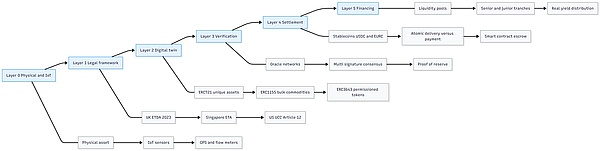
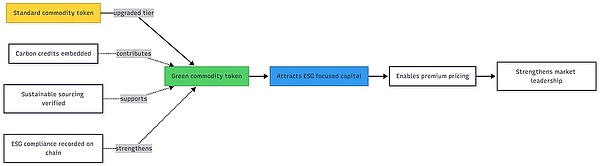
Technology cannot replace law. Over the past three years, global business law has undergone a structural change, shifting from 'actual possession' to 'exclusive control'.. The UK Electronic Trade Documents Act (ETDA) of 2023 is a watershed moment. Given that UK law governs approximately 80% of global trade documents, this is a global signal. ETDA equates the exclusive control of electronic documents with the actual possession of paper documents. This layer of legal interoperability means that a tokenized bill of lading minted in Singapore can be funded by a London bank and sold to a New York buyer with strong legal certainty. Layer 3: Verification (Oracle Network) The most critical layer for preventing token problems. Chainlink's Proof-of-Reserves System: Oracles: Nodes obtain data from IoT sensors, repository APIs, and third-party auditors. Nodes reach consensus on the true state of assets. If the reported reserves are lower than the token supply, the smart contract automatically suspends transactions. This creates a dynamic system where tokens... The effectiveness of leaf=""> will be continuously re-verified: this is a significant improvement over quarterly paper audits. Layer 5: Financing The protocol creates a structured credit pool where: Token holders lock commodity tokens into a vault contract. Risk is tiered: Priority investors (lower risk, 4-6% return) receive rewards first; Subordinate investors… Investors (higher risk, 8-12% return) bear the initial loss. Investors provide stablecoins to earn yields from real-world trade finance. Protocols that make this a reality. Some platforms are already operating at scale, proving the model's effectiveness: Trust-based lending platforms. These platforms address the over-collateralization problem (requiring 150% collateral to borrow 100%) through "trust-based consensus": Borrowers (e.g., agricultural exporters) propose loan pools, auditors verify legitimacy, and collateralize tokens in their assessments. Supporters provide initial loss capital after due diligence. A tiered pool automatically matches supporters' confidence with additional funding. This structure has been successful in financing agricultural exports in markets with the most severe trade finance gaps—where the $2.5 trillion financing gap hits hardest. Risk Vector: What Problems Might Arise? The intersection of physics and digital technology creates a unique attack vector that must be designed into the system. Risk 2: Smart Contract Exploitation Threat: A bug that allows attackers to deplete the liquidity pool. Defense: Formal Verification (Mathematical Proof of Code Correctness) Multiple Third-Party Audits from Top Security Companies Bug Bounties Incentivize White Hat Hackers Insurance Funds Funded by Agreement Fees to Compensate Users Risk 4: Regulatory Reclassification Threat: Tokens being classified as securities triggers prohibitive compliance requirements. Defense: Compliance through Embedded KYC/AML Qualified Custodians Holding Physical Assets Gradual Decentralization Towards DAO Governance Vision for 2035: Hyperliquid Supply Chains (Image of a figure) [Image of a tanker] During a 20-day voyage, an oil tanker is sold 50 times, with each transaction settled immediately. Price discovery becomes real-time, reflecting precise location and quality. Algorithmic Financing: When cargo passes through a geofence checkpoint (leaving port, crossing the Suez Canal), smart contracts automatically issue credit. Interest rates are dynamically adjusted based on real-time risk profiles. Democratic Access: Tokyo-based retail investors profit from copper shipped from Chile to China. Trade finance, once the domain of large banks, has become a new asset class, unaffected by stock market fluctuations and backed by real productive assets. Strategic Opportunity: The Green Commodities Wedge The next frontier in commodity markets is sustainability. Forward-thinking agreements are leading the way by creating a new asset class: Green Commodities. Strategy: Launching premium goods with embedded environmental data. Token Layer: Tokenization of carbon credit offsets. Displaying verifiable source data for sustainable sourcing. Blockchain-tracked chain of custody, starting from the origin. style="text-align:center">
Competitive Advantage:This attracts a large and growing pool of institutional capital, primarily ESG, that is currently unable to access services from the digital asset market. It creates a unique advantage that combines profit with objectives, thereby transforming sustainability from a cost center into a revenue driver.
The Road Ahead: From Intermediary to Protocol
The most profound shift happening in this space is not just a technological shift—it's a structural shift.
Successful platforms don't simply digitize old systems; they completely reimagine them. The Economics Challenge of Tokens: Building a Sustainable Economy. Creating a successful protocol requires more than just smart contracts—it also requires sophisticated token economics to coordinate incentives across the entire ecosystem. Conclusion: Building an Operating System for Modern Trade. The containerization of shipping in the 1950s reduced freight costs by 90% and enabled modern globalization. Tokenization will do what containers do to the physical layer of trade—the financial and informational layer. This is not just technology for technology's sake. This is about solving real, costly problems: A $2.5 trillion financing gap is killing growth in emerging markets; $6.5 billion is wasted annually on paperwork; millions of dollars in cargo delays are caused by lost documents; billions of dollars in fraud are caused by forged certificates. Ships will continue to travel at 14 knots—that's physics. But the value they carry will soon be moving at the speed of light. Strategic Priorities For leaders building in this space, the message is clear: 1. First, address the oracle problem. Establish multi-signature frameworks with economic penalties to combat fraud. Don't launch without strong physical digital verification. 2. Design for antifragility. Build systems that gain strength from market stress. Protocols possess liquidity, insurance funds, and circuit breakers. 3. Embed compliance from day one: Permission pools, KYC-controlled access, and progressive decentralization. Regulatory persistence is a given.
4. Focus on vertical specialization: Build a product-specific risk engine that understands deterioration, late fees, and quality decline. Generalists cannot compete on strength. 5. Capturing the Green Premium Embedding ESG data into the token. The institutional funds waiting on the sidelines for compliant, sustainable investment are enormous. A $16 Trillion Opportunity: Market predictions are not speculation—they are inferred from proven demand: Proven Demand: $8.4 Billion in Treasury Bonds, $3.6 Billion in Gold. Growth: Major institutions (BlackRock, Franklin Templeton) are entering the space. It's inevitable: The $2.5 trillion funding gap needs new solutions. The question isn't whether this shift will happen, but who will build it. The technology is ready. The laws are ready. The market desperately needs solutions. The only missing ingredient is execution—the hard work of building robust, compliant, and economically sustainable protocols that can bridge the gap between the atomic and bit worlds. For platform architects and strategic leaders, this is the moment. The next decade belongs to those who build the trust stack: an integrated architecture of the Internet of Things, oracles, law, and DeFi that allows value to flow as smoothly as information. The operating system for modern trade is being written. It's being written in code. The future of global trade isn't coming. It's already here. The only question is who will build it and who will be left behind.
Preview
Gain a broader understanding of the crypto industry through informative reports, and engage in in-depth discussions with other like-minded authors and readers. You are welcome to join us in our growing Coinlive community:https://t.me/CoinliveSG


 Weatherly

