Tao Zhu, Jinse Finance
Summary
White House digital asset advisor Patrick Witter stated that the CLARITY Act (Clarity of the Digital Asset Markets Act) is expected to pass Congress before July 4, 2026. Trump's push to make the US the "crypto capital of the world" is gaining momentum.
The compromise reached over the weekend on the CLARITY Act triggered a strong rise in the crypto market. Senators released the text of a bipartisan agreement on stablecoin rules, clearing a major obstacle that had been stalled for a long time.
On May 5, crypto journalist Eleanor Terrett posted on the X platform that Senators Thom Tillis and Angela Alsobrooks issued a joint statement on the Section 404 stablecoin yield provisions, announcing a compromise reached despite opposition from banking groups, and hinting that the relevant plan "is likely to be finalized."
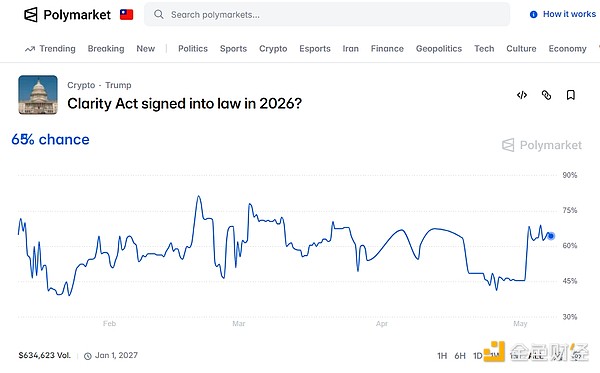
The statement said the compromise was reached after extensive consultation with the banking industry. Its core is to prohibit stablecoin yields from being designed in a form similar to bank deposit interest, to alleviate concerns about capital outflows from the banking system. It also allows crypto companies to offer other types of user incentives. The statement also disclosed "we respectfully agree to disagree," indicating that despite differences in stance, legislative progress may be nearing completion. Polymarket data shows that the probability of the CLARITY bill passing in 2026 is 65%.
I. Latest Developments in the CLARITY Bill
A compromise version of the CLARITY Bill has been released. At its core, the bill provides a balanced solution for stablecoins. Legislators have clearly drawn a line between prohibited banking-like activities and permitted cryptocurrency business models.
The updated bill, introduced by Senators Tom Tillis (Republican, North Carolina) and Angela Althorbrooks (Democrat, Maryland), allows cryptocurrency companies to offer stablecoin rewards and yields to users while strictly protecting traditional bank deposits from competition.
Under the new terms, issuers like Circle can integrate stablecoins into lending, payments, and decentralized finance protocols without entering the regulated banking sector. Bank interest-bearing accounts will retain their protected status. Specifically, this scheme prohibits deposit-type yields but allows behavioral rewards. Users are not allowed to earn interest simply by holding stablecoins, as this is similar to traditional bank deposits and would directly impact the traditional banking system. However, users can earn behavioral rewards by using stablecoins for payments, participating in transactions, and conducting on-chain settlements. Merkle3s Capital's article on X interprets this as follows: The logic behind the three exemptions—bona fide activities, market-making liquidity, and staking and margin yields—is simple: as long as there is economic activity as support, the yield is legal. Legislators haven't eliminated crypto yields, but merely require them to have a nominal "labor" consideration. Banks retain their interest rate advantage but face competition from those with legal licenses. The industry reacted swiftly and positively. Coinbase CEO Neil Armstrong stated on social media that the committee should "consider," meaning the Senate Banking Committee should vote on it. Boosted by this news, Circle's stock price surged, reaching $121.80 at the time of writing, a 27.82% increase over the past five days. Analysts have raised their target price for Circle, citing accelerated market acceptance of the technology and stricter future regulations. However, major U.S. banking groups are opposing the new stablecoin rules in the CLARITY Act, warning that the latest proposal is insufficient in protecting bank deposits. A joint statement from industry organizations, including the American Bankers Association and the Banking Policy Institute, said the wording in the bill regarding stablecoin yields leaves room for addressing the risks the legislation aims to tackle. “We appreciate the work of Senators Tillis and Olsbrooks… however, the proposed wording falls far short of this goal.” Banks believe that if stablecoins begin offering yields similar to savings accounts, customers may shift their deposits away from traditional banks. This, in turn, could impact credit activity across the economy. “Research shows that yield-based stablecoins could reduce all consumer loans, small business loans, and agricultural loans by one-fifth or more. Congress must do this well.” The banking groups plan to submit detailed recommendations to lawmakers “in the coming days” and will continue to work with Congress to balance innovation and financial stability. Coinbase Chief Policy Officer Fariar Hilzad, however, believes that most of the banking industry’s concerns are unfounded. "The final reward terms of the CLARITY Act are now available. Throughout this process, we have made it clear that this debate was largely based on imagined risks, not on real evidence or a genuine understanding of how cryptocurrencies actually work." This compromise protects "the ability of Americans to earn rewards based on actual use of crypto platforms and networks," which is crucial for U.S. national security and innovation.
II. What Industry Insiders Think
White House Digital Asset Advisor Patrick Witter: The White House's goal is to get Congress to pass the CLARITY Act by July 4th. "Our goal is July 4th. I think that would be a fantastic birthday gift for America, celebrating our 250th anniversary." According to Witter, the specific process is as follows: the Senate Banking Committee will review it this month, the Senate will have four working weeks in June for a full vote, and sufficient time will be allowed for the House of Representatives to vote before the Independence Day deadline.
U.S. Senator Kirsten Gillibrand stated that the CLARITY bill would not pass the Senate unless its ethics clause included a prohibition against senior government officials profiting personally from the cryptocurrency industry. "We cannot allow members of Congress, senior government officials, the president, or the vice president to exploit their connections to profit from these industries. This is the worst form of money laundering; this is the worst campaign finance violation; this is a violation of the Constitution." Coinbase Chief Legal Officer Paul Grewal stated, "I am very confident that we will see the CLARITY bill pass by this summer at the latest." He fully supports the Tillis-Alsobrooks stablecoin rewards compromise and sends a clear message to the banking industry: accept the agreement. "I strongly encourage those in the banking industry not to give up when victory is within reach. Accept reality and move on." Ripple CEO Brad Garlinghouse called the CLARITY bill "a giant leap forward." Chris Perkins, CEO of 250 Digital Asset Management, stated, “Even if the U.S. Congress ultimately fails to pass the CLARITY Act, the long-term development of the U.S. crypto industry will ‘not be a problem.’ SEC Chairman Paul Atkins and CFTC Chairman Michael Selig are continuously pushing for the construction of a crypto regulatory framework, bringing the industry the long-missed ‘certainty, stability, and classification system.’” Edul Patel, founder and CEO of Mudrex, stated, “The CLARITY Act marks a significant structural shift, marking a move from enforcement-oriented to design-driven regulatory models.” "With proper rules, the market will mature faster." III. A Review of the Development of the CLARITY Act In 2023, the House Financial Services Committee first proposed the "Digital Asset Market Structure Act," the core of which was to define the concept of "digital goods" and attempt to resolve the jurisdictional dispute between the SEC and CFTC. However, it failed to reach a vote due to opposition from the SEC and resistance from the Democrats. On May 29, 2025, House Financial Services Committee Chairman French Hill, along with members of both parties, submitted the "Digital Asset Market Clarity Act," the core of which was to distinguish between "digital goods" (regulated by the CFTC) and "digital asset securities" (regulated by the SEC), eliminating the long-standing ambiguity in digital asset regulation. On June 9, 2025, the "Blockchain Regulatory Certainty Act" was incorporated into the CLARITY Act. The bill strengthens regulatory rules related to blockchain. Several prominent blockchain and cryptocurrency organizations issued a joint statement welcoming the inclusion of the "Blockchain Regulatory Certainty Act" in the new CLARITY Act. The updated bill is based on FinCEN. The 2019 guidelines clarified that developers and infrastructure providers should not be regulated like money transferors when they do not control customer funds. On June 11, 2025, the House Financial Services Committee and the Agriculture Committee passed the bill, which proceeded to a full House vote. On June 23, 2025, the House Financial Services Committee and the Agriculture Committee submitted the bill, which defined digital goods as digital assets whose value is "intrinsically linked" to the use of blockchain. On July 17, 2025, the House passed the CLARITY Act with 294 votes in favor and 134 against, and sent it to the Senate for consideration. This bill became one of the important crypto regulatory bills in the United States. On January 12, 2026, Senate Banking Committee Chairman Tim Scott released a bipartisan revised text, strengthening the criminal liability of stablecoin issuers and detailing the "blockchain maturity" requirement. Verification process. On January 15, 2026, Coinbase publicly opposed the CLARITY Act. Brian Armstrong stated that after reviewing the Senate Banking Committee's draft cryptocurrency bill, Coinbase could not support the version of legislation. Key issues included: a de facto ban on tokenized stocks; restrictions on DeFi, granting the government unlimited access to personal financial records and weakening privacy rights; weakening the CFTC's authority, stifling innovation, and subordinating it to the SEC; and amendments that could stifle stablecoin reward mechanisms and allow banks to block competitors. Armstrong pointed out that the draft was "worse than maintaining the status quo," preferring no bill to a bad one, but he remained optimistic about reaching a more reasonable version through continued collaboration and emphasized that the crypto industry should receive the same regulatory treatment as traditional finance in the United States. On February 4, 2026, a closed-door meeting was held within the US Senate Democratic Party to restart discussions on the CLARITY Act and improve its support base within the Senate (market predictions indicated a rise in support). According to a Democratic staffer, the atmosphere of the meeting was... "Positive developments," this meeting was described as "arguably the most productive Democratic meeting to date." Senate Majority Leader Schumer attended and addressed the meeting, emphasizing the importance of industry participation and urging all parties to maintain momentum and push for the relevant legislation. Although senators still raised specific demands, the core message of this meeting was that this legislative work, which was considered on the verge of being shelved just weeks ago, is far from over. In March 2026, Senators Thom Tillis and Angela Alsobrooks pushed for the formation of a compromise. Specific provisions included: prohibiting the simple holding of stablecoins to earn interest; and allowing rewards based on payments, transactions, and consumption. This proposal was seen as an important balancing act between the banking and crypto industries. Coinbase subsequently reiterated its support. From April to May 2026, the CLARITY bill continued to advance in the Senate. Numerous crypto companies and industry organizations, including Circle, Coinbase, Ripple, and Kraken, continued to lobby Congress, hoping to complete the legislation as soon as possible. The market generally believes that CLARITY... The bill will determine the future regulatory framework for cryptocurrencies in the United States. On May 2, 2026, the U.S. Senate released a compromise text of the CLARITY Act, prohibiting the use of stablecoin yields in reserves while retaining activity-based rewards. This cleared the way for months of negotiations between cryptocurrency companies and bank lobbyists before its submission to the Banking Committee for consideration.


 Weatherly


