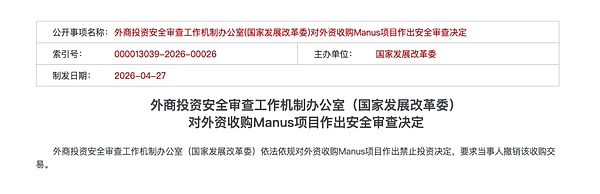
On April 27, 2026, the Office of the Foreign Investment Security Review Mechanism (National Development and Reform Commission) issued a decision prohibiting foreign investment in the Manus project, requiring the parties involved to withdraw the acquisition. These few dozen words effectively ended the deal, which was valued at over $2 billion. Manus's years of product development, legal framework construction, financing, and exit strategies all collapsed and went down the drain. This is the first publicly halted foreign acquisition in the AI field since the "Measures for Foreign Investment Security Review" came into effect in January 2021. This transaction has a unique aspect: both parties are legally offshore: Meta is a US company, and Manus has completed its relocation to Singapore and established a holding structure in the Cayman Islands. However, Chinese regulators ultimately decided to prohibit the investment. The spillover effects of this case, along with AI companies like Moonlight, ByteDance, and Leapfrog, are facing clearer compliance guidance. Behind this lies a deeper issue: traditional offshore structure practices are becoming completely ineffective. Entrepreneurs need to clearly define their compliance path from Day 0. This article doesn't tell stories, it delivers practical information - what laws and regulations govern this; where is the red line drawn for "bathing-style" overseas expansion; and how companies should choose their strategies starting today.
According to laws and regulationsLooking back at the Manus case, the initial discussions within the industry mostly focused on "what happened" - migration, separation, and injunction. But as the details of the case gradually surfaced, the legal community's focus returned to a more fundamental question: On what grounds could regulators halt this transaction? What law? What regulation?
The answer is not in any single law, but rather a three-tiered, progressive regulatory logic. These three layers work together to ultimately form an inescapable review logic.
The answer is not in any single law, but rather in a three-tiered, progressive regulatory logic. These three layers combine to form an unavoidable review logic.
Reviewing the Manus case, the initial discussions within the industry mostly focused on "what happened" - migration, separation, and injunction. But as the details of the case gradually surfaced, the legal community's focus returned to a more fundamental question: On what grounds could regulators halt this transaction? What law? What regulation?
The answer is not in any single law, but in a three-tiered, progressive regulatory logic. These three layers work together to form an unavoidable review logic.
The answer is not in any single law, but rather in a three-tiered, progressive regulatory logic.
First layer: Identifying "Chinese entities" - the underlying basis for penetrating review
This is the legal starting point of the entire case: What kind of company is Manus?
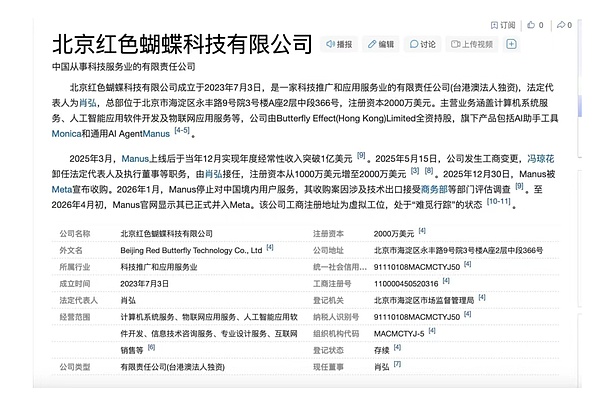
From a legal perspective, the answer seems clear - Manus has completed its relocation to Singapore, its holding structure is located in the Cayman Islands, and its parent company, Butterfly Effect Pte, is a genuine Singaporean entity.
From a legal perspective, the answer seems clear - Manus has completed its relocation to Singapore, its holding structure is located in the Cayman Islands, and its parent company, Butterfly Effect Pte, is a genuine Singaporean entity.
This is also the core legal argument of the Manus team throughout the entire transaction: "Our main structure has been converted to an offshore structure." However, the regulator's response was: Form doesn't matter; substance matters. Jingtian & Gongcheng Law Firm systematically analyzed from a legal perspective why the "offshore legal shell" failed in the Manus case. The root cause lies in the fact that core AI assets have an unbreakable and substantial connection with Chinese legal jurisdiction in four dimensions: Team Dimension: The engineering team that masters the underlying core logic has accumulated R&D experience domestically for a long time, and its technical capabilities were trained and developed within China; Computing Power Dimension: Domestic R&D has created a path dependency in technical interfaces and computing power scheduling, and the core system's architectural genes are marked with a Chinese label; Algorithm Dimension: The core model weights were developed and trained within China, representing the most legally significant "technological source." Data Dimension: The training data accumulated from Human Feedback Reinforcement Learning (RLHF) based on massive user interactions is highly concentrated within China. These four dimensions point to the same conclusion: Manus's legal form is Singaporean, but Manus's "technological substance" as a company—its source, core, and foundation—is entirely within China. Based on the principle of "substance over form," from a regulatory perspective, this substantive connection is sufficient to constitute the basis for penetrating scrutiny—the first cornerstone of all subsequent legal actions. So, although Xiao Hong founded Butterfly Effect Technology in Beijing in 2022, established a "Cayman Islands-Hong Kong-Beijing" red-chip structure in 2023, and relocated the company to Singapore in 2025, completing the team separation and business isolation, the law does not consider "when the relocation occurred," but rather "where it originated." Any technology assets originating in China do not change their nationality due to a mere registration change.
Second Layer: Export Restrictions and Regulatory Avoidance - The Legal Characterization of "Bath-Style" Overseas Expansion
Once the first layer is established: Manus is essentially recognized as a "domestic enterprise," the legal logic of the second layer follows: transferring core assets overseas is itself an export activity. Export activities are subject to export control regulations.
Once the first layer is established: Manus is deemed to be a "domestic enterprise," the legal logic of the second layer immediately follows: transferring core assets overseas is itself an export activity. Export activities are subject to export control regulations.
Manus's three-step approach, in the eyes of regulators, forms a complete puzzle of "export control circumvention": Step 1: Relocation of the main entity. The company moved its main entity from China to Singapore, establishing an offshore entity, Butterfly Effect Pte, and setting up a Cayman Islands holding structure. Legally, this completed the first step of "de-Sinicization." Step 2: Relocation of the team and assets. Nearly two-thirds of its employees in China were laid off in a swift move (80 out of 120), with only about 40 core technical personnel remaining, who were relocated to Singapore. The third step is to separate data from business operations. This involves clearing domestic social media accounts, blocking access from Chinese IP addresses, and terminating cooperation with local partners such as Alibaba's Tongyi Qianwen. Legally, the export of core technical personnel's technical knowledge, R&D capabilities, and algorithmic experience constitutes "technology export" under the "Catalogue of Technologies Prohibited and Restricted from Export." Furthermore, according to the "Data Security Law" and the "Measures for Security Assessment of Data Export," the large amount of user interaction data trained before the separation was highly concentrated in China – the data's origin was already written into the model, making the separation process untraceable and impossible to delete. Therefore, the logic of regulatory penetration can be summarized in a cold, hard statement: The code is written on Chinese soil, the data resides with Chinese users – this is "Chinese assets," and transferring them is exporting them; exports are subject to regulation. The essence of "shower-style overseas expansion" is using formal compliance to conceal substantive violations; this is a systematic circumvention of export control regulations. The third layer: Proactive reporting mechanism - You can't say "I don't know". If the first two layers are "substantive violations", the third layer is a "procedural violation" - and it's the easiest to be convicted of. Article 4 of the "Measures for the Security Review of Foreign Investment" clearly stipulates that for foreign investments involving important information technology, key technologies, and other fields, the parties involved "shall proactively report to the working mechanism office before implementing the investment." This is a mandatory prior reporting obligation, not a "recommendation" or a "supplementary report after an incident". Throughout the entire transaction process, until the completion of the settlement, Manus and Meta never made any voluntary declarations to Chinese regulatory authorities. During the months-long settlement period, Manus and its investors seemed to have reached a dangerous tacit agreement: they wouldn't proactively open the window unless the regulators knocked. In legal practice, "failure to report when required" is itself a serious violation. It sends the signal that either the violation was knowingly committed or intentionally evaded regulations. In either case, regulators will not let it go unpunished. A compliance lawyer summarized the situation after the Manus case: "The biggest compliance flaw exposed by the Manus case wasn't the controversial applicability of a particular regulation, but rather that the company completely abandoned its reporting obligations to Chinese regulators. In the legal system, evading procedures is more intolerable to regulators than substantive violations." Looking back, Manus's fate was actually predetermined at the first level: once a thorough review determined that you were a "de facto Chinese entity," the second level of export control logic and the third level of reporting obligations automatically unlocked. These three layers of legal principles are progressive and interconnected, forming a logical closed loop. Within this loop, no link allows for any room for "luck." Why the National Development and Reform Commission (NDRC)? The Ministry of Commerce acted first. On January 8, 2026, a spokesperson for the Ministry of Commerce publicly stated that it would conduct an assessment and investigation into the acquisition's consistency with relevant laws and regulations concerning export controls, technology import and export, and foreign investment. However, on April 27, it was the NDRC that made the final decision. There's more to this departmental switch than meets the eye. Some experts believe that the Ministry of Commerce is basing its decisions on the "Catalogue of Technologies Prohibited and Restricted from Export," which provides very specific descriptions of controlled technologies: artificial intelligence interactive interface technology specifically designed for Chinese and minority languages. However, after its restructuring, Manus has switched all its services to English, excluding Chinese users. This means that simply following the export control route might lead to some controversy. This is the space for debate regarding the applicability of regulations. But we tend to believe in a deeper meaning, since the applicability of law is less important than political considerations in terms of prioritization. The National Development and Reform Commission (NDRC) manages "security reviews," while the Ministry of Commerce manages "technology import and export." The NDRC's involvement signifies that this matter has shifted from a "business" issue to a matter of "sovereignty." In other words, the National Development and Reform Commission (NDRC), as a macro-level department with more comprehensive economic management power than the Ministry of Commerce, sends a clear signal through its intervention – this is not an accidental enforcement action targeting a particular company, but a systemic deterrent aimed at preventing future repercussions. Killing one is to warn a hundred. All those practitioners who were still observing now see where the red line is drawn – not in the ambiguity of a specific clause, but on the indisputable ultimate standard of safeguarding national security. Based on the Manus case and the "penetrating review" principle established in the "Measures for the Security Review of Foreign Investment," the following four red lines are clear. If any of these lines are crossed, the "shower-style" overseas expansion strategy is no longer viable. Red Line 1: Founder Holds Chinese Passport and Has Not Revoked Chinese Citizenship Manus founder Xiao Hong is a Chinese citizen. China's export control law covers natural persons. This means the founder himself may also become a target of regulatory scrutiny, and related arrangements cannot be understood solely at the company level. A more severe reality lies across the Pacific: In North American VC geopolitical risk assessments, the financing environment for Chinese founders is also tightening. Under geopolitical pressure, leading Silicon Valley venture capital firms like a16z have drastically reduced their investment interest in founders holding Chinese passports. Manus's Series B funding round was led by Benchmark, but Benchmark subsequently faced strong backlash from the US political establishment, with several Republican senators calling the deal "aiding the Chinese government." Investors at Silicon Valley's Founders Fund were blunt: "The founder is Chinese, the company is in Beijing, and the core technology is a general-purpose AI agent – that's the 'original sin.'" Both sides are closing in. If you have a Chinese passport, American capital is uneasy; if you have Chinese technology, Chinese regulators won't let go. This gap is much narrower than most people imagine. Red Line Two: Receiving Money from State-Owned Assets
Red Line Two: Receiving Money from State-Owned Assets
It's not only "direct investment by state-owned funds" that counts as state-owned assets. Government-guided funds at all levels, state-owned components in RMB fund LPs, and policy bank loans—these all fall within the scope of "state-owned asset infusion." And those small, seemingly insignificant subsidies like office space, computing power, and talent allowances—complained about during the application process—will all be noted down when it comes to accountability.
Red Line Three: The First Line of Code Was Written in China The initial location where the core code was written, the location where the algorithm model was trained, and the storage location of the technical documentation—these seemingly "purely technical" facts all constitute legal proof of the "source of technology." Manus's early development was completed in China, and when the team moved to Singapore, the code they took with them already constituted a technology export. Manus never made any technology export declaration for this transfer. Red Line Four: Use of Chinese Data This is a common illusion among many AI entrepreneurs: they believe that as long as they clear out domestic users and block Chinese IPs later, their company will be clean. However, in the eyes of regulators, 'technical substance' is not only about code, but also about data fundamentals. The Data Security Law and the Measures for Security Assessment of Cross-border Data Transfer have clear review requirements for cross-border transfers involving "important data". Although Manus shut down its Chinese service and blocked Chinese IPs, the user interaction data accumulated in its early stages had already completed the core training of its model – the data's DNA was etched into the model's weights and could not be recovered or deleted through "post-processing." Since the data originated from Chinese users, the model carries a Chinese label. Entrepreneurs in Specific Industries: Choose Sides, Start Now
The "Security Review Measures" establish a security review mechanism for foreign investment that may affect national security, focusing on defense security fields such as the military industry, as well as important areas where foreign capital gains actual control, such as important information technology, key technologies, major infrastructure, and important resources.
According to laws and regulations was a principle in the past, and it will be an ironclad rule from now on.
Today's focus is not on convicting anyone, but on recognizing a trend: the gray areas that used to be exploited by changing the place of registration, structure, and entity are being continuously compressed. For founders, going global is no longer a game of "circumventing regulations first, then fulfilling compliance later," but rather a game where they need to figure out their entity, funding, technology, data, and application path from Day 0.
We hope that every founding team seeking a way out in the cracks of this era, whether you choose to go all out on the US-funded track or cultivate the domestic system in depth, can understand the rules, gain a foothold, and go further.
We hope that every founding team seeking a way out in the cracks of this era, whether you choose to go all out on the US-funded track or choose to cultivate the domestic system in depth, can understand the rules, gain a foothold, and go further.


 Anais
Anais