Ethereum-Based Altcoin Soars 1,000% as Crypto Whales Dive In
Ethereum-based altcoin Tellor has taken the spotlight with a remarkable surge, soaring over 1,000% in just three months and reaching an impressive $131.
 Jasper

Author: Santiago Roel Santos; Translator: Tim, PANews
Crypto adoption will continue, but market prices may not recover for a long time.
This contradiction between the accelerating adoption and the lagging market prices is not a flaw, but a necessary characteristic of the current stage of crypto market evolution.
If you look at the crypto market from a ten-year perspective, its prospects are very attractive. However, maintaining this long-term perspective is psychologically challenging. You should be prepared to watch adoption rates expand while prices stagnate or slowly decline; you should also be prepared to witness others profiting in other areas (artificial intelligence, stocks, or the next hot trend) while the crypto space seems to be forgotten.
It will feel very unfair, and the process will be agonizing.
However, price lag is inevitable. Fundamentally, many crypto assets shouldn't have enjoyed their previous valuations. The market doesn't care about actual adoption until prices crash and then it does. Adoption proliferation breeds bubbles. Early adoption can actually create bubbles. This is the growing pain of value discovery; when real demand can't support inflated valuations, the market will recalibrate, which is essential for long-term healthy development. When crypto infrastructure achieves large-scale adoption, it becomes clear that external investment far exceeds actual demand. Adoption proliferation will be a stress test of business models, not a validation of value. Some projects will perish in obscurity, while others will survive, but their valuations will be far below the vision painted at their peak. Cryptocurrencies are gradually fading from the spotlight, becoming less prominent. They're going from exciting to mundane, but this is a necessary step in the process of maturing from hype. This is a good thing. This isn't the first time this has happened. During the dot-com bubble burst, the Nasdaq plummeted by about 78%, while the number of internet users tripled and broadband infrastructure was deployed across the board. It took the market years to recover, but now the internet has quietly reshaped the world, and while investors are still licking their wounds, software has already "swallowed" the world.
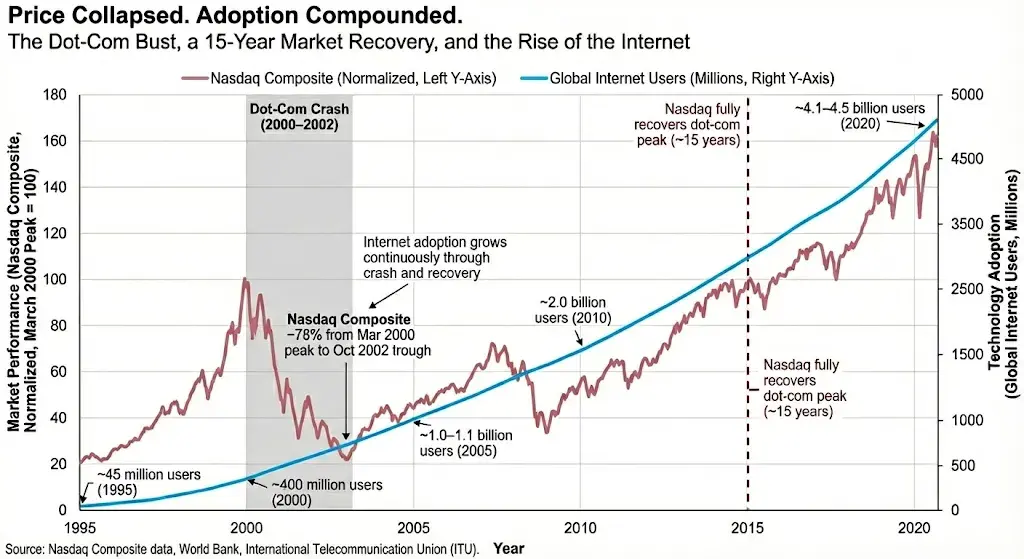
Infrastructure technology will not reward short-sighted investors.
The shift in market phases will make many participants uncomfortable. Those builders who have poured years of effort into maintaining open-source codebases will witness other companies copying their achievements and reaping most of the economic benefits; native crypto venture capital firms that invested in infrastructure early on will see traditional venture capital firms gain more value; retail investors who buy tokens instead of equity may feel marginalized, as companies benefit from the ecosystem network but do not return the corresponding value to token holders.
I'm not particularly optimistic about price action over the next few years. Adoption will continue to rise, but prices could fall further, potentially exacerbated by broader stock mean reversion and a cooling AI hype cycle. However, patience is a major advantage. I am bullish on the Encryption-as-a-Service model. I am bullish on companies empowered by encryption. I am bearish on over-financialization. I am bearish on failed unit economics. I am bearish on over-construction of infrastructure. Protecting principal has become crucial. Cash is undervalued: not for its returns, but for the psychological immunity it provides. It allows you to act decisively when others cannot. The market has entered a fast-paced and increasingly impatient era. Today, having a longer time horizon than most participants is a substantial advantage. Professional managers must frequently rebalance their portfolios to prove their worth. Faced with increasing life pressures, retail investors are increasingly chasing short-term trends. Institutional investors, too, will inevitably declare cryptocurrency dead once again. Gradually, more traditional companies will adopt crypto technology, and more balance sheets will be connected to the blockchain. One day, when we look back on this period, everything will seem so clear. The signals are everywhere, but unwavering conviction often seems effortless only after prices have risen. Until then: wait for the pain to arrive. Wait for sellers to cut their losses, wait for faith to crumble, but we haven't reached that stage yet. Don't rush into action; the market will continue to fluctuate, life goes on, spend more time with those you care about. Don't let your portfolio become your entire life. The crypto world will operate silently, whether the market is in the shadows or in the bright light. Good luck to everyone.Ethereum-based altcoin Tellor has taken the spotlight with a remarkable surge, soaring over 1,000% in just three months and reaching an impressive $131.
JasperThe inaugural STO, led by Grinnodot, the parent company of Sunnyfounder, introduces the loosely translated "Sunshine Green Benefit Debt STO."
 Davin
DavinMuesliSwap, the Cardano-based decentralized exchange, faces growing discontent among users over prolonged delays in launching the refund claim site.
 Aaron
AaronBitdeer Technologies Group, a Singapore-based crypto mining platform, has marked a significant milestone by becoming the preferred cloud service provider (CSP) in the Nvidia partner network. This strategic move places Bitdeer at the forefront of AI development in Asia, providing customers access to the cutting-edge NVIDIA DGX SuperPOD with DGX H100 systems through its upcoming Bitdeer AI Cloud.
 Joy
JoyMicrosoft briefly restricted ChatGPT access due to a security glitch, swiftly rectifying the incident and highlighting the complex AI landscape and global efforts to address evolving risks.
 Hui Xin
Moisés Zamora, the creative force behind Netflix's "Selena: The Series," is steering away from the conventional avenues of Hollywood, embracing a groundbreaking move into the world of NFTs.
JasperAsset management giant BlackRock is set to venture into the Ethereum landscape with plans for an exchange-traded fund (ETF) focused on the cryptocurrency.
JasperIn a legal win, the head of Upbit's operator, Dunamu, was declared not guilty by South Korea's Supreme Court in a case involving alleged data manipulation. The charges, related to fake accounts and order volume manipulation, were unanimously dismissed by all three courts, citing "illegal methods" used by prosecutors to obtain evidence. Upbit's success in dominating 80% of South Korea's crypto market is attributed to strategic partnerships, including one with neobank K Bank, streamlining account openings in adherence to regulations.
 Jixu
JixuSC Ventures and SBI Holdings form a $100 million crypto investment initiative, signalling their active involvement in decentralised finance, tokenisation, and the metaverse.
Hui XinJudge Martin Glenn, of the Southern District of New York Bankruptcy Court, has given the nod to Celsius Network's reorganization plan
Aaron