Author: Zheng Jie Source: artemis Translation: Shan Ouba, Jinse Finance
Summary
In short, an entire generation has calculated the returns of passive investing and found that they are far from sufficient. Financial anxiety will replace greed as the core driving force of trading.
The interval between forming market judgments and executing trades is approaching zero.
AI will narrow the information gap between retail investors and institutions, but the returns of ordinary active traders will continue to underperform the market.
AI will narrow the information gap between retail investors and institutions, but the returns of ordinary active traders will continue to underperform the market.
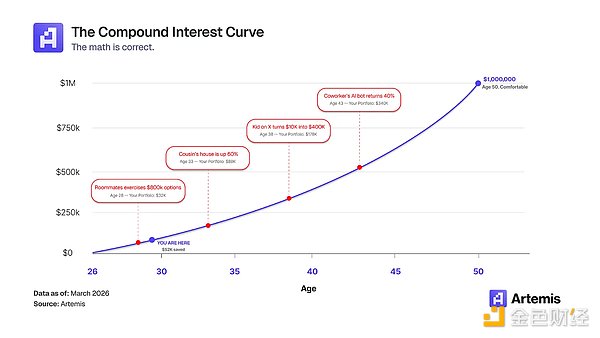
Winners: Robinhood, Coinbase, IBKR Losers: Traditional brokerages selling patience to a speed-driven generation I. The math is clear to everyone Saving $1200 per month, with an 8% annual return, for 24 years. This is the standard answer for someone starting from scratch at age 26 to earn $1 million—by then you'll be 50. You earn $90,000 a year, but after taxes, New York rent, and student loans, you can only actually save $1200 per month. Investing in index funds with an annualized return of 8%: Approximately $220,000 in 10 years; approximately $710,000 in 20 years. Even with a smooth and uneventful investment, one might only reach a million dollars by age 50. This is the baseline scenario assuming everything is done correctly.
Then you open your phone: your college roommate cashed out $800,000 in startup stock options; your cousin's house bought in 2019 appreciated by 60%; a 24-year-old stranger turned $10,000 of meme coins into $400,000 in just a few weeks. You know these are extreme cases, most people won't post about their losses, but it doesn't matter, you still feel like you're being left far behind.
So, you start trading.
II. Data Doesn't Lie
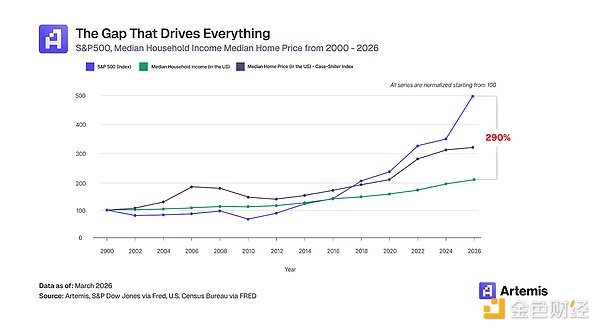
Since 2000:
S&P 500 return approximately 400%
Home prices have risen approximately 230%
Median US wages have only increased by approximately 110%
IV. Industry Landscape
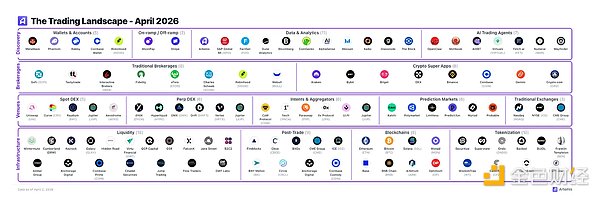
The seemingly crowded trading market can actually be clearly divided into four layers:
Discovery Layer: Wallets, deposit channels, data products, and AI tools. Users view prices, receive alerts, deposit funds, and form trading intentions here. Brokerages do not control this layer—you already know what you want to do before you open Robinhood.
Brokerage Layer: Brokerages and Crypto Super Apps.
Brokerage Layer: Brokerages and Crypto Super Apps.
Brokerage Layer: Brokerages and Crypto Super Apps.
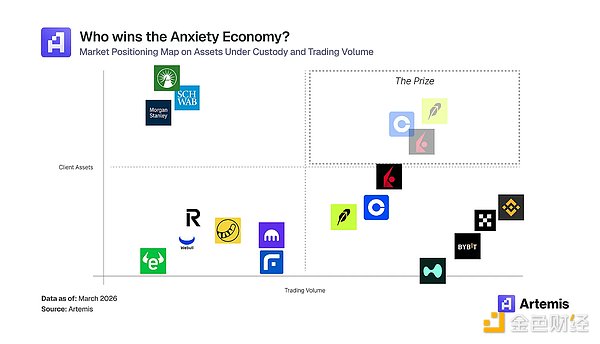
Intent translates into action here: click to buy, set up a position, confirm the order. The platform strives to control user funds and transactions; the more funds, the harder it is for users to leave. Trading Venue Layer: Exchanges, perpetual contract platforms, aggregators, prediction markets, tokenized exchanges. Transactions are truly settled here. Globalized assets and 24/7 trading will allow this layer to capture more traffic. Infrastructure Layer: Liquidity, clearing systems, blockchain, tokenized infrastructure. Furthest from users, unconcerned with app wars, only profiting from trading volume. The biggest winners will be: the apps users first open, the platforms that manage funds, and the venues for executing trades. V. Value Flow The ultimate winners will be those companies that enable users to most easily translate this feeling into action.
Winner
1. Robinhood is the most obvious winner. From day one, it has served those who "feel behind": zero commission, fractional shares, and a simple interface. Now, it adds prediction markets, gold cards, cryptocurrencies, and retirement accounts, boasting the fastest product iteration speed in fintech. In Q1 2026, it launched the AI assistant Cortex, acquired a CFTC-licensed exchange, and reached 3.9 million gold card users, a year-on-year increase of 77%. Its success lies in understanding: trading volume growth is driven by anxiety. 2. Coinbase's perfect synergy between consumer finance and its 24/7 native marketplace. Controlling crypto deposits and underlying infrastructure, USDC becomes the default savings and settlement tool, and the Base chain achieves profitability. Revenue has shifted from fluctuating transaction fees to subscriptions, stablecoin interest, and infrastructure services. Stablecoin revenue reached $332 million in a single quarter, and USDC's market capitalization reached a record high of $76 billion. Even if users stop trading, their funds remain within the system. 3. Interactive Brokers (IBKR) covers over 170 markets in 40 countries, adding over 1 million new accounts in 2025, bringing the total to 4.4 million accounts and $780 billion in client assets. It supports stablecoin deposits, launched a Visa co-branded card, and redesigned its app to incorporate AI market insights. If a company can maintain its professional depth while achieving Robinhood-like simplicity, it will reap the rewards from high-intent users in the anxiety economy. 4. ICE (NYSE's parent company) collects "tolls." The more tradable instruments, the longer the trading period, and the wider the scope of the market, the more commission it takes. In 2025, it achieved record trading volume, with ADV increasing by 14% year-on-year and revenue reaching $9.9 billion. 5. Hyperliquid: A dark horse in the pure trading venue sector. When traditional markets are closed, it becomes the pricing center for assets such as oil. WTI-related contracts see daily trading volume exceeding $2 billion, a more than 100-fold increase in six months. The 24/7 trading venue offers a structural advantage. Traditional brokerages will be the losers. Companies that don't innovate will ultimately be eliminated. If they continue to sell security and long-term planning to a generation driven by speed and hope, they might retain the assets of baby boomers, but they won't win over the next 100 million traders (Generation Z and Alpha). On watch list: Webull has built a powerful product for active traders—offering realistic charting capabilities, longer trading hours, and a convenient mobile experience. However, its risk lies in its mediocre feature positioning: too complex for beginners, and not deep enough for professionals. eToro—one of the earliest platforms to socialize trading. Copy trading, community dynamics, and the ability to follow the ideas of people who know more than you—in today's anxious economic environment, this intuition that "those who understand the market are more favored" only grows stronger. SoFi remains one of the best examples of integrating financial services (banking, lending, credit, and investment) into a single consumer brand. My concern is its market positioning. When people think of SoFi, do they think of "trading" or "student loan refinancing"? Their product range is extensive, but lacks depth. Every company on the list grows with increasing trading volume. Now you should understand why.
VI. The “False Advantage” Brought by AI
AI will reshape trading technologically, but its greater impact lies on the psychological level.
Imagine this: Before the market opens, an AI briefing summarizes your portfolio, identifies key catalysts, and explains the potential impact of the Consumer Price Index, tariffs, or earnings on your holdings. By the time you've finished your coffee, you already have a clear investment strategy. You feel like you have something in your grasp.
Preview
Gain a broader understanding of the crypto industry through informative reports, and engage in in-depth discussions with other like-minded authors and readers. You are welcome to join us in our growing Coinlive community:https://t.me/CoinliveSG



 Kikyo
Kikyo


