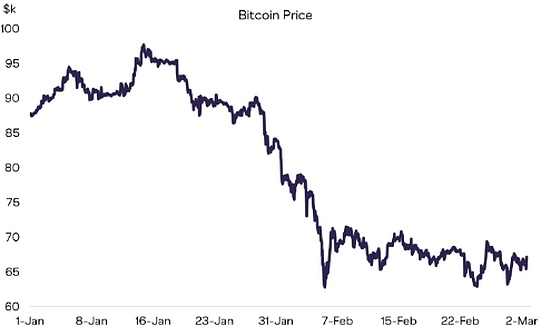
Blockchain and AI are complementary, the industry fundamentals remain positive, and the macro environment also provides support. The progress of the US Senate's Clarity Act remains an uncertainty. In early February, the crypto market fell along with high-growth software stocks and other early-stage US tech stocks. Innovation in the field of artificial intelligence appears to be accelerating, putting pressure on some business-related assets facing potential disruption. For example, at the end of January, Anthropic launched a plugin for its Claude Cowork tool, applicable to professional business service scenarios such as human resources, compliance, and legal. Blockchain is not a competitor to AI—we believe the two technologies are complementary, as will be explained below—but the risk-averse behavior of growth portfolios is likely to spill over into crypto assets (see Figure 1). Figure 1: Bitcoin Price Stabilizes After Early February Decline. [Image: https://img.jinse.com.cn/7437451_watermarknone.png] In late February, the market stabilized in terms of price performance, trading volume, and other indicators. For example, the market capitalization-weighted FTSE/Grayscale Crypto Sector Index fell 26% between January 30 and February 5, then rebounded by about 4% by the end of the month. Spot trading volume and implied volatility in options surged during the decline before falling back at the end of the month (see Figure 2), and open interest in perpetual contracts also stabilized. Figure 2: Bitcoin trading volume surges during market downturns. [Image of image: https://img.jinse.com.cn/7437452_watermarknone.png] Reasons for increasing holdings: Bitcoin and other crypto assets have experienced significant pullbacks, and short-term uncertainty remains high. However, we believe that for long-term investors, this is a good time to consider allocating capital. Our relatively optimistic core reasons are threefold: 1. Blockchain and AI are complementary. Large language models and public blockchain technology are not in competition: Blockchain aims to replace trusted financial intermediaries with cryptography and economic incentive systems. In fact, blockchain has specific advantages over the traditional banking system and is expected to become the underlying financial infrastructure for AI agents—Citrini Research's popular report has already discussed the potential disruption brought by AI. In this round of adjustments, crypto assets fell along with software stocks, but investors may more carefully distinguish between technologies that compete with and complement AI in the future. 2. The major trends of stablecoins and asset tokenization remain unchanged. Increased regulatory clarity (including the passage of the Genius Act last year) is driving institutional funds into stablecoins and tokenized assets—the two core application scenarios of public blockchains. In February, news emerged that Meta, after shelving its Libra/Diem project due to regulatory pressure, might be repositioning itself for stablecoins; Stripe stated in its annual open letter, "Stablecoin payments are quietly and irreversibly evolving as real-world adoption continues to accelerate." Furthermore, BlackRock announced the integration of its tokenized money market fund, BUIDL, with UniswapX.
3. Macroeconomic Environment Favorable for Risk Assets
The US economy has a solid fundamental foundation, with some high-frequency indicators showing accelerating growth. Overinvestment in AI poses a medium-term risk, but the pace of innovation remains rapid, and there is still a capacity gap in data centers. The market reacted negatively to Kevin Warsh's nomination to succeed Jerome Powell as Federal Reserve Chairman, but we believe his actual policy stance is unlikely to be as hawkish as some of his views during his tenure as a Federal Reserve Governor from 2006 to 2011.
The fate of the US Senate's Clarity Act is a key variable for the short-term market outlook.
In January, the Senate Banking Committee delayed the scheduled markup process for the bill, causing a major setback for the legislation. Subsequently, the White House held three meetings with the crypto and banking industries. According to media reports, the third meeting on February 19th had a smaller scope and more focused discussion, and produced a concrete draft text on the thorny issue of stablecoin yields. The Clarity Act provides a traditional financial regulatory framework for many areas of the digital asset industry, and we believe its passage is likely to drive institutional funds into this asset class. Meanwhile, regulatory clarity is progressing on multiple fronts, not just with a single bill. Even without the Clarity Act, the industry can continue to develop with more rules being established by regulators. However, in our view, the best-case scenario is still the passage of this bipartisan bill, formally enshrining digital asset regulation in written law. AI and 3P From the perspective of crypto industry sectors, the best-performing sub-sector in February was AI-related, with a smaller pullback than other sectors (see Figure 3). The excess returns primarily stemmed from a renewed market enthusiasm for AI agents (independent software capable of autonomously performing complex goals on behalf of users). Technological innovation in agent-based systems continued to accelerate, particularly with the locally deployed productivity assistant OpenClaw, which became one of the fastest-growing open-source projects in history. Leading projects within the AI crypto sector included Kite AI, a blockchain built for native agent stablecoin payments, and Pippin AI, which provides infrastructure for on-chain AI agents. Figure 3: AI and Crypto Sector Leads Performance in February. [Image of image: https://img.jinse.com.cn/7437453_watermarknone.png] Within the entire digital asset ecosystem, there have been numerous advancements in the "3P areas" of privacy, perpetual futures, and prediction markets. For example, Near, also within the AI and crypto sector, announced several initiatives combining AI and privacy, including introducing confidential transactions for its popular intents feature and providing support for AI agents with built-in privacy and encryption guarantees. Furthermore, the perpetual futures exchange Hyperliquid continues to expand beyond native crypto assets (HIP-3 perpetual futures). On January 30th, Hyperliquid's silver futures trading volume accounted for approximately 2% of CME COMEX silver futures, indicating that this market is large enough to warrant attention alongside traditional exchanges, especially during non-traditional trading hours. In addition to commodities, Hyperliquid has launched global stock futures. If liquidity continues to accumulate, its contracts may gradually become a venue for 24/7 trading and hedging of some global macro assets. During the Super Bowl on February 8th, prediction market platforms Polymarket and Kalshi saw another surge in trading volume (see Figure 4). More notably, trading volume remained high in the weeks that followed. These platforms have integrated into the news and information ecosystem, maintaining sustained activity beyond major events. Last month, Polymarket filed a trademark application for its POLY token, and its Chief Marketing Officer had previously hinted at an upcoming token launch. Meanwhile, the Federal Reserve released an analysis report affirming the value of prediction markets in predicting economic variables such as CPI inflation. Despite progress, these platforms still face regulatory questions: In February, the U.S. Commodity Futures Trading Commission (CFTC) reaffirmed its federal-only regulatory authority and intervened in litigation against states regulating them as unlicensed gambling. Figure 4: Prediction market trading volume remains high after the Super Bowl. After a significant correction since last October, the crypto market is showing signs of stabilization. Stablecoins and tokenized assets are expected to continue driving industry adoption, while innovations in areas such as AI, privacy, perpetual contracts, and prediction markets are progressing steadily. If the fundamental trend remains positive, crypto asset valuations will eventually recover.

 Catherine

