CoinFLEX CEO Mark Lamb Sued By Exchange's Creditors Over OPNX
Aside from Mark Lamb, the case also names Roger Ver as a defendant.
 Clement

Author: Thejaswini MA Translator: Shan Ouba, Jinse Finance
Value creation and value monetization are two different things. Value creation is making products that the market truly needs; value monetization is retaining your own profit from the fees paid by users.
Most of the time, people assume that the two happen simultaneously: creating valuable products, charging users, and retaining a portion of the revenue—this is the conventional business logic.
But few people discuss that many historically significant giant companies focused entirely on creating value in their early stages of growth, deliberately forgoing value monetization. They offered products for free or even nearly free, and their ultimate profitability relied on only one core assumption: that scale and user distribution advantages would one day translate into pricing power. Some companies eventually succeeded.
Amazon Web Services (AWS) operated at near-zero profit for many years until Amazon realized that once enterprises deeply committed to cloud infrastructure, they would never easily migrate or replace it. Stripe, after processing hundreds of billions of dollars in payment transactions, only achieved a healthy profit margin by leveraging its solid industry position and new products. Now, we return to the industry issue of zero-profit retention. Ethena has generated $256 million in fees to date, yet it retains almost no profit. The root cause lies in the infrastructure bundling trap: once enough institutions have built their businesses on your protocol, charging fees prematurely will trigger market resistance. Ethena is not voluntarily offering concessions. This article continues last week's analysis of Morpho—as an underlying protocol. When can scale advantages translate into pricing power? When will the model of free value transfer end, and when will value monetization begin? Companies that can play this model well have clear answers; while those without a clear path will fall into a unique development dilemma. Ethena is currently in this situation. It has created the world's third-largest stablecoin. In the past 16 months, it has generated $470 million in transaction fees, retaining only $13.8 million, a profit retention rate of only 2.93%. For every $100 in revenue generated by the protocol, it retains only $3, with the remainder distributed to sUSDe holders as returns according to the product design mechanism. Ethena's predicament differs from Morpho's; the underlying issues are entirely different. We will break down the logic in detail below. Let's start with Ethena's product mechanism: USDe is a synthetic US dollar stablecoin without bank reserve backing. For every $1 USDe minted, Ethena deposits crypto assets as collateral and opens an equivalent short position in the perpetual contract market. This combination of spot long positions and perpetual short positions ensures that the overall net position is almost unaffected by Bitcoin price fluctuations. Revenue comes from three sources: funding rates paid by long traders in the perpetual contract market to short traders, Ethereum staking rewards on the collateralized assets, and interest generated from idle stablecoin reserves. All of these revenues flow to sUSDe holders who stake USDe in exchange for protocol rewards. Ethena only allocates a very small portion to the reserve fund and charges a small minting and redemption fee; the rest is distributed. In 2024, the annualized funding rate for perpetual contracts remained high, ranging from 8% to 11%. At that time, the protocol was still in its early stages, the market was generally bullish, and long positions in perpetual contracts were willing to pay high funding rates to maintain leveraged positions. For sUSDe holders, this was an excellent investment opportunity, with an annualized return of up to 18%. In just ten months, USDe's circulating supply surged from zero to $6 billion. In August 2025, Ethena's total monthly fee revenue reached $54.7 million, with $4.08 million retained, setting a new peak for protocol revenue. At that time, everything seemed to be running perfectly.
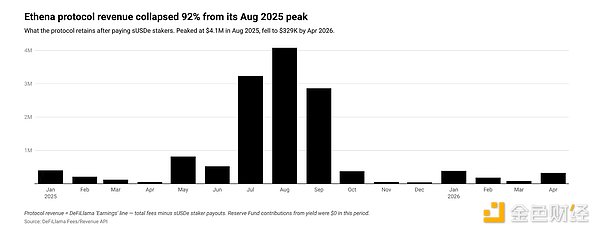
Then came the October market crash. The crash on October 10th was the largest concentrated liquidation event in the crypto industry in years, with leveraged positions being liquidated exceeding $19 billion. USDe briefly de-pegged to Binance, returning a few hours later, which was the only information that received outside attention. However, behind the violent market fluctuations, the risks hidden beneath the surface of stablecoins have received little attention. At the peak of the market, over $4.2 billion in sUSDe was deposited into the Pendle protocol, representing approximately 60% of the then-current circulating supply of USDe, which was $11.3 billion. A large number of structured yield products emerged: users locked in fixed returns on sUSDe on Pendle while simultaneously using their positions as collateral for borrowing on Aave to profit from the interest rate spread. These participants were essentially yield speculators, relying on leveraged arbitrage trading to maximize the high annualized returns of sUSDe, and immediately exiting the market once the market reversed. After the October crash, the entire arbitrage cycle completely collapsed. Within just two months, $8 billion flowed out, with $5.7 billion flowing out in October alone. Users who remained active largely did not use leverage. The collateralization ratio (the proportion of USDe pledged as sUSDe) fell from a peak of approximately 60% to 47% in early 2026, showing almost no change relative to the retention rate. In absolute terms, the total amount pledged fell from $84 billion to $33 billion, primarily due to a significant reduction in the overall circulation of USDe; however, existing holders chose to hold their positions firmly. Users seeking interest-bearing USD assets remained, while purely profit-driven short-term speculators completely exited. For Ethena, however, the October crash completely ended its original strategy of expansion. The protocol distributed almost all its revenue to sUSDe holders, relying solely on meager fees from minting and redemption to survive, representing a very small percentage of the overall trading volume. In the first quarter of 2026 alone, Ethena's total fee revenue reached $65 million, but its quarterly net profit was only $614,000. In contrast, Tether's net profit during the same period reached $5.2 billion. Both are stablecoin issuers, yet their profit structures are vastly different. Total revenue from the protocol does not equate to the actual profit Ethena retains. In early 2025, perpetual contract positions accounted for 93% of USDe reserves; by early 2026, this proportion had fallen to 11%, with the remaining 89% allocated to liquid stablecoins and lending positions. Ethena has completely transformed from a delta-neutral hedging trading mechanism into a tool similar to Treasury yield distribution, distributing US Treasury interest to sUSDe holders. The current annualized yield has dropped to approximately 3.5%, on par with high-quality money market funds, and the complex delta-neutral hedging structure is no longer necessary. The reserve asset structure has undergone a fundamental shift. At an annualized yield of 18%, sUSDe possessed unique advantages that USDC could not match; however, with the annualized yield dropping to 3.5%, this differentiated advantage has weakened significantly, while the underlying complex product mechanism has begun to become a hidden weakness. In March 2025, the German Federal Financial Supervisory Authority (BaFin) ruled that USDe was an unregistered security, ordering Ethena's German subsidiary to cease operations and granting EU users a 42-day redemption window. Ethena subsequently responded that its German subsidiary had no whitelisted users or direct clients at the time the ban took effect, and that most USDe were issued overseas before the EU's Crypto Asset Market Regulation (MiCA) came into effect. This capital outflow was not due to EU regulation causing capital flight; the core trigger was still the collapse of the Pendle carry trade. The Fee Switching Problem: Ethena plans to implement a fee switching mechanism: instead of distributing 10%–20% of the protocol's profits to sUSDe users, it will be distributed to holders of staked sENA tokens. The distribution of returns follows a strict priority order: first, the reserve fund must be fully replenished; second, the annualized return of sUSDe must be maintained at a level deemed competitive by the risk committee; only the remaining returns after these two conditions are met can be distributed to sENA stakers. The risk committee has the right to set and adjust the return benchmark independently; there is no absolutely fixed return floor before the final governance vote. In short: ENA stakers can only receive the leftover returns. Currently, market interest rates are low, and the protocol has no surplus profits to distribute; the fee switching mechanism has no funds available for circulation. The funds for fee switching come from the same pool as sUSDe returns. At peak revenue and with funding rates of 15%, even a two-percentage-point reduction in sUSDe returns would be imperceptible to users. However, in the current environment of 3.5% annualized returns and a market benchmark return of approximately 4.5%, the yield protection mechanism is directly triggered, preventing any returns from flowing to ENA stakers. Ethena must rely on higher perpetual funding rates to generate sufficient surplus revenue to make the fee switching mechanism meaningful. This high funding rate stems from the crypto derivatives bull market—the same market environment that fueled the Pendle carry trade cycle and triggered an $80 billion capital outflow. The path to commercial monetization and protocol stability risk are highly intertwined and mutually reinforcing. Tether's core logic: building trust through institutional-level long-term existence. Having survived long enough, weathered multiple bull and bear cycles, and never experienced de-pegging losses, users are naturally willing to hold long-term. The cost of questioning it far outweighs the cost of continuing to hold. Tether retains all profits, a fact well understood by its holders. Users stay because alternatives are fraught with uncertainty, and uncertainty itself is costly. This user loyalty is built on long-term performance. Another type of loyalty is based on shared interests: the beneficiary and the protocol itself are aligned, their interests completely aligned, requiring no deliberate trust because all rules are transparent. Ethena takes this reverse path: distributing all profits to users and keeping almost no profit for itself, deeply binding the protocol's success or failure to user gains, thus building another form of user stickiness. However, the fatal flaw of this shared interest model is that once the protocol needs to retain profits for itself, the bond instantly breaks down. When the protocol starts retaining profits for itself, the relationship transforms from a win-win symbiotic relationship back into a regular business transaction. Those users who stuck with the shared interests will immediately feel the disconnect. This transformation will thoroughly test whether users truly value the product itself or are merely accepting the complex mechanism for the sake of high returns. Tether (USDT) doesn't face this conflict because it has never claimed to be aligned with user interests from the beginning. Ethena's fee switching mechanism, however, is directly impacting the consensus on which its survival depends. Ethena has built an ecosystem sustained by user trust, and the fee switching mechanism will ultimately determine how much of that trust remains.
Aside from Mark Lamb, the case also names Roger Ver as a defendant.
ClementTraditional UK banks have recently tightened their stance on cryptocurrency-related activities, resulting in numerous account closures and stricter policies. This shift in the financial landscape has prompted around 38% of crypto investors in the UK to switch banks.
 Jasper
Microsoft's AI advancements surpass Google's, shaping technological landscape.
 Hui Xin
While the crypto market is basking in its most fruitful week in over a year, the SocialFi app seems to be encountering headwinds.
 Kikyo
KikyoIn November 2022, Input Output Global (IOG) announced a new project known as Midnight. Midnight is a sidechain solution for Cardano, designed to address various limitations and open up new possibilities for users and developers
 Aaron
AaronMore than 200 companies have received alerts for violating the new advertising rules since their inception on October 8.
ClementThe groundbreaking collaboration between Christian Louboutin and Marvel, offering exclusive NFT collectibles as complimentary treasures to investors in their limited-edition fashion collection, seamlessly merging haute couture and comic book extravagance.
 Jixu
JixuThe demonstration focused on enabling the seamless exchange of vital trade documents across diverse platforms and blockchains.
 Alex
AlexThe 100 Digitally Native Note issued by the IBRD was listed on the Luxembourg Stock Exchange.
AlexAs AI technologies continue to progress, the importance of AI global governance is growing significantly.
Hui Xin