Written by: Yanz & Liam Edited by: Liam
"This time I really sold it!"
On April 22, the ETH/BTC exchange rate briefly fell to 0.01766, setting a new low since 2020.
Lin Feng, who had been investing and holding Ethereum for four years, could no longer bear it and issued a heartbreaking declaration in his circle of friends. Compared with a simple loss of flesh, this is more like a collapse of faith and a farewell to a dream.
On the same day, institutional investors also took action.
Galaxy Digital swapped ETH for SOL, and crypto VC Paradigm also transferred 5,500 ETH (about 8.66 million US dollars) to the brokerage platform Anchorage, suspected of preparing for sale.
The most ironic thing is that another institution, the Ethereum Foundation, joined the army of selling coins. A wallet associated with the Ethereum Foundation deposited 1,000 ETH (about 1.58 million US dollars) into Kraken.
Ethereum, a project once regarded as the flag bearer of the blockchain revolution, seems to have reached its darkest hour.
Behind this collective exodus are stories of being forced to say goodbye to ideals, and difficult choices between faith and interests.
And all of this was recorded, witnessed, and remembered in the group chat called "Ethereum Madhouse".
Ethereum Madhouse
"The name of our group at the beginning was not 'Ethereum Madhouse', but 'I was wrong, I regret buying Ethereum'".
On February 3, 2025, the cryptocurrency market fell collectively, and Ethereum once plummeted by 25%, reaching a minimum of US$2080.19 per coin, catching many Ethereum Holders off guard, including Orange.
Orange, who previously worked for a venture capital firm (VC), entered the crypto market in 2021, and his research on Ethereum technology laid the foundation for his belief in entering the circle.
However, the price of Ethereum dropped to $3,300, which made Orange feel uneasy. He kept complaining, and a group chat "I was wrong, I regret buying Ethereum" came into being.
On February 3, Orange panicked all of a sudden - "I can't run away, so what should my brothers do?".
In order to seek psychological comfort and to keep each other warm, this small group of only 6 friends began to welcome more "people who made mistakes": there were super big investors like Dachengzi and Du Jun, as well as VC executives. Everyone gathered here to heal each other's wounds and seek psychological comfort.
As Ethereum continued to fall, the number of "patients" increased day by day, gradually expanding and stabilizing to 250 people in just one month - Orange said: "Buying Ethereum is 'idiots'" , this deliberately controlled number carries some self-deprecating meaning.
“At first, some people shouted to buy the dip when the price was 3,000 US dollars. Later, it fell to 2,500 US dollars and 2,100 US dollars, and the voices of buying the dip became smaller and smaller. In the end, everyone began to joke that those who wanted to buy the dip should ask Professor Yang Yongxin to give them a call. So we changed the name of the group to "Ethereum Madhouse" because everyone felt that they had gone crazy. ”
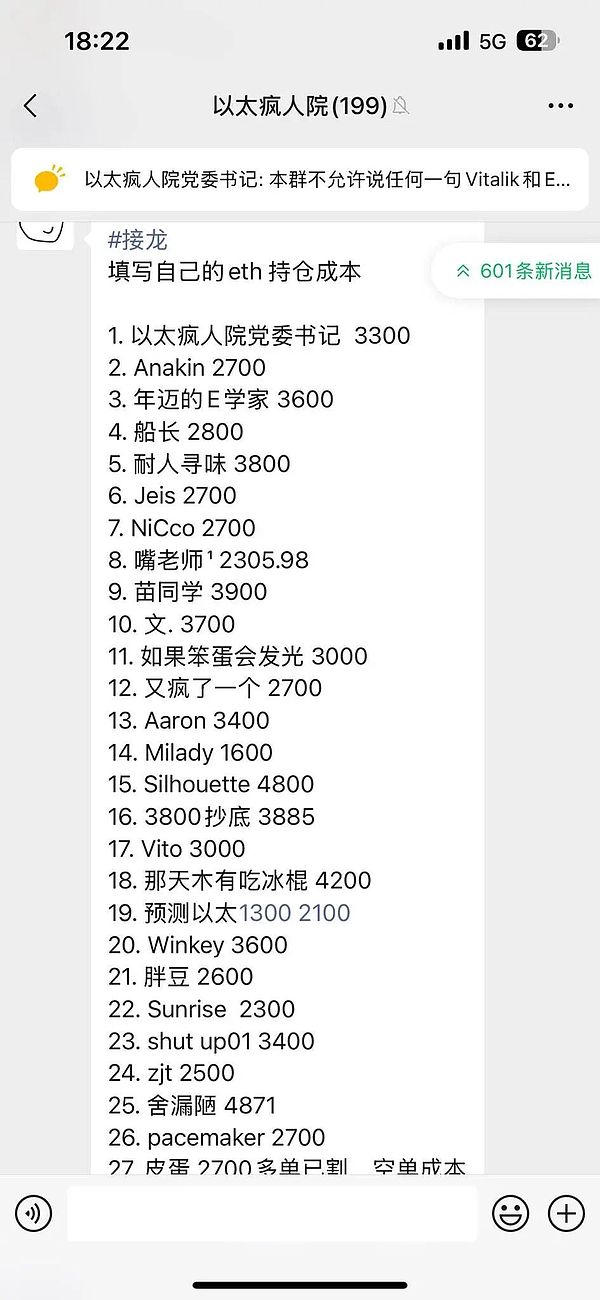
Image source: Big Orange @0xVeryBigOrange
As the group leader, Orange witnessed all of this. He was an observer and one of those locked up in a lunatic asylum. But he was helpless, and it could even be said that
most of the people who stayed in the group were helpless.
Orange couldn't help but miss the summer of 2020.
DeFi Summer is like a frenzy of technology feast. Ethereum, as the protagonist of this feast,,attracted the attention of countless investors and developers.
For traditional Web2 VC practitioners like Orange, this is not only an opportunity to make money, but also an enlightenment and baptism of thought.
"We really did a lot of research at the time," Orange recalled, "Vitalik and the Ethereum Foundation (EF) painted a lot of 'big pictures', such as sharding technology (Sharding), zero-knowledge proof (zk)... At the time, I felt that this was the future."
Similarly, Lin Feng also bought Ethereum in the summer of 2020. At that time, he was full of hope and expectation, and was excited about Ethereum's vision of "the world computer".
"At that time, as an Ethereum holder, I was very proud. This is the real value investment and the innovation of human civilization."
In addition to individuals like Orange and Lin Feng, a large number of traditional VCs also entered the emerging land of Web3 that summer with curiosity and longing for the new world.
As the founder and spiritual leader of Ethereum, Vitalik's every word and deed attracted widespread attention, and everyone followed Vitalik's guidance in investment layout. A large number of VCs have invested heavily in Ethereum's ecological infrastructure. The valuations of ZK and Layer2, which Vitalik is optimistic about, have skyrocketed. Scroll is valued at $1.8 billion, zkSync is valued at $2 billion, and Starknet is valued at $8 billion... Various types of capital have entered the market, betting on Ethereum's expansion dream.
However, after the DeFi Summer craze subsided, in the new cycle, the technical narrative was abandoned by investors, and replaced by the opposite of technology, MEME, as if it were a mockery.
"We firmly believed that Solana would not become the 'Ethereum killer', but now it seems that the market does not care about the core issues of privacy and security at all." This deviation made Orange feel helpless, but what really put him in trouble was his deep feelings for Ethereum.
As a loyal believer, he not only held a large amount of Ethereum in the bull market, but also chose to pledge ETH in exchange for long-term returns. However, when the market entered a cold winter, the price of ETH plummeted, and the pledged assets could not be withdrawn, Orange, like many members of the madhouse, was caught in a dilemma.
In fact, most of these trapped people are not speculators with the mentality of "getting rich overnight", but long-term holders who have experienced multiple rounds of market fluctuations and have a certain understanding of Ethereum, commonly known as old leeks.
The paradox of this cycle is vividly reflected here - Paper Hand PVP is rewarded, Diamond Hand is punished, and constantly experiences the dual torture of reality and cognition.
For them, Ethereum is both a symbol of hope and an inescapable shackle.
They love Ethereum because it represents technological innovation and future possibilities; they also hate Ethereum because the pain and difficulties brought about by the price drop are real.
For Lin Feng, the pain of selling Ethereum comes from real financial losses on the one hand, but more from "damage to the heart of Taoism." He entered the crypto world because of Ethereum and called himself a value investor. He used to be proud of investing in Ethereum, but now reality makes him deny his former self. What makes him even more ashamed is that he found that the belief he once boasted about was not firm. In the face of the continuously falling K-line, he simply couldn't ignore the price, and finally chose to give up.
Lin Feng sold Ethereum and his former dream.
However, most of the patients are still waiting in the "ward". Not only are they eager to get their money back and be discharged from the hospital, the dreams they planted in the story three years ago are also waiting for another hot summer.
Ethereum has no new story
"There has been no paradigm innovation in Ethereum this year!"
The well-known KOL Big Orange is also a member of the Ethereum Madhouse. On Twitter, he is known as the "Head of the E Guard" by everyone.
On March 21, 2024, Big Orange tweeted,From today on, I am a die-hard Ethereum bull. If Ethereum does not reach a new historical high before May, I will eat shit.
Despite his passionate love, Big Orange also admits that Ethereum currently lacks innovation.
"There is nothing new that will catch people's eyes," said Yuan Jie, co-founder of the public chain Conflux, who calls himself "Director of Web3 Investment Promotion". He once aspired to create an "Ethereum Killer" and witnessed the rise and fall of the Ethereum ecosystem.
The craze of DeFi, NFT, and GameFi in the last cycle is still unforgettable to him. "At that time, there were a lot of new things to learn every day, and in the process of learning, participation could also get good wealth returns."
During the "golden age", Ethereum had the best story. That year, the on-chain ecosystem exploded, the Ethereum "cult" was pushed to a climax, capital, developers and users focused their attention on certain specific directions (such as Layer 2, DeFi, ZK technology, etc.) and expanded blindly for a time, and investors came and went.
The narrative three years ago nourished the prosperity of the previous cycle, but now, such a story is over.
Just like the land loses its fertility due to over-cultivation, when talking about the present, Yuan Jie said, “Vitalik used his personal charm to participate too deeply in the guidance of the industry direction and route formulation, resulting in the ineffectiveness of Ethereum's resource allocation”.
Whether it is a breakthrough in technology or a new application in the ecosystem, Ethereum has failed to provide enough freshness to attract the market's attention.
Like a frog in boiling water, the Ethereum main chain is facing the dilemma of a "gradually barren land".
"The transaction volume and activity on the chain are very low, and the entire ecosystem has become cold, resulting in Ethereum's deflation mechanism (EIP-1559) not working well." In the eyes of Big Orange, the deflation mechanism of EIP-1559 is like a beautifully designed irrigation system, but in the absence of sufficient "water source" (liquidity), this system can only be superficial and cannot provide real nutrients for the Ethereum ecosystem.
What's more complicated is that "blood-sucking flowers" have bloomed on such barren land.
Layer 2 carries Ethereum’s dream of expansion. It is the common master of the world. Each Layer2 regards Ethereum as the orthodoxy, but each of them has established its own country, sucking the value of Ethereum’s main network, and constantly weakening Ethereum’s control over its own ecology.
“Everyone is scrambling to transfer Ethereum’s assets to their own chains, because the more they transfer, the higher the points, and the more airdrop tokens they will get,” Yuan Jie seemed a little excited. He attributed these “blood-sucking flowers” driven by the short-term profit-seeking mentality and the current ecological homogeneity to the “prisoner’s dilemma” of human nature.
Yuanjie believes that this may not be Vitalik's original intention, but in the process of planning to use Layer2 to expand the boundaries of the Ethereum ecosystem, he ignored "the human nature of everyone wanting to get rich quickly and compete for the same property", and eventually "fell into a cycle of involution and self-destruction".
The Layer2 network is highly fragmented, separating the user experience from on-chain liquidity. The composability advantage that the Ethereum mainnet once boasted of in the DeFi Summer is gone. Instead, Solana has become the habitat for many consumer applications with its simple feature of "fast".
"When I think of ETH now, I think of ATOM. I'm really afraid that ETH will repeat the mistakes of ATOM."
Lin Feng believes that ETH's dilemma is similar to that of ATOM, and both are experiencing "value transfer upstream."
In the Cosmos ecosystem, various sovereign application chains (such as OSMO, JUNO, etc.) are interconnected through the IBC protocol, but they capture the value of their own ecosystems, while ATOM, as a central hub, fails to effectively capture value from these chains.
After the rise of various Ethereum L2s, they have obtained a large amount of MEV and transaction fee income by relying on sorters, which has greatly reduced the value flowing back to the Ethereum main network and weakened ETH's value capture ability.
"If the Ethereummain chainis successfully upgraded and its carrying capacity is greatly improved, then Ethereum may truly usher in a new peak of development", Big Orange believes so.
How to Reshape Greatness?
On April 22, when many institutions were selling ETH, F2Pool co-founder WangChun once again exchanged 50 WBTC for 2,794 ETH, worth about $4.36 million, which brought a glimmer of hope to those who still hold ETH.
Ethereum, a land that once gave birth to countless innovative fruits, seems to need a long "fallow period".
During the fallow period, some people cut their losses, while others held on.
Big Orange chose to hold on. The bull market in 2021 has brought great benefits to Big Orange, and his feelings for Ethereum have long surpassed a simple investment relationship. For him, ETH is not just an asset, but more like a belief.
Among the "E Guards" that still exist today, everyone has become an extra-staff consultant to the Ethereum Foundation, offering advice and suggestions for Ethereum. According to their respective "reform measures", they can be roughly divided into two camps.
One faction is right, advocating drastic reforms, and believes that Ethereum should pursue more "practicality" and should be compliant and "close to authority."
For example, Orange believes that Ethereum needs to "stop playing dead" and actively embrace compliance.
"Since the birth of mankind, some things have been destined. You can't compete with the state machine. If you want to survive well, or show your own functions, you should not fight against the entire state machine."
Between ideals and bread, the Ethereum Foundation needs to strike a balance. Yuanjie does not deny that the Ethereum Foundation focuses on academic discussions and the purity of technological innovation, but a pragmatic business department is necessary.
"If Trump is in power, and we need Trump to accept Ethereum, then we need someone who doesn't hate Trump to deal with him. If Vitalik can't do it himself, he can let someone else do it. A good foundation, as a non-profit organization, should be able to accommodate various decisions."
Lin Feng even believes that the Ethereum Foundation has paid too much attention to ideology in the past, neglected real creation and construction, and was too "weak".The Ethereum Foundation needs a Trump-style reform figure to completely innovate the atmosphere.
The other faction is on the left, believing that Ethereum’s greatest value lies in “decentralization, and that it is the last “idealistic place” in the crypto world besides Bitcoin.
The well-known KOL Blue Fox Notes said that he only pays attention to one point about Ethereum,“whether it will continue to maintain its core values of decentralization, security, and trustlessness in the future. If it does, we will continue to support it. If it changes, we will leave no matter how high the price is. ”
“The crypto world needs an internationalist fighter. Except for the disappeared Satoshi Nakamoto, no one can compare to Vitalik,” said investor Jacob, who invested in Ethereum. Despite facing huge financial losses, he still recognizes Ethereum’s values of not compromising with authority.
“SOL and other emerging high-performance public chains are essentially capital-driven company stock logic. Their high efficiency will naturally attract more market attention.But Ethereum is a new form of human civilization. ”
Behind this left-right dispute is a different understanding of the priority of blockchain -
Is it pragmatic, pursuing efficiency and commercial success, or adhering to the spirit of decentralization and freedom?
In the darkest hour, confidence is more important than gold.
IOSG founder Jocy called,“Ethereum will not die. It is the most successful decentralized organization in the Web3 industry. Looking to the future, please cherish the Ethereum in your hands and look at its value and innovation from a ten-year perspective. ”
Back to the "Ethereum Madhouse", the refuge that was originally created out of panic, has now become a corner that witnesses history.
Whether it was the moment when Lin Feng pressed the sell button, or every day that Big Orange held firmly, or every emotional fluctuation that Orange saw in the madhouse, they were recording and shaping the history of Ethereum.
No matter what the future holds, regardless of leaving or sticking to it now,


 Anais
Anais


