Singapore Court Grants Freeze Order Linked to Wallets as Soulbound NFT
The freeze order takes the form of "soulbound" NFTs and is firmly linked to the specific wallets under scrutiny.
 Catherine

Deng Tong, Jinse Finance
As 2025 draws to a close, Jinse Finance presents a series of articles titled "Looking Back at 2025" to mark the passing of the old year and the arrival of the new. This review summarizes the progress of the crypto industry throughout the year, and expresses the hope that the industry will overcome its winter and shine brightly in the new year.
2025 was a pivotal year for the crypto industry, marked by a gradually clarifying regulatory framework, deep penetration of traditional finance, and accelerated technological iteration. Each key milestone was driven by key figures who either guided policy direction, led institutional entry, tackled technical challenges, or stirred up market trends. This article focuses on the key figures in the crypto industry in 2025.
On January 20, Trump was sworn in as the 47th President of the United States in the Capitol Rotunda in Washington, D.C., becoming the first "Crypto President" in U.S. history.
On January 23, Trump issued his first executive order on crypto.
Specific content includes: protecting and promoting the ability of individual citizens and the private sector to access and use public blockchains; allowing U.S. citizens to develop and deploy software, participate in mining and verification, conduct transactions, and self-custody digital assets; promoting and protecting the sovereignty of the U.S. dollar and promoting the development and growth of dollar-backed stablecoins; protecting and promoting fair and open access to banking services for all law-abiding citizens and private sector entities; providing regulatory clarity and certainty; protecting Americans from the risks of CBDCs and prohibiting the establishment, issuance, circulation, and use of CBDCs within U.S. jurisdiction; rescinding Executive Order 14067, "Ensuring the Responsible Development of Digital Assets," and the Treasury Department's "Framework for International Participation in Digital Assets"; establishing the Presidential Working Group on Digital Asset Markets; proposing a federal regulatory framework to manage the issuance and operation of U.S. digital assets (including stablecoins); assessing the possibility of establishing and maintaining a national digital asset reserve and proposing standards for establishing such a reserve. For details, please see the Jinse Finance special report: "Trump's Official Inauguration" "The Crypto Industry Ushers in a New Era" 2. Wielding the Tariff Stick February 1: Trump signed an executive order imposing a 10% tariff on Chinese goods imported into the US, citing issues such as fentanyl; simultaneously, a 25% tariff was imposed on goods from Mexico and Canada, with a separate 10% tariff on Canadian energy products; April 3, "Liberation Day," Trump officially signed an executive order regarding reciprocal tariffs; April 8: Announced an increase in the "reciprocal tariff" on Chinese goods imported into the US from 34% to 84%, bringing the total tariff rate to 104% after adding previous tariffs; April 10: First, a 90-day tariff suspension period was announced, significantly reducing reciprocal tariffs to 10% for relevant countries, but simultaneously raising tariffs on China to 125%, ultimately bringing the total tariff to 145% after adding the fentanyl tariff; May 12: Following the Sino-US Geneva trade talks, a joint statement was issued, with the US reducing tariffs on Chinese goods to 30%; May 14 The US and Japan officially finalized the tariff adjustment; August 12: Following trade talks in Stockholm, the US and China reached a consensus to suspend the 24% reciprocal tariff increase for 90 days, with both sides retaining their 10% tariffs on each other's goods. China also suspended some non-tariff retaliatory measures against the US. November 5: In conjunction with the previous US-China tariff suspension agreement, China announced that it would continue to suspend the 24% tariff increase on US goods for one year, starting November 10, retaining the 10% rate. The US maintained its corresponding tariff policy and did not introduce any new tariff increases. The cryptocurrency market is significantly affected by tariff policies. In late February, when Trump suddenly announced plans to impose tariffs on Canada and the EU, BTC fell by about 15% in the following days; in early April, as Trump frequently escalated his measures, the total market capitalization of the cryptocurrency market fell by about 25.9% from its January high, wiping out nearly $1 billion in market value. The trillion-dollar mark highlights the crypto market's high sensitivity to macroeconomic instability. For details, please see the Jinse Finance special report: "Trump Wields the Tariff Stick: What's Next for the Crypto Market?"
On January 18th, Trump announced the launch of his personal Meme coin, Trump. Upon its launch, Trump immediately experienced a surge, reaching a high of over $44 on January 22nd, before plummeting. As of this writing, it is trading at $5.09, a drop of 82.4% from its January high.
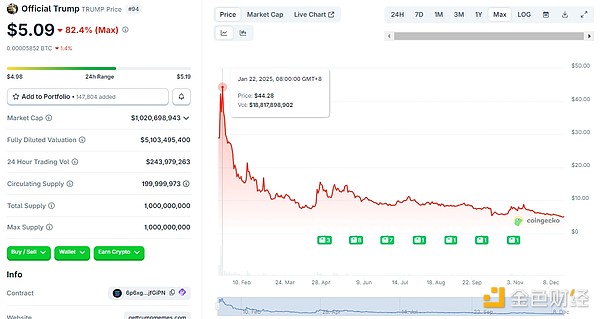
The launch of the Trump Meme coin directly ignited the celebrity Meme coin craze at the beginning of the year, and Trump's price trend is a microcosm of all celebrity Meme coins. First, after the launch of Meme coins, the celebrity effect was used to pump and dump, for example, Trump launched Trump three days before his inauguration to create a short-term frenzy of speculation; second, Memes have no real value support, and Trump has been controversial since its inception, with accusations of political bribery being rampant; finally, most Meme coins have internal manipulation issues, with selling at the price peak causing a price crash.
On September 16, 2024, World Liberty Financial, a decentralized finance project of the Trump family...
Established on September 1st of this year, WLFI was listed on several cryptocurrency trading platforms. However, it's clear that WLFI's popularity was merely a temporary fad. While it peaked at $0.24 in its launch month, it has since fallen 45.1% to $0.1284 as of this writing. WLFI's product architecture is based on the governance token WLFI and the stablecoin USD1, aiming to connect traditional finance with DeFi. Its core consists of the institutional-grade stablecoin USD1 and the community-driven governance token WLFI. The product architecture features multi-chain deployment, compliance management (including KYC and third-party audits), and community governance mechanisms, and is backed by the USD reserve stablecoin USD1. Provides transparent and secure digital asset services. However, since its initial launch last September, WLFI has not achieved remarkable results. WLFI co-founder Zach Witkoff recently announced that it will launch its real-world asset product in January next year, but the final implementation is still unknown. For details, please see the Jinse Finance special report "When Politics Meets Crypto: The Trump Family's WLFI Experiment"In April 2025, after Atkins took office as Chairman of the SEC, he proposed Project Crypto, which is considered to be the clearest crypto strategy from US regulators to date. Its main objectives include: clarifying that most digital assets are not securities, reducing legal uncertainty; avoiding complex regulation, that is, clarifying the financial and legal attributes of crypto tokens as commodities, avoiding case-by-case situations.
The cumbersome review of cases; supporting on-chain capital raising, making a compliant tokenized market possible; establishing stablecoins and on-chain settlement systems to promote the dominance of the US dollar in the crypto market; promoting cross-institutional cooperation (with the CFTC, the Treasury Department, and the White House task force); supporting crypto innovation, and even supporting platforms that integrate trading, staking, and lending to improve financial efficiency. He believes that if the United States wants to maintain its financial leadership, it must establish compliance and market advantages in the digital asset field.For details, please see 《Paul Atkins: A Believer in Free Economics and the Head of Project Crypto》
Under his leadership, the SEC shifted to a pro-crypto policy. In 2025, the SEC ended its illegal enforcement case against Coinbase and its investigations into crypto projects such as Ondo, Aave, and Yuga Labs.
Vitalik
On May 7th, the Ethereum Pectra upgrade was triggered and completed on the mainnet around 10:05 UTC. This is the most significant upgrade since the merger in 2022. This update aims to simplify the staking process, enhance wallet functionality, and improve overall efficiency. One of the key elements of this upgrade is increasing the amount of ETH that users can stake from 32 to 2048. This change aims to help staking institutions and infrastructure providers by meeting the needs of validators who stake ETH to maintain the operation of the blockchain.
For details, please see the Jinse Finance special report "Understanding the Ethereum Pectra Upgrade"
On December 3rd, the Ethereum Fusaka upgrade was officially activated at mainnet block slot 13,164,544.
Fusaka This marks a significant step in Ethereum's scaling roadmap, enhancing Layer 1 performance, expanding Blob capacity, improving the cost-effectiveness of Rollups, and delivering an upgraded user experience. It also introduces a "Blob-only" fork mechanism to safely increase Blob capacity as Rollup demand grows. For details, please see the Jinse Finance special report: "A Comprehensive Analysis of the Ethereum Fusaka Upgrade"
2. Focus on the Privacy Track At the Ethereum Developer Conference held from November 17th to 22nd, Vitalik released Kohaku, an Ethereum privacy-preserving encryption tool. For developers, the Ethereum Foundation provides an open-source framework that includes a modular Software Development Kit (SDK) and a reference wallet. The SDK It provides reusable components for private sending, more secure key management and recovery, and risk-based transaction control, so teams don't need to build the entire privacy protocol stack from scratch. For users, the first version is a browser extension wallet for advanced users, built on Ambire. It supports private and public transactions, independent accounts for each decentralized application, peer-to-peer broadcasting (instead of centralized relay), and tools for hiding Internet Protocol (IP) addresses and other metadata as much as possible. For more details, see "Ethereum Privacy Explosion? What Voices Did the Ethereum Developer Conference Convey?" On November 27th, Vitalik again focused on the privacy field and strongly supported two decentralized messaging applications, Session and SimpleX Chat, donating 128 tokens to each. ETH. Vitalik points out: Digital privacy protection in encrypted messaging is crucial. Two important future directions in this field are: (i) permissionless account creation; (ii) metadata privacy protection.For details, see "What are the two applications Vitalik strongly supports? Is privacy communication the next big thing?"
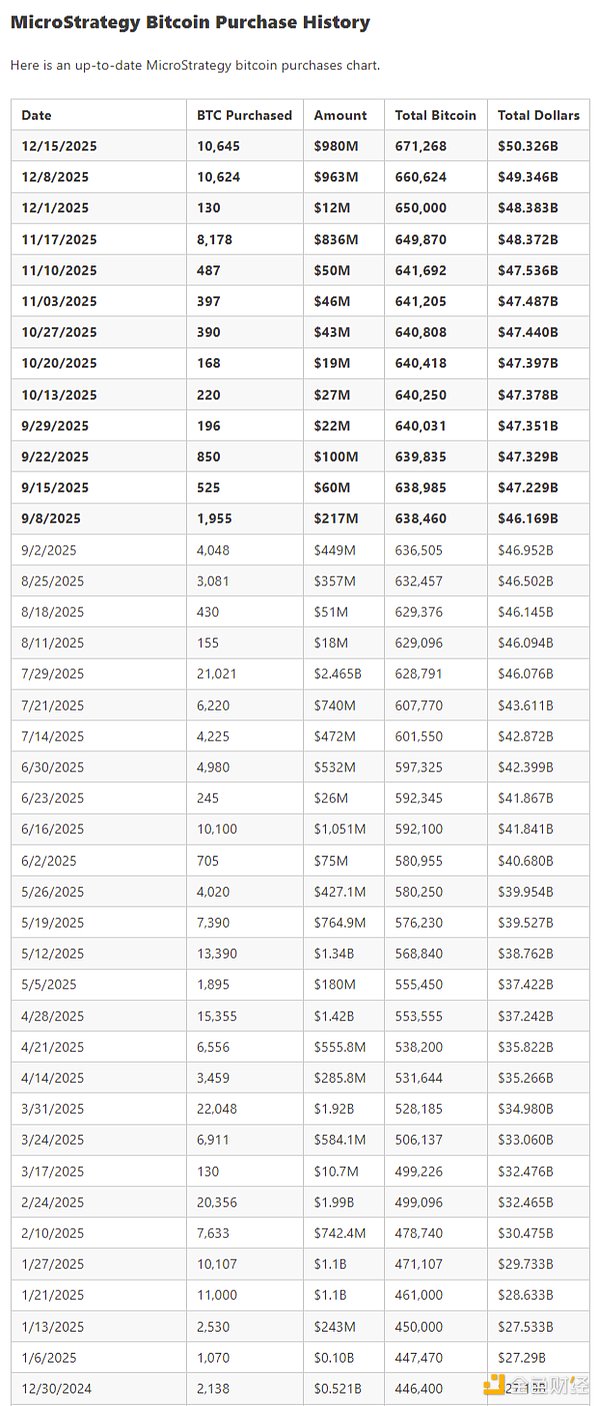
On December 30, 2024, Strategy's total BTC holdings were 446,400; as of December 15, 2025, Strategy's total BTC holdings were 671,268. In nearly a year, Strategy bought 224,868 BTC. Its holdings account for 3.197% of the total BTC.
In October, MSCI announced that it was soliciting opinions from the investment community to discuss whether digital asset companies with a balance sheet of more than 50% crypto assets should be excluded from its indices. MSCI noted that some feedback suggested that such companies "exhibit characteristics similar to investment funds, which currently do not meet the criteria for index inclusion." The consultation period will last until December 31, with a final decision to be announced on January 15 next year, and any resulting changes taking effect in February. The initial list of companies MSCI is considering includes Michael Saylor's Strategy Inc., Sharplink Gaming, and cryptocurrency mining companies Riot Platforms and Marathon Digital.
38 companies including Holdings. Michael Saylor responded to the MSCI index removal risk issue in a social media post, stating that Strategy, as a publicly traded operating company, is fundamentally different from funds, trusts, and holding companies. Strategy not only has a $500 million software business but also uniquely uses Bitcoin as productive capital in its fund management. Index classification cannot define Strategy. The company has a clear long-term strategy, a firm belief in Bitcoin, and its mission has always been to become the world's first digital currency institution based on sound money and financial innovation. 3. Promoting Government Development of Bitcoin-Backed Digital Banking Systems In early December, Michael Saylor promoted the development of Bitcoin-backed digital banking systems by governments worldwide. These systems would offer high-yield, low-volatility accounts capable of attracting trillions of dollars in deposits. Saylor stated that countries could utilize overcollateralized Bitcoin reserves and tokenized credit instruments to create regulated digital bank accounts with higher yields than traditional deposits. Bank deposits in Japan, Europe, and Switzerland yield almost nothing, while Euro money market funds offer yields of around 150%. The US money market interest rate fell by 400 basis points, which explains why investors turned to the corporate bond market. For details, please see 《Controversial Strategy: The Dilemma of BTC Faith Stocks After the Crash》On December 12, Tether announced its plan to fully acquire the Italian football club Juventus FC. Tether submitted an all-cash binding offer to its controlling shareholder, Exor, to acquire 65.4% of its shares and prepared to launch a public offer for the remaining shares after the transaction was completed, aiming to increase its shareholding to 100%. However, the EXOR Group rejected Tether's proposal to acquire Juventus shares, reiterating that it had no intention of selling Juventus shares.
On December 8th, it was reported that Tether is supporting the development of a new type of industrial humanoid robot, which will undertake dangerous and physically demanding tasks in factories and logistics centers. Tether, along with AMD Ventures, the Italian National AI Fund, and other investors, raised €70 million for Generative Bionics (a new spin-off company of the Italian Polytechnic Institute).
On December 2nd, Tether Data announced the launch of the large language model framework QVAC Fabric, enabling users to execute, train, and personalize large language models directly on everyday hardware, including consumer-grade GPUs, laptops, and even smartphones. Tasks that previously required high-end cloud servers or dedicated NVIDIA systems can now be accomplished on existing user devices. The model reportedly supports training on various GPUs, including AMD, Intel, NVIDIA, Apple Silicon, and mobile chips.
BlackRock's Bitcoin ETF (IBIT) continues to lead the market, holding the top spot in the global Bitcoin spot ETF market throughout the year. At its peak, it ranked 23rd among all ETFs globally. Its latest net asset value (AUM) is approximately $70.84 billion.
IBIT successfully established its dominant position in the integration of crypto assets and traditional finance in 2025. Its performance is closely linked to the volatility of the Bitcoin market and the sentiment of institutional funds, exhibiting characteristics of both "long-term capital inflow" and "short-term volatility."
For more details, please see target="_blank">BlackRock: Why IBIT Can Change the Bitcoin Investment Landscape?
mUSD is issued by Bridge, a stablecoin issuance platform under Stripe, and minted through M0's decentralized infrastructure. Deeply integrated into MetaMask wallets, mUSD provides users with a seamless, USD-denominated stablecoin experience for holding, spending, and trading in web3. MetaMask USD is designed for composable cross-chain use through the M0 liquidity network, setting a new standard for stablecoin utility in the MetaMask ecosystem, from dApps to DeFi and payments. mUSD is a neutral, highly liquid asset that enables seamless 1:1 transactions for certain payment methods.
The integration of fiat currency into cryptocurrency unlocks a range of upcoming product integrations and user benefits. For details, please see "MetaMask Enters the Stablecoin Track: Can mUSD Reshape the Stablecoin Market Landscape?"On May 27th, ConsenSys led a $425 million private placement in SharpLink. SharpLink will use the funds raised to purchase Ethereum (ETH) as its primary treasury reserve asset.
ConsenSys founder and Ethereum co-founder Joseph Lubin stated, "Following the completion of the transaction, ConsenSys looks forward to collaborating with SharpLink to explore and develop an Ethereum treasury strategy and to serving as a strategic advisor on its core business. This is an exciting moment for the Ethereum community, and I am very pleased to work with Rob and his team to bring Ethereum's potential to the public capital markets."
For details, please see 《From Gambling Operator to "ETH Micro-Strategy": Understanding SharpLink's Ethereum Treasury Path》On October 22, Trump signed a pardon for CZ and disclosed it to the public the following day.
White House Press Secretary Carolyn Levitt issued a statement saying: "The President exercised his constitutional powers to pardon Mr. CZ, who was prosecuted in the Biden administration's war on cryptocurrencies. The Biden administration's war on cryptocurrencies is over."
After his release, Changpeng Zhao quickly expressed his gratitude to Trump, stating that he "will do everything in his power to help the United States become the cryptocurrency capital and promote the development of Web3 globally." For details, please see 《From Imprisonment to Presidential Pardon: Zhao Changpeng's 'Political Career'》On June 5th, Circle officially listed on the NYSE. During trading, Circle triggered circuit breakers multiple times, closing with a 168.48% increase on its first day of trading, at $83.23, giving it a market capitalization exceeding $18.5 billion. It continued to rise by nearly 30% the following day. Circle's listing brought stablecoins, previously only recognized by a select few, into the mainstream, gaining favor with some old money and making it one of the most successful IPOs in recent years.
Jeremy Allaire stated after Circle's listing that stablecoins may be the most practical form of currency ever, but the industry has yet to reach a critical juncture similar to the "iPhone moment".
He pointed out that once the stablecoin industry enters this stage, developers will be able to unlock programmable digital dollars just like unlocking a programmable phone. At that time, digital dollars will unleash enormous potential and bring a wide range of opportunities on the internet. He believes that this era may not be far off.For details, please see the Jinse Finance special report "The Profound Impact of Circle's Listing on the First Stablecoin Stock on the Industry"
On December 1, the Hong Kong Stock Exchange disclosed that HashKey Holdings Limited had passed the Hong Kong Stock Exchange's listing hearing and was about to IPO. JPMorgan Chase, Guotai Haitong, and Guotai Junan International were the joint sponsors. On December 17, HashKey Holdings Limited was officially listed on the Hong Kong Stock Exchange.
HashKey's successful IPO under Xiao Feng's leadership is an important milestone in the compliant development of Hong Kong's cryptocurrency industry and a microcosm of global crypto companies embracing the mainstream capital market.
For details, please see "Xiao Feng: The Old Regime and Revolution in the Crypto World - New Coordinates of HashKey"
The freeze order takes the form of "soulbound" NFTs and is firmly linked to the specific wallets under scrutiny.
CatherineNavigating the future of healthcare by integrating AI's transformative role in medicine.
 Hui Xin
The company has encouraged users to use Binance Pay instead.
 Alex
AlexThis decision involves tokenizing a court-issued worldwide freeze order as soulbound NFTs
 Clement
Among his early NFTs, "Crossroad," a commentary on the 2020 U.S. presidential election, made headlines by selling for $6.6 million in February 2021.
 Brian
BrianFTX clientele finds itself confronted by a deceptive priority withdrawal scam. These misleading emails purportedly originate from FTX Trading, West Realm Shires Services, and FTX EU.
CatherineTech-driven compassion shows how Gitam BBDO's war room rescues hostages with innovation.
Hui XinElon Musk's public scrutiny of Wikimedia Foundation's financial requests has generated considerable speculation, particularly regarding the prospect of a potential acquisition.
 Kikyo
KikyoMagic Eden, a popular NFT marketplace on the Solana blockchain have decided to temporarily halt trading of Bitcoin BRC-20 assets on their platform
 Aaron
AaronThe brief supports an appeal against the IRS that challenges government access to user transaction history on crypto platforms.
Alex