「Pokémon TCG Pocket」首周收入突破2000万美元:宝可梦IP结合NFT,未来前景可期?
日本宝可梦公司在10月30日全球上线手机对战卡牌游戏《Pokémon TCG Pocket》。这款融合抽卡和策略对战的游戏在首周内收入突破2000万美元,凭借精致画风和有趣机制,吸引了台湾等多个市场的玩家热情参与。
 Weiliang

Authors: Spencer Applebaum & Eli Qian, Multicoin Capital; Translated by: Jinse Finance
Over the past two decades, fintech has changed how people access financial products, but it hasn't changed how money actually flows. Innovation has mainly focused on simpler interfaces, smoother registration processes, and more efficient distribution channels, while the core financial infrastructure has remained largely unchanged. For most of this period, this technology stack has simply been resold, not rebuilt.
Generally speaking, the development of fintech can be divided into four stages:
The earliest wave of fintech made financial services more accessible, but efficiency did not improve significantly. Companies like PayPal, E*TRADE, and Mint digitized existing products by combining traditional systems built decades ago (such as ACH, SWIFT, and card networks) with internet interfaces.
Settlement was slow, compliance processes relied on manual processes, and payments were strictly based on predetermined schedules.
While the financial industry went online during this period, the fundamental way funds flowed remained unchanged. What changed was who could use financial products, not how those products themselves operated. Fintech 2.0: The New Banking Era (2010-2020) The next breakthrough came from smartphones and social media. Chime targeted hourly workers who could access their wages early. SoFi focused on providing student loan refinancing services for aspiring graduates. Revolut and Nubank reached under-banked consumers globally with their user-friendly experiences. Each company told a more compelling story to a specific audience, but they were essentially selling the same products: checking accounts and debit cards operating on the same traditional systems. Like their predecessors, they relied on partner banks, card organizations, and ACH systems. These companies succeeded not because they built new channels, but because they reached customers better. Brand, user onboarding, and customer acquisition were their strengths. Fintech companies of this era have become sophisticated distribution companies attached to banks. Fintech 3.0: Embedded Finance (2020-2024) Around 2020, embedded finance began to flourish. APIs enabled almost any software company to offer financial products. Marqeta allowed companies to issue bank cards via APIs. Synapse, Unit, and Treasury Prime offered Bank as a Service. Soon, almost any application could offer payment, bank card, or loan services. But beneath the abstraction layer, the essence remained unchanged. Bank as a Service (BaaS) providers still relied on the existing banks, compliance frameworks, and payment channels. The abstraction layer had moved from banks to APIs, but the economic benefits and control still flowed to the existing systems. The Commodification of Fintech By the early 2020s, the drawbacks of this model were evident everywhere. Almost all large new banks relied on a few sponsoring banks and Bank as a Service (BaaS) providers.
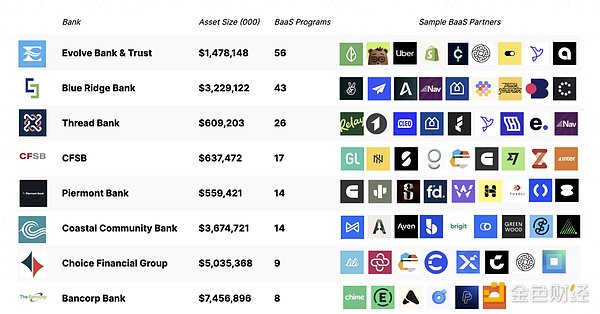 Source: Embedded
Therefore, as companies fiercely compete through performance marketing, customer acquisition costs have skyrocketed. Profit margins have been squeezed, fraud and compliance costs have surged, and infrastructure has become almost monotonous. Competition has evolved into a marketing arms race. Many fintech companies are trying to differentiate themselves through card colors, sign-up rewards, and cashback gimmicks.
Meanwhile, risk and value capture are concentrated at the banking level.
Large financial institutions regulated by the Office of the Comptroller of the Currency (OCC), such as JPMorgan Chase and Bank of America, retain core privileges: accepting deposits, making loans, and accessing federal payment systems such as ACH and Fedwire. Fintech companies like Chime, Revolut, and Affirm lack these privileges and must rely on licensed banks to provide these services. Banks earn interest and platform fees; fintech companies earn transaction fees. As fintech projects proliferate, regulators are increasingly scrutinizing the banks that underpin these projects. Regulatory orders and stricter requirements are forcing banks to invest heavily in compliance, risk management, and third-party project oversight. For example, Cross River Bank entered into a regulatory order with the Federal Deposit Insurance Corporation (FDIC), Green Dot Bank faced enforcement action from the Federal Reserve, and the Fed issued a cease and desist order against Evolve. Banks' responses include tightening customer onboarding processes, limiting the number of projects they support, and slowing product iteration. Models that were once allowed for experimental trials now increasingly require economies of scale to offset compliance burdens. Fintech development is slowing, costs are rising, and there's a greater tendency to develop general-purpose products rather than specialized ones. We believe there are three main reasons why innovation has consistently led the way over the past 20 years. 01. Funding infrastructure is monopolized and closed. Visa, Mastercard, and the Federal Reserve's ACH network left no room for competition. 02. Startups need substantial funding to develop financial-centric products. Launching a regulated banking app requires millions of dollars for compliance, anti-fraud, treasury operations, and more. 03. Regulation restricts direct involvement. Only licensed institutions can hold funds or transfer funds through core channels.
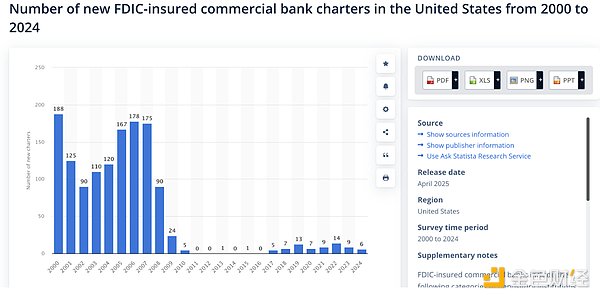
Data source: Statista
Given these limitations, it clearly makes more sense to develop products rather than fight the established rules. As a result, most fintech companies are simply tweaking banking APIs. Despite two decades of innovation, the industry has seen very few truly new financial technologies emerge. And for a long time, there have indeed been no viable alternatives.
The trajectory of cryptocurrency development is quite the opposite. Developers initially focused on basic functionality.
Features such as automated market makers, bond curves, perpetual contracts, liquidity vaults, and on-chain lending have all evolved from the ground up. Financial logic itself has also become programmable for the first time. Fintech 4.0: Stablecoins and Permissionless Finance While the first three fintech eras saw numerous innovations, their underlying mechanisms remained largely unchanged. Whether products were delivered through banks, new types of banks, or embedded APIs, the flow of funds still followed a closed, permissioned path controlled by intermediaries. Stablecoins disrupt this model. Instead of simply adding software on top of the banking system, stablecoins directly replace key banking functions. Developers interact with open, programmable networks. Payments are settled on-chain. Functions such as custody, lending, and compliance have also moved from contractual relationships to the software layer. Banking as a Service (BaaS) reduces friction but does not change the economic model. Fintech companies still need to pay compliance fees to sponsoring banks, settlement fees to card organizations, and access fees to intermediaries. Infrastructure remains expensive and requires licensing. Stablecoins completely eliminate the need for rented access. Developers don't need to call bank APIs; instead, they write code directly to the open network. Settlements occur directly on-chain. Fees go to the protocol, not an intermediary. We believe the cost of building stablecoins will be dramatically reduced: from millions of dollars through banks or hundreds of thousands of dollars through Blockchain-as-a-Service (BaaS), to just a few thousand dollars using permissionless smart contracts on-chain. This shift is already evident at scale. The market capitalization of stablecoins has grown from almost zero to approximately $300 billion in less than a decade, and their actual economic transaction volume now surpasses that of traditional payment networks like PayPal and Visa, even excluding intra-exchange transfers and MEV transactions. For the first time, non-bank, non-bank card payment channels have achieved truly global-scale operation.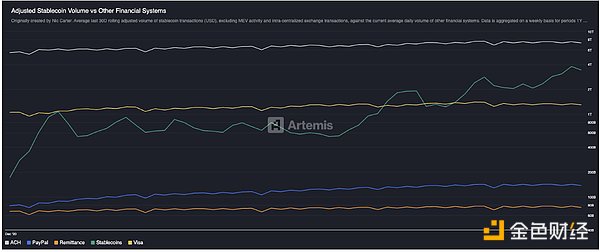
Source: Artemis
To understand why this shift is so important in practice, we need to understand how today's fintech companies are structured.
Launching fintech products under this architecture means managing contracts, audits, incentive mechanisms, and failure modes for dozens of counterparties. Each layer adds cost and delays, with many teams spending as much time coordinating infrastructure as product development.
The native stablecoin system simplifies this complexity. Functionality that previously required six vendors is now consolidated into a single set of on-chain primitives.
In the world of stablecoins and permissionless finance, banks and custody services will be replaced by Altitude. Payment channels will be replaced by stablecoins. While authentication and compliance are important, we believe they can exist on-chain and remain confidential and secure through technologies like zkMe. Underwriting and credit infrastructure will be completely overhauled and moved on-chain. Capital markets firms will become irrelevant once all assets are tokenized. Data aggregation will be replaced by on-chain data and selective transparency, such as using fully homomorphic encryption (FHE).
Compliance and OFAC compliance will be handled at the wallet level (for example, if Alice's wallet is on the sanctions list, she will not be able to interact with the protocol). This is the real difference in Fintech 4.0: the underlying architecture of finance has finally changed. People no longer need to develop another application that sneaks around requesting bank authorization in the background; instead, they can directly replace most of the bank's business with stablecoins and open payment channels. Developers are no longer tenants; they own the land. Opportunities for Specialized Stablecoin Fintech Companies The most direct impact of this shift is obvious: the number of fintech companies will increase dramatically. When custody, lending, and money transfers are virtually free and instantaneous, starting a fintech company is akin to launching a SaaS product. In the native stablecoin environment, there's no need to interface with card issuers, no waiting days for clearing windows, and no cumbersome KYC verification—none of these will hinder your growth. We believe the fixed costs of launching finance-centric fintech products will plummet from millions of dollars to thousands. Once infrastructure, customer acquisition costs (CAC), and compliance hurdles disappear, startups will be able to begin offering profitable services to smaller, more specific social groups through what we call specialized stablecoin fintech. There's a striking historical parallel here. The previous generation of fintech companies initially served specific customer groups: SoFi offered student loan refinancing, Chime offered early paychecks, Greenlight offered debit cards for teenagers, and Brex served entrepreneurs without access to traditional commercial credit. But this specialized model ultimately failed to become a sustainable operating model. Transaction fees limited revenue, and compliance costs soared. The reliance on originating banks forced companies to expand beyond their initial market segments. To survive, teams were forced to scale horizontally, ultimately launching products not based on user demand, but because the infrastructure needed to be scaled to sustain operations. As cryptocurrency infrastructure and permissionless financial APIs significantly reduced startup costs, a new generation of stablecoin banks will emerge, targeting specific user groups, much like early fintech innovators. With significantly lower operating costs, these new banks can focus on more niche, specialized markets and maintain their specialization: for example, Sharia-compliant financial services, the lifestyle of cryptocurrency enthusiasts, or athletes with unique income and spending patterns. The second-order effect is even more pronounced: specialization improves unit economics. Customer acquisition costs (CAC) decrease, cross-selling becomes easier, and customer lifetime value (LTV) increases. Specialized fintech companies can precisely match products and marketing to high-conversion target groups and gain more word-of-mouth by serving specific demographics. Compared to the previous generation of fintech companies, these businesses have lower operating costs but clearer profitability per customer. When anyone can launch a fintech company in weeks, the question shifts from "Who gets to the customers?" to "Who really understands them?" Exploring the Design Space of Professional Fintech Where traditional tracks fail, the most compelling opportunities often emerge. Take adult content creators and performers, for example. They generate billions of dollars in revenue annually, but are frequently delisted by banks and credit card processors due to reputational and chargeback risks. Payments are delayed by days, withheld under the guise of "compliance reviews," and often incur 10% to 20% fees through high-risk payment gateways like Epoch and CCBill. We believe that stablecoin-based payments could provide instant, irreversible settlement with programmable compliance, enabling performers to self-manage their earnings, automatically transfer them to tax or savings wallets, and receive payments globally without relying on high-risk intermediaries. Now consider professional athletes, especially in individual sports like golf and tennis, who face unique cash flow and risk dynamics. Their income is concentrated in a short career and typically needs to be allocated to agents, coaches, and staff. They need to pay taxes in multiple states and countries, and injuries can completely interrupt their income. A stablecoin-based fintech product can help them tokenize future income, pay employee salaries using multi-signature wallets, and automatically withhold taxes according to jurisdiction. Luxury goods and watch dealers are another market case where traditional financial infrastructure is underserved. These businesses frequently transport high-value inventory across borders, often in six-figure transactions, usually via wire transfers or high-risk payment processors, with settlements taking days. Working capital is often tied up in inventory stored in vaults or display cases rather than in bank accounts, making short-term financing both expensive and difficult to obtain. We believe that stablecoin-based fintech can directly address these challenges: enabling instant settlement of large transactions, lines of credit secured by tokenized inventory, and programmable custody capabilities built into smart contracts. When you study enough cases, you'll find the same limitations recurring: the banking model is not well-suited for serving users with global, uneven, or unconventional cash flows. However, these groups can leverage stablecoin platforms to develop into profitable markets. We believe some theoretically specialized stablecoin fintech companies are quite attractive, such as: Professional athletes: income concentrated in a short period; frequent travel and relocation; may need to file taxes in multiple jurisdictions; payroll includes coaches, agents, trainers, etc.; may want to hedge against injury risk. Adult performers and creators: turned away by banks and credit card processing institutions; audiences worldwide. Employees of unicorn companies: cash "shortage," net assets concentrated in illiquid stocks; exercising options may face high taxes. On-chain developers: net assets concentrated in highly volatile tokens; face exit and tax challenges. Digital nomads: automatic foreign exchange transactions using banks without a passport; automatic tax management based on location; frequent travel/relocation. For prisoners: Family/friends often struggle to obtain adequate support within the prison system, and the costs are exorbitant; funds are often unavailable through traditional channels. Sharia law compliance: Avoids interest. Generation Z: Light credit banking services; gamified investing; social features. Cross-border SMEs: High foreign exchange costs; slow settlements; frozen working capital. Gamblers: Use credit cards to pay for roulette. Foreign aid: Aid funds flow slowly, require intermediaries, and are opaque; significant funds are lost due to fees, corruption, and mismatches. Tandas/Rotating Savings Club: Defaults to cross-border, suitable for global households; pooled savings earn interest; potential to build income records on the credit chain to access credit. Luxury goods dealers (e.g., watch dealers): working capital is tied up in inventory; they require short-term loans; they conduct many high-value cross-border transactions; and they frequently conduct transactions through chat applications such as WhatsApp and Telegram. Summary For most of the past two decades, fintech innovation has focused primarily on distribution channels rather than infrastructure development. Companies compete on brand building, user registration, and paid customer acquisition, but the flow of funds itself remains along closed channels. This has expanded the reach of financial services but has also led to intractable problems such as commoditization, rising costs, and thin profit margins. Stablecoins promise to change the economic model of financial product development. By transforming functions such as custody, settlement, credit, and compliance into open, programmable software, they significantly reduce the fixed costs of starting and operating fintech companies. Functions that previously required sponsoring banks, card organizations, and large supplier systems can now be built directly on-chain, greatly reducing overhead. Specialization becomes possible when infrastructure costs decrease. Fintech companies no longer need millions of users to be profitable. Instead, they can focus on niche, clearly defined communities whose needs are difficult to meet with a "one-size-fits-all" product. Groups like athletes, adult content creators, K-pop fans, or luxury watch dealers share common backgrounds, trust, and behavioral patterns, making it easier for products to spread organically rather than relying on paid marketing. Equally important, these communities often have similar cash flow situations, risk tolerance, and financial decision-making processes. This consistency allows product design to revolve around people's actual income, consumption, and financial management methods, rather than abstract demographic categories. Word-of-mouth marketing is effective not only because users know each other, but also because the product truly fits the community's operating model. If our vision becomes a reality, economic transformation will be significant. As distribution channels integrate into communities, customer acquisition costs (CAC) decrease; as intermediaries are reduced, profit margins expand. Markets that were once too small or unprofitable will transform into sustainable, profitable businesses. In this world, the advantage of fintech lies not in brute-force expansion and massive marketing investments, but in a deep understanding of real-world situations. The next generation of fintech companies will not win by serving everyone, but by providing exceptional services to specific groups through infrastructure built on the actual flow of funds, thereby gaining market share.日本宝可梦公司在10月30日全球上线手机对战卡牌游戏《Pokémon TCG Pocket》。这款融合抽卡和策略对战的游戏在首周内收入突破2000万美元,凭借精致画风和有趣机制,吸引了台湾等多个市场的玩家热情参与。
WeiliangPresident-elect Donald Trump has vowed to replace SEC Chair Gary Gensler, whose strict approach toward crypto has defined his tenure. Who are the possible successors, and is Gensler’s position truly at risk?
 Catherine
WonderFi CEO Dean Skurka was recently abducted and released after paying a $1M ransom. Skurka confirmed his safety, noting that no company funds or data were impacted. Authorities are investigating, and the case underscores a troubling rise in kidnappings of crypto executives for financial gain.
 Kikyo
KikyoTapSwap is launching its skill-based Web3 platform on 30 November 2024, with the aim of transforming the tap-to-earn gaming space by rewarding players for their skills. Despite delays, the platform has gained significant attention, with a growing community and ambitious goals to impact the Web3 gaming world.
 Anais
AnaisAt this year’s Singapore FinTech Festival, Coinlive explores ZKPAY, an innovative payment method by PlatON, an open financial infrastructure led by the LatticeX Foundation. Using ZKP technology, it enables transactions independent of traditional banking systems and Visa's authentication, enhancing security, privacy, and transaction efficiency.
CatherineTelegram is set to become a decentralized super app, similar to China’s WeChat. As businesses increasingly use it for marketing and support, could it become the all-in-one app for the West?
KikyoCoinbase has launched its wrapped Bitcoin token, cbBTC, on the Solana blockchain, giving users a reliable alternative for Bitcoin in Solana's DeFi ecosystem. This move supports Coinbase’s goal of expanding beyond Ethereum, tapping into Solana’s fast-growing market where it ranks as the platform’s third most traded asset.
AnaisAnthropic's AI model will integrate with Palantir's classified data system through AWS, granting US intelligence and defense agencies access to Claude 3 and 3.5. This partnership enables secure, flexible use of Claude within Palantir’s AI Platform, enhancing its role in national security efforts.
KikyoDetroit will begin accepting cryptocurrency payments for taxes and city fees in mid-2025, making it the largest U.S. city to do so. This move is part of the city's broader effort to embrace emerging technologies and position itself as a tech-friendly hub.
 Weatherly
Monkey-themed meme coins are surging as South Carolina residents secure their homes after 43 monkeys escaped a Yemassee research facility. Though used in vaccine development and not a public health risk, the incident has ignited memes, conspiracy theories, and nostalgia for Hollywood’s primate escapades.
Catherine