Today, Nvidia announced a $500 million investment in Corning. This money will be used to expand Corning's optical connectivity manufacturing capacity in the US tenfold and its fiber optic capacity by more than 50%, while also building three new factories in North Carolina and Texas. This capacity expansion includes the construction of three advanced manufacturing plants in North Carolina and Texas; the new capacity will supply optical connectivity products to hyperscale data centers, supporting the large-scale deployment of Nvidia's accelerated computing clusters. Leveraging its long-term strategic partnership with Nvidia, Corning is selling two warrants to Nvidia: One call warrant: exercisable at $180 per share, allowing the purchase of up to 15 million Corning (GLW) shares; One prepaid warrant: exercised at only $0.0001 per share, allowing the purchase of up to 3 million shares; The total transaction price for the two warrants is $500 million. Looking at Nvidia's investment portfolio over the past two years, a phenomenon emerges: Nvidia is using real money to reshape the entire AI industry supply chain. And the ability to control the supply chain has become the most difficult hurdle to overcome in the AI era. Nvidia's Investment Portfolio Over the past two years, Nvidia has made investments in various segments of the AI supply chain. We've compiled publicly available information into the following diagram:
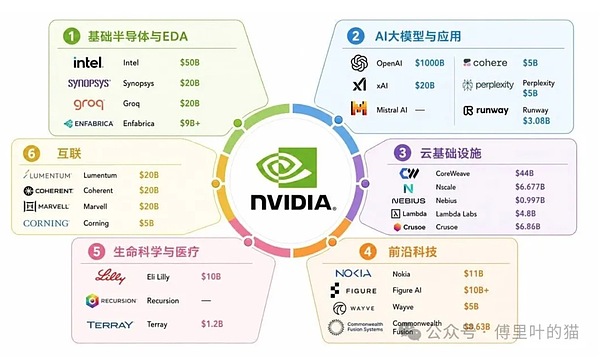
As you can see from the diagram, Nvidia's investments cover everything from the most basic chip manufacturing to the most advanced AI applications, with a presence in almost every key area.
Cooperation with Corning
Corning has previously stated that it will only expand production after receiving advance payments from customers. Nvidia's $500 million investment is actually sending a signal to the market: the demand for fiber optic cables for AI data centers will increase more than tenfold in the next 2-3 years. This isn't just Nvidia's own demand, but the demand of the entire AI industry. By securing production capacity in advance, Nvidia has achieved one thing: when competitors want to build large-scale AI clusters, they may find that fiber optic supplies have already been fully booked. The situation in China also reveals some clues; since the beginning of this year, fiber optic prices have risen dramatically, and prices are expected to continue to rise. Supply Chain Control With shortages across the entire industry chain, supply chain management has become a huge competitive advantage. Nvidia's control over the supply chain is unmatched by any other competitor. This capability is not only reflected in technology but also in capital and strategy. Nvidia's core strategy in its partnership with Corning is "investing and locking in production capacity in advance." This is fundamentally different from traditional supply chain collaborations. This reminds me of long-term agreements in the storage industry. This wave of long-term storage agreements differs significantly from the previous one: many buyers want to participate in the original equipment manufacturer's (OEM) capital expenditures. In other words, they want to form a community of shared interests, rather than simply signing a gentleman's agreement locking in quantity and price as in the previous round. Why this change? Because everyone realizes that in an era of tight production capacity, contracts alone are insufficient. Only by investing real money can a company secure its priority in the supply chain. Speaking of supply chain lock-in, OpenAI is a must-mention. Although there were reports last week that OpenAI encountered some problems, as we analyzed, its main issue lies in product capabilities; it does lag behind Claude in terms of actual production capacity. However, OpenAI's biggest advantage remains its supply chain capacity. Last year, Altman frequently signed cooperation agreements with supply chain companies, making grand promises, essentially locking in production capacity. This will be a significant advantage for OpenAI in the future. Because in the AI industry, products can iterate, and technology can be caught up, but production capacity takes time to build. When your competitors want to expand, they may find that TSMC's wafer capacity is already fully booked, data center power capacity is insufficient, and fiber optic cables are unavailable. This is the power of the supply chain. Domestically, we understand that CSPs have been actively scrambling to acquire inventory. Therefore, managers of companies in the AI/semiconductor supply chain should secure necessary materials in advance if AI might seize their production capacity. Many AI supply chain products are no longer sold on a cash-on-delivery basis as they once were.


 Brian
Brian


