Author: Anthony Pompliano, Founder and CEO of Professional Capital Management; Translated by Shaw Jinse Finance
Federal Reserve Chairman Jerome Powell and the Federal Open Market Committee (FOMC) began a two-day meeting, with markets closely watching whether the Fed will cut interest rates.
On Polymarket, the odds of a 25 basis point rate cut have risen to 95%, while the probability of no change is 5%.
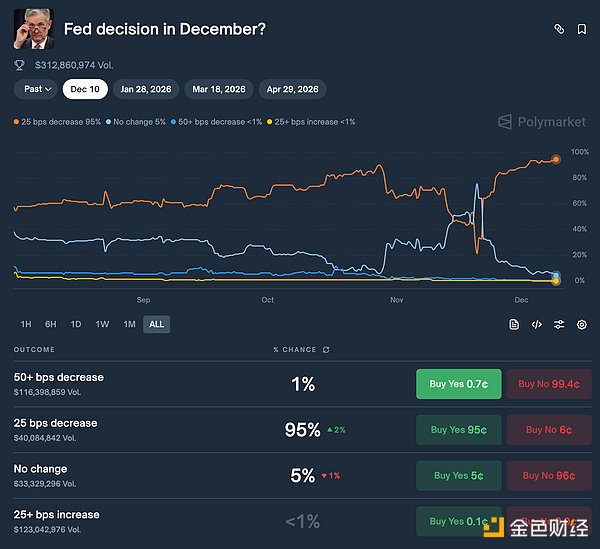
If the Federal Reserve cuts interest rates, this will be the third consecutive rate cut this year (following a 25 basis point cut in September and another 25 basis point cut in October). Even if inflation remains high, the rate cut will act as "insurance" to address the escalating risks in the labor market.
But I want to explain why the Federal Reserve should actually cut rates by 50 basis points tomorrow. First, we know that the labor market is weakening, and if not addressed proactively, it could trigger concerns about a full-blown economic slowdown or even a recession.
Nonfarm payrolls increased by only 119,000 in September, a significant slowdown from the post-pandemic average and below expectations. As a result, the unemployment rate rose slightly to 4.4%. Year-to-date, layoff announcements have surged to 1.17 million, the highest level since the outbreak of the pandemic in 2020. Meanwhile, hiring plans have reportedly fallen to their lowest level since the end of the financial crisis. Finally, private sector indicators such as the November ADP employment data and the Challenger layoffs report weakened further. These trends suggest that job growth is insufficient to match the expansion of the labor force. Given the labor market situation, the argument for a 50 basis point rate cut is that a larger rate cut would help employment and prevent a vicious cycle of reduced consumption and further hiring freezes. However, the arguments for a 50 basis point rate cut are not solely based on the labor market. I believe the government's published inflation gauges significantly overestimate inflation, which supports a larger rate cut. Core personal consumption expenditures (PCE) inflation is currently around 3% (about 1% above target), but deflationary factors mitigate the risk of renewed inflation acceleration. This should allow the Fed to focus on its dual mandate's employment goal. Critics argue that commodity prices remain high due to tariffs and fiscal stimulus, but falling oil prices, oversupply in the rental market, and declining home prices pose a deflationary risk, which, in my view, gives the green light for a larger rate cut. In addition to these factors, both the Fed's forecasts and market-implied inflation expectations are stable at around 2%. This is clearly lower than the nearly 4% predicted by consumer surveys, but we know these surveys are biased and may deviate further from market consensus. A 50-basis-point rate cut aligns with the Fed's October statement that it would "adjust policy as appropriate if risks materialize," therefore, the Fed could interpret a larger rate cut as targeted support rather than a policy shift. Thus, while we face a weak labor market and inflationary conditions, the final decision on a rate cut exceeding 25 basis points still rests with the FOMC members. Fortunately, there are some pragmatic individuals within the Fed who seem to believe a larger rate cut would be beneficial. We know there are currently significant divisions within the Fed, which could foreshadow a surprisingly large rate cut. Fed Governor Stephen Milan has recently opposed a 50-basis-point cut twice. He stated in November that a significant rate cut in December would be "appropriate" to address labor market risks. At the time, he stated that the December rate cut would be "at least 25 basis points, but without new information... 50 basis points would be appropriate." Milan was not alone in this view. New York Fed President John Williams and San Francisco Fed President Mary Daly also expressed support for accommodative monetary policy. Williams explicitly stated that he believed rate cuts were "insurance" against a labor market downturn without jeopardizing the inflation target. So, what changes do analysts foresee within the Fed? Nomura Securities analysts predict that Milan will take a dovish stance, advocating for a 50 basis point rate cut, while other members may take a hawkish stance, even opposing a 25 basis point cut. This highlights a rare divergence among committee members on the issue of easing policy. This kind of internal dynamic is rare, because we've almost never seen such a wide range of opinions in the past 35 years. This could prompt policymakers to take bolder action or cut rates more drastically. So what are my expectations? I think the final cut will be only 25 basis points. I would prefer a 50 basis point cut, but I don't see enough power within the Fed to take more aggressive measures. Market dynamics suggest that the rate cut should be larger. The economy would also benefit from a larger rate cut. Unfortunately, the Fed's strategy is too conservative. They are afraid to face themselves, let alone make bold decisions. Now we are all waiting for the results. The Fed is holding its FOMC meeting. Trillions of dollars will be betting on what Jerome Powell will say at his press conference tomorrow. The world will continue to turn, the US economy will continue to strengthen, and the stock market will rise sharply in the coming months. The Federal Reserve cannot stop this trend, no matter how poorly they manage monetary policy.


 Miyuki


