Bitcoin Users Face High Fees as Ordinals Activity Resurges
Bitcoin fees have surged to a six-month high, causing concerns among users as Ordinals activity makes a strong comeback.
 Jasper

Author: Stacy Muur; Translator: Tim, PANews
How to evaluate a project's TGE performance?
For each token, I examined three aspects:
Current price compared to all-time high: What percentage has it retraced from the high?
Time: How long has it been since the all-time high (early-stage projects ≠ completely "tested")
Liquidity to market capitalization ratio: Is this genuine price discovery, or market noise due to insufficient liquidity?
You can understand this as: If you bought at the TGE and didn't sell at the high, how does your profit/loss compare to other tokens of the same tier?
Note: This article represents the author's views only, not PANews's views, and is not investment advice. S-Level: TGE Winner Avici (AVICI) is in a league of its own, S+ Performance: Highest price $5.6, current price $4.3, only a 20-25% drop. For a new coin, this performance is exemplary: strong price, low volatility, and although the circulating supply is small, the turnover rate is considerable. Analysis: Typical "winner" characteristics; it experienced a surge, but unlike most new coins in 2025, the price has not completely fallen back to its starting point. Even now, early investors are still making substantial profits. YieldBasis (YB) Performance: Highest price $0.82–$0.94, current price $0.44–$0.56, a drop of 45–55%. The all-time high occurred in mid-October 2025, making it a recent peak; the current token price is still more than double its lowest point. Analysis: For a yield-generating project launched in a volatile market, maintaining half of its all-time high a month after launch is remarkable. This type of token falls into the category of "strong performance but beginning to revert to the mean." Sahara Labs AI (SAHARA) Performance: Highest price $0.16, current price $0.008, a drop of more than 50%, but still a 3-4 times increase from the low point. The project has received support from well-known venture capital firms (Pantera, Binance Labs, Polychain, etc.) and completed large-scale financing; its value discovery is not a meme-style correction. Analysis: In the current market environment, the fact that the price has fallen by half from its high while still maintaining strong trading volume is truly remarkable. The price has not collapsed and still maintains good liquidity. Limitless (LMTS) Performance: Depending on different data sources, the highest price ranged from $0.47 to $0.72, with the current price at $0.23, a drop of 50-65%. The TGE timeline is very close (late October 2025), and even after the initial airdrop unlock, the price is currently holding within the middle of the range. Analysis: While not reaching the level of AVICI, compared to the 70-90% plunge of most new coins, LMTS's stability is sufficient to barely place it in the bottom of the S-level or the top of the A-level. Grade A: Strong post-TGE trend but significant drop. Lombard (BARD) Performance: High of $1.5-$1.6, current price $0.72-$0.75, a drop of 50-55%, but still 2-3 times higher than the low. Analysis: A strong surge after launch, followed by a 50% drop, but it didn't fall into a death spiral. For the Bitcoin ecosystem narrative that relies on high leverage, this pullback is a tolerable growing pain. Kaito AI (KAITO) Performance: Highest price $2.89, current price $0.8-$0.9, a drop of 70%-75%. The current price is still more than 10 times higher than its early low, with ample liquidity and listing on multiple major exchanges. Analysis: This is exactly the TGE case I mentioned as a "successful but already revalued" scenario: early buyers made a fortune, while later entrants faced selling pressure. However, compared to most AI tokens in 2025, this can still be considered a relative winner. Omnipair (OMFG) Performance: Highest price $1.83-$1.86, current price $0.45, a drop of 75%. However, it's worth noting that the price is trending upwards from its earlier lows, and the circulating supply is relatively small. Analysis: After an initial strong surge, it experienced a significant pullback, but it hasn't been abandoned by the community. Performance is good, but not top-tier. Umbra (UMBRA) Performance: Highest price $2.47, current price $0.59-$0.6, a drop of 75%. Analysis: Similar to OMFG: it experienced excessive speculation and value reassessment, but still maintains activity and liquidity in the market, ranking in the upper-middle range. Avantis (AVNT) Performance: Highest price $2.64, current price $0.44-$0.45, a drop of 80%-83%, but still a 2x increase from its lowest point. A derivative DEX token, born from extreme speculative frenzy, it has now entered a value correction phase. Analysis: While the pullback was painful, it remains within the normal fluctuation range of derivative DEX tokens. Performance was mediocre but not catastrophic. OG Labs (0G) Performance: High of $7-7.3, current price $1.2-1.3, a drop of 80%-83%. Analysis: A typical high FDV infrastructure project, its fully diluted valuation was overextended, leading to a sharp market revaluation. However, it still maintains a considerable market capitalization and trading volume, and has not yet become an empty chain, falling into the A- to B+ range. Plasma (XPL) Performance: Highest price $1.69, current price $0.25-$0.27, a drop of 85% High trading volume, large market capitalization Analysis: Similar to 0G, it experienced a dramatic revaluation after a strong launch. However, compared to many seed-labeled tokens that plummeted by 98% in 2025, it is still considered a "success story". Grade B: TGE surges and then falls back. Linea.eth (LINEA) Performance: Highest price $0.046-$0.05, current price $0.01, a drop of 75%-80%. As a Layer 2 token with a huge airdrop volume, such a pullback is normal. Analysis: Similar to 0G, it performed strongly upon launch, but subsequently experienced a significant revaluation. Similarly, compared to many seed-labeled tokens that plummeted by 98% in 2025, it is still considered a "success story". Story (IP) Performance: Highest price $14.9, current price $2.9-$3, a drop of 80%. Due to strong VC support and an IP narrative, the token still maintains a considerable fully diluted valuation. Analysis: Early hype was unprecedented, followed by a continuous decline. While not disastrous, it clearly belongs to the "peak and fall" type of project. Falcon Finance (FF) Performance: Highest price $0.667, current price $0.14-$0.15, a drop of 75%-80%. Public data shows that its daily trading volume remains large, and its TVL is considerable. Analysis: From a price trend perspective, TGE was successful (early participants profited), but the token price still experienced a 70-80% drop. Babylon (BABY) Performance: Highest price $0.165-$0.17, current price $0.023-$0.025, a drop of up to 85%. Analysis: As a highly anticipated Bitcoin restaking token, its performance, while falling short of expectations, has not yet fallen into the "CORN/NC-style death spiral" trap. Union (U) Performance: Highest price $0.023-$0.027, current price $0.004, a drop of 80%-85%. Analysis: Typical trend for mid-cap governance tokens, a strong launch followed by a slow decline due to unlocking and inflation. U is not an exception among these tokens. Grade C: Poor performance after TGE. Berachain Foundation (BERA) Performance: Highest price $14.5, current price $1.3, a massive drop of 90%-91%. For a Layer 1 token with a top-tier narrative, huge expectations, and a high valuation, this performance can be considered a major failure. Analysis: From the perspective of TGE's performance, this is a typical example of excessive VC hype leading to inflated valuations and eventual value reassessment. Boundless (ZKC) Performance: Highest price $1.79, current price $0.15, a drop of 91%. Analysis: Its trajectory mirrors that of BERA, but with weaker brand strength; in terms of price, it is clearly a failed TGE. Mira (MIRA) Performance: Highest price $2.35-$2.61, current price $0.18, a drop of 92%-93%. Analysis: Similar to ZKC, after a significant surge, it experienced a deep decline, and its chart now resembles a skid-slope curve for a mid-cap token. Solv Protocol (SOLV) Performance: Highest price $0.15-$0.25, current price $0.016, a drop of a staggering 90%. Analysis: Considering Solv's experience and its claimed ecosystem scale, the price performance after TGE is truly disappointing. Allora (ALLO) Performance: Due to different data sources, the highest price was $0.85-$1.70, and the current price is $0.17-$0.18, a drop of 80%-90% in a short period of time. Analysis: This is an accelerated version of the airdrop coin model: after the hype subsides, the price plummets by 80-90% instantly. Grade D: TGE Disaster If these tokens generate heated discussions on Twitter, I will include them in this list as "headline-worthy failures". Corn (CORN) Performance: Highest price $13.98, current price $0.07, a drop of 99.5% Interpretation: This is a normal value correction. Unless you sell quickly near the peak, TGE will become a graveyard for investors. Nodepay (NC) Performance: Highest price $0.327, current price $0.0035, a drop of 99% Interpretation: A typical surge followed by a decline; the price almost completely collapsed after a rapid rise. A victim of the "airdrop + points mining" craze. Manta Network (MANTA) Performance: Highest price $4.05-$4.08, current price $0.1-$0.11, a drop of 97%. Analysis: For this project, which carried the L2 narrative and was once a star of Binance Launchpool, the current performance is disastrous. Among the well-known projects on this list, Manta is one of the most prominent examples of "excessive FDV".
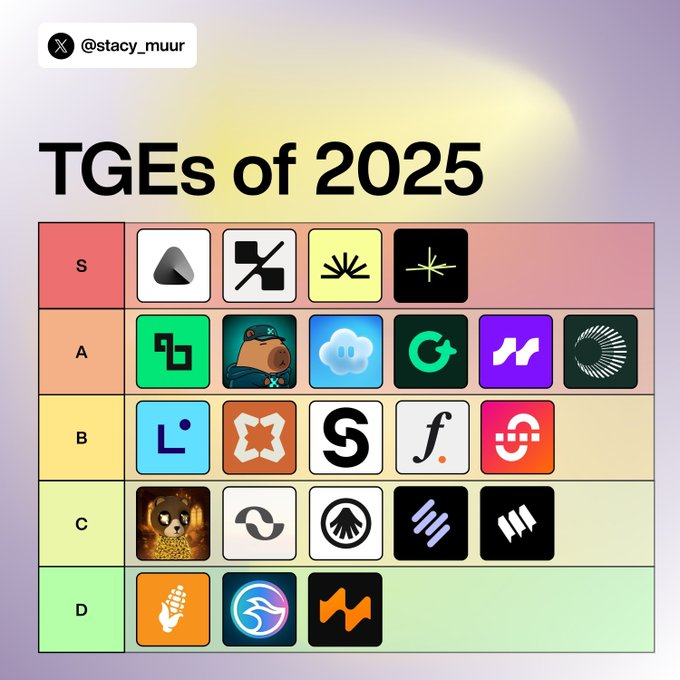
Brief Review of Mid-Tier Tokens
BABY: An 85% drop from its all-time high is indeed bad, but not an isolated case; I placed it in Tier B because, from a market perspective, it still trades like a legitimate Layer 1, restaking project, rather than becoming a dead mining token.
XPL, 0G, AVNT: All experienced 80-85% price retracements, but still maintained high trading volume and market capitalization.
XPL, 0G, AVNT: All experienced 80-85% price retracements, but still maintained high trading volume and market capitalization.
Failure to sell at the peak could result in significant losses, but in the 2025 token issuance environment, this is almost "normal." Omnipair, Umbra, BARD, and KAITO: These are mid-tier TGE cases that performed "decently"—they experienced a sharp initial surge followed by a significant pullback, but still maintained high market liquidity.
Bitcoin fees have surged to a six-month high, causing concerns among users as Ordinals activity makes a strong comeback.
JasperGemini's compliance with the UK Travel Rule raises worries about restrictions on crypto users' freedom and self-custody rights.
 Hui Xin
The US SEC counters Binance's plea to dismiss the lawsuit, asserting that the cryptocurrency exchange has not accurately applied the law.
 Kikyo
KikyoGoogle's YouTube AI introduces comment summaries and conversational AI, streamlining the comment section, enriching user experience, and aiding content creators. These features are currently in beta testing for premium users until December 5, showcasing Google's commitment to AI innovation.
 Jixu
JixuThis comprehensive order seeks to establish rigorous artificial intelligence (AI) safety standards, with a focus on safeguarding citizens, government entities, and companies.
JasperFormer CEO and co-founder of Kyber Network, Loi Luu, recently unveiled Caliber, a pioneering Web3 venture builder focused on crafting crypto consumer applications.
 Joy
JoyBitcoin has achieved a significant milestone by surpassing Ethereum in 24-hour NFT sales volume, marking a notable shift in the NFT market. Despite Ethereum's higher total sales, Bitcoin's lower wash percentage suggests a potentially healthier market, while the data also highlights a narrowing volatility spread, indicating increased attention towards Ethereum and alternative cryptocurrencies.
JixuBraden John Karony, the CEO of SafeMoon, has been detained in Provo, Utah, marking a significant development in the ongoing legal case against him.
 Aaron
AaronTop enterprises participate in a bidding process with the aim of resurrecting FTX from its financial distress. Meanwhile, SBF’s awaiting sentencing for alleged fund misappropriation.
 Catherine
US introduces bills to limit China's role in blockchain and cryptocurrency, aiming to protect national security and data privacy.
Hui Xin