AI-Fi金融芯片与Openclaw奇点后的全球金融
AI Agent和Crypto智能合约封装的超智能金融资产和AI-Fi适配下一个时代的金融环境。
 JinseFinance

Author: @ratsxp
We produce the most cost-effective tokens to welcome the era of application explosion.
Now it's American programmers and Wall Street's turn to lose sleep and start getting anxious.
Now it's American programmers and Wall Street's turn to be sleepless and anxious.
Author: @ratsxp
If the first miracle was the generative AI boom sparked by ChatGPT, and the second was the arms race of multimodal and super-large models, then the third miracle belongs to the emergence of autonomous agents, and the Claude series from the American AI company Anthropic is one of the protagonists in this scene. Claude Code is an intelligent programming assistant launched by Anthropic at the end of 2024, which brings an almost magical "vibe coding" experience.
The process of writing code using Claude Code is jokingly described by some developers as playing a "slot machine" gambling game: You simply describe your requirements in natural language, and Claude Code generates a piece of code; if the result is unsatisfactory, you describe the problem again, and the model quickly adjusts and fixes; this cycle repeats itself, and this continuous trial and error is like repeatedly pulling the lever of a slot machine until a satisfactory "jackpot" code randomly appears. The wildly popular OpenClaw this month is the result of developer and founder Peter Steinberger spinning the Claude Code slot machine for two months.
“This experience is so addictive, like a slot machine. For months, I barely slept. I even started a club where everyone started using it at 5 a.m. every day….”
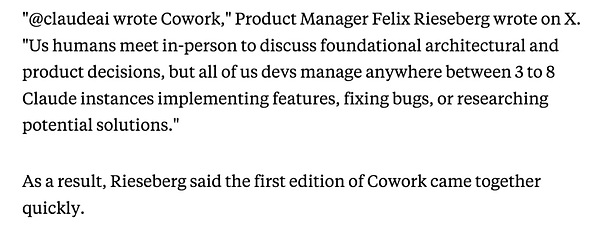
This is what the world's top developers have been doing every day for the past few months. It can be said that Claude Code has led a revolution in coding paradigms, amazingly lowering the barrier to software creation. Later, OpenClaw was officially released and received a huge response, becoming the third AI "spectacle" after AlphaGo's victory over Ke Jie and the release of Chatgpt. The remarkable thing about OpenClaw is that it is compatible with almost all mainstream models, allowing users to freely combine OpenAI's GPT model, Anthropic's Claude model, Google's Gemini model, and even various Chinese open-source models as the "brain" to perform autonomous tasks. While major tech companies are still vying for control of closed ecosystems, this grassroots product takes a different approach, adopting a completely open strategy and making "your AI, your choice" a reality. After its explosive popularity in February, OpenClaw quickly gained the favor of millions of users worldwide, hailed as a "phenomenal breakthrough" in the field of AI agents. The successive releases of Claude Code and OpenClaw signify that this "AI wonder" has moved from the laboratory to the masses. A new concept has emerged—the era of "AI wonders." AI is no longer just a competition of model parameters and benchmarks, but has begun to demonstrate miraculous efficiency and productivity at the application level. Anthropic's Claude Code proves that AI can significantly simplify complex tasks like programming; while OpenClaw demonstrates that agent-based AI can automatically perform complex tasks in the real world. These two achievements complement each other, laying the groundwork for the Agent era. 1M Reviews doesn't want to paint a grand narrative, but we are currently standing at the turning point of the third miracle of AI development, a world created by autonomous agents is slowly unfolding. The first chapter of the Agent history textbook: Replacing the software industry. Again, it's Anthropic. Last week, its AI Agent tool, Claude Cowork, added plugin functionality and released 11 plugins covering finance, sales, legal, and other fields. Upon its release, global software stocks collectively plummeted, wiping out $300 billion in market value. Wall Street even coined a new term for this phenomenon: "SaaSpocalypse," meaning the end of SaaS. All of Claude Cowork's code was automatically generated by Claude Code, a process that took only 10 days. Boris Cherny, head of Anthropic, stated that all his code over the past two months was generated using AI, and Cowork is precisely "a product written with AI tools." The product manager in charge of the project revealed on social media platform X: "@claudeai wrote Cowork. We humans only discussed architecture and product decisions in meetings, while developers each managed 3 to 8 Claude instances to implement features, fix bugs, or research solutions." Because of this, the first version was completed in just a week and a half. In other words, from deciding to develop to officially launching, a complex software plugin completed the entire process in only about 10 days. The rapid birth of the Cowork plugin declares to the world: The software development model has been fundamentally revolutionized. On X, it was observed that the industry interprets the birth of Claude Cowork as a real-world prototype of a "one-person company": with minimal human resources (even just one person), and with the help of powerful AI agents, projects that previously required an engineering team of months to complete can be finished. A programmer plus an agent can essentially become a company.

By taking a macro perspective, we can see that in this competition of the Agent era,「
AI Agent和Crypto智能合约封装的超智能金融资产和AI-Fi适配下一个时代的金融环境。
JinseFinanceStart cultivating a Claw. Not because it's easy—it's painful, and the tools are crude. But the people who put this into the work today are building something that grows with compound interest.
JinseFinanceOpenClaw founder Peter Steinberger has banned all crypto mentions on Discord after a user was removed for mentioning Bitcoin in a technical discussion. The rule followed a scam in which hijacked accounts promoted a fake $CLAWD token that briefly reached about $16 million before collapsing.
 Weatherly
OpenClaw community rules: No discussion of finance or crypto. This is perhaps the most incisive criticism of Web3, and also the most sincere advice.
JinseFinanceOpenAI, Artificial Intelligence: The father of OpenClaw joins OpenAI; Ultraman gets his hands on him! Golden Finance reports a major personnel change in the AI Agent industry.
JinseFinanceAn in-depth analysis of the asset repricing triggered by AI's shift from providing advice to autonomous execution: revealing the collapse of the value of old assets that rely on human labor, and exploring the systemic migration of funds to computing power, automated settlement protocols, and embodied intelligent hardware.
JinseFinanceMoltbooks are like dazzling fireworks, illuminating people's fantasies about AI-powered social interaction while also revealing the absurdity of current technology. But in the darkness after the fireworks have faded, OpenClaw is quietly building the future.
JinseFinanceThe various components of the AI-driven intelligent agent economy—payments, reputation, and identity—have been built up over the past few months. OpenClaw may be the platform through which they are connected.
JinseFinanceHow can a local AI "born to be lazy" become the master of your computer?
JinseFinanceOn the Base chain, a native ecosystem of AI agents called OpenClaw is rapidly taking shape.
JinseFinance