Foreword
Vitalik has always been a man of principle. I don't recall him ever going through a period like this.
In the cryptocurrency world, he is my favorite person for many reasons, but for now, please allow me to set aside emotions. Set aside my admiration, set aside my years of following his work, and set aside the fact that he built a system I spent nearly five years thinking about. Forget all of that.
He's right. I said it yesterday, and I'll say it again tomorrow.
In his 2017 paper, "The Meaning of Decentralization," he outlined three key axes—architecture, politics, and logic—which still define how we view blockchain today, and he is correct.
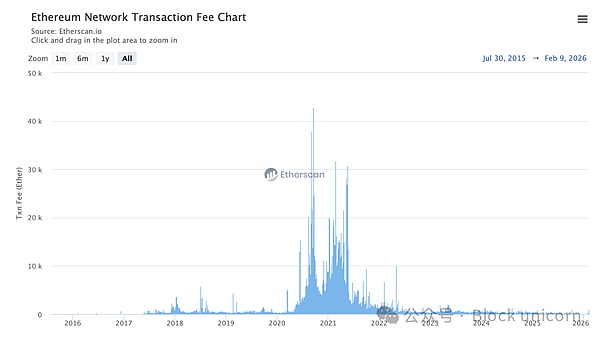
He was right when he published his 2024 article, "Don't Choose Your Political Stance Based on Who 'Supports Crypto'," and he was right in his point. He was also right to question the notion that Ethereum is merely "ultrasonic money," and to argue that we value Ethereum more as a practical infrastructure than as a speculative asset. He was also right to refuse to reduce decentralization to a marketing term and insist that it has real meaning. And now, when he says that a Rollup-centric roadmap is no longer valid, he is still right. His views on artificial intelligence and Ethereum are also correct, which we will discuss later, but currently almost no one is paying attention to this part (though they may have to later). I am not an extreme advocate of Vitalik (well, maybe I am). But I disagree with his execution, timing, and whether Ethereum's pace of development in certain areas should be faster or slower. However, I trust his judgment. I believe he speaks publicly because he firmly believes it to be the truth, not because of political considerations, to benefit token prices, or to appease allies. He never talks empty theory; he corrects course in a timely manner. And now, Ethereum needs a directional adjustment. Let's start by talking about what has changed. The Ethereum L1 layer is now doing what the L2 layer should be doing. The Rollup-centric roadmap stemmed from a problem: Ethereum L1 couldn't scale. During peak hours, gas fees per transaction soared to $50, $100, and sometimes even $200. Slow network speeds and high costs meant that Ethereum had to make some changes if it was to become the foundational layer of the crypto economy. The solution that began in 2020 was Rollup. The original plan was to build an execution layer on top of Ethereum to process transactions faster and cheaper, then settle the final state back to the L1 layer. Ethereum itself would remain decentralized and secure, while transaction volume would be handled by the L2 layer. So, what happened next? L1 is scaling. Ethereum transaction fees average less than $1. Gas limits are expected to increase significantly by 2026. PeerDAS is already live on the mainnet. ZK-EVM proofs are ready, and cryptographic proofs are in development. Today's L1 is vastly different from the L1 of 2020 that needed a Rollup-centric roadmap to save it. It's faster, cheaper, and, from a technological development perspective, its functionality will be significantly enhanced.
![]()
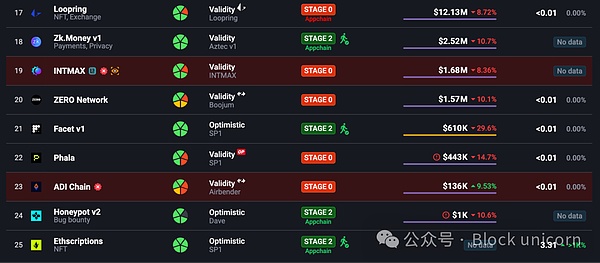
Four. Four out of 25 Rollups. Four out of 151 projects.
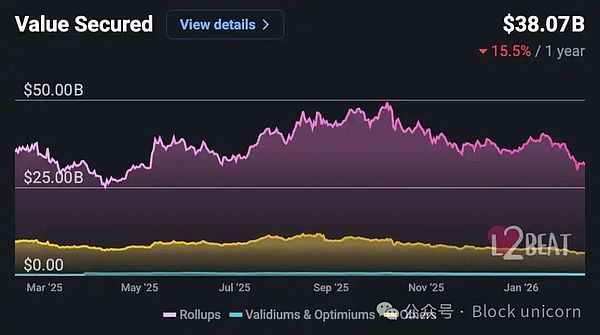
The rest are in Phase 0 or Phase 1. Phase 0 means the blockchain is completely centralized, and the governing body can unilaterally change the rules. Phase 1: There is a path to decentralization, but ultimate control remains with the security council or multi-signature mechanisms. L2 aims to be an extension of Ethereum's branded sharding, offering the same security, the same trustlessness, and the same guarantees, but faster and cheaper. This hasn't happened. Base is one of the most active L2 platforms, but it won't reach Phase 1 until 2025. Arbitrum, Optimism, and Scroll are currently in Phase 1. Starknet is in Phase 0. Many smaller L2 platforms launched in the past two years are still in Phase 0 and are likely to remain there indefinitely. Some teams have even publicly stated that they may never want to move beyond a stable state because their corporate or regulatory clients demand ultimate control. That's fine. But it means they're not Ethereum, but something else entirely. Now, let's talk about where this activity is actually happening. The total value locked (TVL) of all Ethereum L2 is $38.5 billion. Of that, Arbitrum holds $15.7 billion and Base holds $10.4 billion. These two chains account for 68% of all L2 TVL. The next tier, such as OP Mainnet, Lighter, Starknet, Ink, Linea, and zkSybc Era, has a total market capitalization of approximately $6 billion. The rest are negligible. 

 Anais
Anais


