Author: Naly Source: moneyverse Translation: Shan Ouba, Jinse Finance
The clock ticks, leverage roars and groans. That fleeting glimmer of hope, under the interwoven sky of K-lines, ultimately transforms into an unheard sob.
How much of your life have you spent trying to predict the direction of the next K-line? How many hours have you buried yourself in studying charts, analyzing narratives, and tracking catalysts—all for a zero-sum game with a win rate of less than 1%?
Data may not prove your so-called advantage, but that doesn't mean there's no winning strategy in the market.
You don't need to fight tooth and nail for every trading opportunity, nor do you need to spend your weekends chasing fleeting "excess returns."
You don't need to obsess over every trading opportunity, nor do you need to waste your weekends chasing those ephemeral "excess returns."
You can look to the wise investors who have weathered multiple bull and bear market cycles—they prove with iron discipline that composure is far more vital than fleeting dopamine rushes. These investors are rational and patient, their trading frameworks robust enough to withstand any market storm. Lyn's Macro Perspective: Lyn's views are straightforward. The strength of the US economy is not comprehensive or balanced. If capital expenditures on artificial intelligence and data centers are excluded, real GDP growth would plummet from 4% to near zero. The current economy exhibits a two-speed pattern: artificial intelligence, cloud computing, and deficit spending are far ahead, while most other sectors are sluggish. Most industries show signs of fatigue. Commercial real estate is still slowly clearing out, while residential real estate is struggling to breathe under the pressure of high prices; private equity and some venture capital sectors are frozen; manufacturing and service industries, while not collapsing, lack any momentum for expansion. This is merely a weak cycle masked by a noisy sector. If you are at the top of the income pyramid, if you can personally enjoy the benefits of the artificial intelligence industry and the lure of government funding, you will feel that prosperity is within reach; but if you are a young person, burdened with debt, or an ordinary person outside the circle of benefits, you will feel like you are struggling against a cold, turbulent current, with the whispers of every poor decision you've made this year constantly echoing in your ears. Student loans, demographic burdens, and healthcare costs—these mountains are suffocating people, crushing them before they even have a chance to begin their lives. This is the underlying logic behind the frenzied speculation we see on the blockchain every day: when you can't afford quality assets and can't keep up with inflation, you'll desperately seek any opportunity that might get you out of the predicament. People aren't looking for sound long-term planning, but rather the "jackpot" of overnight riches. This is why a large amount of speculative capital is flowing into meme coins instead of into emerging infrastructure construction. As I wrote in my article "The Era of Overnight Riches": many people today aren't building investment portfolios, but rather firing desperate escape velocity bullets at this seemingly manipulated system. Lyn believes that artificial intelligence has a dual nature: it is both a real technological revolution and a massive bubble. The AI industry related to data centers has already begun to reshape the work patterns of white-collar workers. Its disruptive impact is comparable to the impact of automation on traditional factories, and given time, it will undoubtedly create trillions of dollars in value. However, beneath this core lies a bubble of unprofitable companies—companies that burn through cash to maintain the illusion of "exponential growth." Nvidia and large cloud service providers are exceptions, while the vast majority of participants in the ecosystem are merely "scaffolding" for this speculative game. Lyn predicts that the artificial intelligence industry will cool down. This will not be a collapse, but rather a two- to three-year period of digestion and adjustment: capital expenditure growth will slow, weaker companies will be eliminated, the entire sector will be reset, and it will build momentum for the next round of growth. Liquidity and Fed Policy Lyn points out that quantitative tightening is nearing its natural limit. Bank reserves cannot be drained indefinitely, otherwise the financial system will inevitably crack. Her baseline forecast is that quantitative tightening will pause, and the Federal Reserve's balance sheet will resume expansion as early as the first half of next year—a slow and low-key process. This will not be a panic-driven, large-scale quantitative easing, but rather a structural adjustment to accommodate fiscal deficits and nominal GDP growth. In her words, this is the era of fiscal dominance. The government sets the trajectory of fiscal spending, and the central bank will ultimately have to "make way" for it.
Bitcoin in Lyn's Eyes
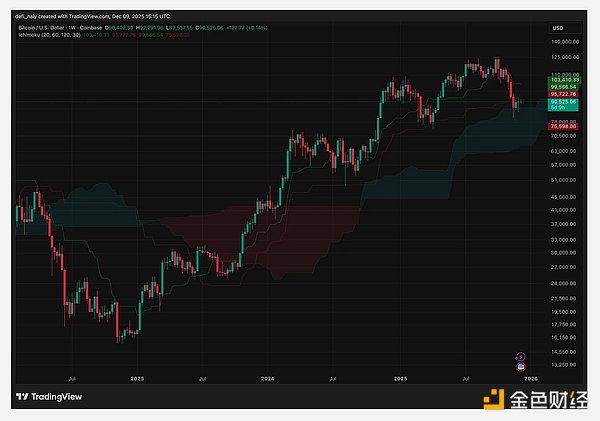
Bitcoin's price has been fluctuating sideways throughout the year, but Lyn believes this is not a sign of weakness, but rather the proper posture of a mature monetary asset.
Inflows into Bitcoin spot ETFs have remained stable, but long-term holders are taking this opportunity to reduce their holdings for hedging, absorbing the market's buying pressure; retail investors have not yet returned; the impact of the halving event has weakened, and liquidity is the key to determining the trend.
Bitcoin's price has been fluctuating sideways throughout the year, but Lyn believes this is not a sign of weakness, but rather a natural posture for a mature monetary asset.
Inflows into Bitcoin spot ETFs have remained stable, but long-term holders are taking this opportunity to reduce their holdings for hedging, absorbing the market's buying pressure; retail investors have not yet returned; the impact of the halving event has weakened, and liquidity is the key to determining the trend.
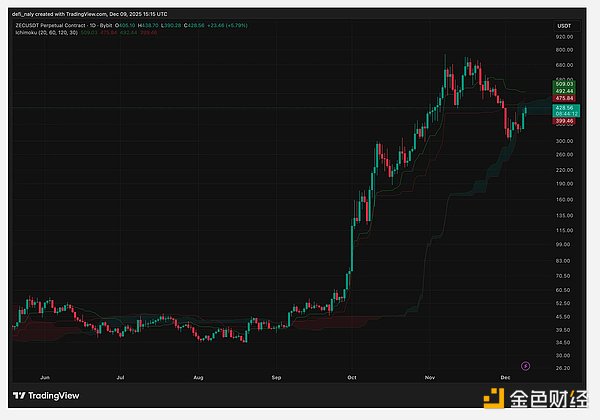
Her baseline prediction is that Bitcoin will consolidate in early 2025, reaching a new all-time high in 2026 after a liquidity inflection point. Lyn also mentioned a potential long-term risk that the industry still considers science fiction: quantum computing and AI-driven on-chain data analytics. These two technologies are constantly eroding the long-term security of transparent blockchains. Early Bitcoin addresses with exposed public keys are the weakest link in the entire system. If we assume that Bitcoin's mission is to survive for decades rather than just a few years, then the resistance of its encryption technology to attacks will ultimately become a core issue concerning its survival. As she stated, while Bitcoin can certainly be upgraded to a quantum-resistant signature algorithm, "this process will bring a significant disruptive risk to decentralized systems." The boundaries of macro narratives are constantly narrowing, and Bitcoin is gradually moving towards a "mature form"; the cryptocurrency field has not seen a new underlying innovation paradigm for a long time; at the same time, the world we live in is becoming increasingly transparent—everything can be tracked and analyzed by machines. If the cryptocurrency industry solved the feasibility problem of "digital currency" in the past decade, then in the next decade, we must overcome the difficulties of private digital currency. Mert discusses privacy technology, zero-knowledge proofs, and the forgotten cornerstone of cryptocurrency. Mert begins by pointing out the core principle that early cypherpunks never forgot: privacy was never an add-on option for cryptocurrency, but rather its underlying premise. However, almost all mainstream public chains have abandoned this principle in pursuit of convenience and composability. The consequence is that the entire crypto ecosystem has become a transparent "glass house." Account balance, fund flows, user behavior—all information is readily available and permanently stored. Zcash has chosen a completely different path. It retains Bitcoin's monetary framework but completely replaces the transparency mechanism with encryption technology. Zero-knowledge proof technology conceals the sender, receiver, and transaction amount, fundamentally eliminating the possibility of identity verification. For this reason, Mert believes that Zcash is currently the most quantum-resistant Layer 1 project among all existing public blockchains. This is also why a host of industry leaders are once again focusing their attention on it—Naval, Ferriss, Barry Silbert, and Chris Burniske are among them. Mert emphasizes that this is not a passing hype, but a sober understanding of the market: the trillions of dollars in value previously created by the cryptocurrency industry were built on the assumption that no one has the ability to analyze every transaction on the chain. Artificial intelligence technology is dismantling this assumption in real time. Once slow and cumbersome privacy transactions can now be smoothly completed on mobile devices through the Zashi wallet; cross-chain privacy protection features are gradually becoming more widespread. Zcash's core concept is transforming from a niche experiment into a much-needed piece of the crypto ecosystem's puzzle. In a world where funds are on-chain, wallets are identities, and artificial intelligence can track fund flows in real time, privacy protection has become a macro-hedging tool. It protects user assets, maintains token fungibility, and reduces the risk of system attacks. Privacy is no longer an added bonus, but a necessity for the long-term healthy development of the cryptocurrency ecosystem.
Conclusion
Based on various perspectives, the outline of the future is already clear.
The macroeconomic landscape is narrowing. Bitcoin is gradually playing its due role. The old narrative of cryptocurrencies has dried up. And the complete transparency that was once seen as a trophy is now beginning to seem like a burden in a world filled with surveillance and pattern recognition.
If the past decade has proven the possibility of "digitally held assets," then the next decade requires us to prove that these assets can remain secure. This security extends beyond simply mitigating the risks of code vulnerabilities or poorly designed tokens; it also requires preventing indiscriminate scraping of on-chain traces by artificial intelligence, the cracking of old keys by quantum computing, and the harsh reality that permanent transparency and ubiquitous adversaries are fundamentally incompatible. This is why privacy technology is no longer just a niche preference but is poised to become the next major narrative. This privacy is not merely superficial obfuscation but true cryptographic protection. We need to build systems that elevate confidentiality to the same level of importance as Bitcoin's scarcity. Zcash's position in this arena is particularly unique. It not only replicates Bitcoin's monetary model but also incorporates zero-knowledge proof technology at the underlying protocol layer. Furthermore, it's one of the few public blockchains that seriously addressed quantum risks from the project's initial design, rather than treating it as a problem to be solved later. Of course, this is not a guarantee of Zcash's success. For a narrative to become reality, it requires the joint efforts of developers, capital, and users. However, if future value continues to migrate on-chain, and quantum computing technology does indeed achieve a breakthrough within 10-30 years, it's hard to imagine that privacy-preserving digital currencies won't become a core component of the crypto ecosystem. If everything can be on-chain, how can privacy protection be absent?


 Weatherly

