US and UK Establish Official Partnership on AI Safety
The United States and the United Kingdom have formalised a partnership aimed at enhancing safety protocols for artificial intelligence systems.
 Catherine

Author: Punk (2898) Source: X, @punk2898
First conclusion: Binance and OKX's biggest enemies have never been each other; they may even be a community of shared interests.
Recently, Binance and OKX have been competing with each other in various public occasions. On CT, people are comparing who is stronger and who has been surpassed by whom every day. The BD, operations, and KOLs of both companies are secretly competing. But to put it bluntly—these two companies are focusing on each other, which is a typical "competition trap."
You focus on your biggest enemy, and as a result, you get stabbed in the back without even knowing where the blood came from.
Why can't Binance and OKX kill each other? Second-tier exchanges: Three ferocious beasts no one dares to ignore. Compliance is a double-edged sword: armor is also a shackle. US stock trading—the most terrifying battlefield shift. Campuses, altcoins, and Chinese communities—a slow, agonizing process. The endgame: the enemy of my enemy is my friend. I. Why can't Binance and OKX kill each other? Many people have this ingrained mindset—market share is limited; it will either be swallowed up by Binance or OKX. This logic sounds correct, but it's actually completely wrong. Look at the current situation of these two companies: Binance has received the "endorsement" of the US government (CZ has finished his jail time and moved on), and has obtained compliance licenses in more than a dozen countries worldwide. OKX isn't far behind either—European payment license, Dubai VASP authorization, Singapore MPI, Australian AUSTRAC, and a federal registration license in the US. To put it bluntly, these two companies are too big to fail. The only thing that could bring them down is the risk inherent in their founders. However, CZ is currently keeping a very low profile, and Star is also focusing on product development; both are quite conservative. Therefore, the conclusion is simple: neither of them can completely destroy the other. Market share may fluctuate, but the overall landscape will remain the same. The question then arises—since neither can completely eliminate the other, who is eroding market share?
The answer is those second-tier exchanges that are eyeing us covetously
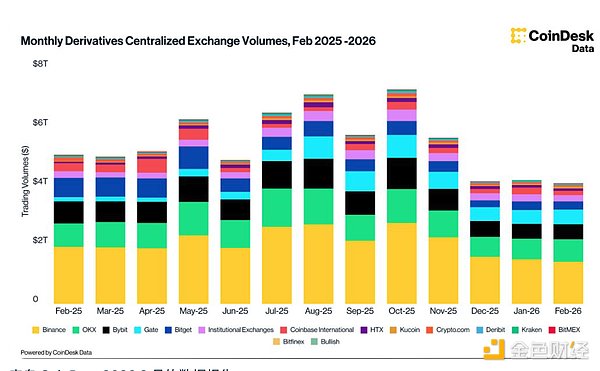
Data report from CoinDest, February 2026
Don't underestimate them just because they don't have the same level of influence as Binance and OKX
Don't be fooled by their lower profile compared to Binance and OKX
Large, but each player has carved out its own niche in a specific market. Bybit is the most competitive among the second-tier players, with the best refined operations. It boasts 70 million registered users and ranks among the top five globally in derivatives trading volume. Bybit is clever; it's not high-profile in PR, quietly making its mark. Look at its contract products, copy trading system, and wealth management products—their iteration speed is even faster than OKX's (the reasons will be explained later). Bitget has found its own unique path—US stock trading, and it's all in. They officially announced: "We are transforming into a full-asset exchange," which translates to trading US stocks. Partnering with Ondo Global Markets, they've listed a host of US stock tokenization assets, including Tesla, Nvidia, Apple, Microsoft, and Amazon, with 24/7 trading. Previously, could you trade Tesla on Binance or OKX? No. For the best liquidity in US stock tokenization trading, you had to go to Bitget. Why is Bitget the only option? In two words: compliance. Binance and OKX dare not touch this. Note: However, in the last week or two, Binance and OKX finally resolved their compliance issues and listed on US stock futures contracts. Gate has a relatively weak presence, but it did something that others were unwilling to do—listing all new coins immediately. Projects that couldn't be listed on Binance or OKX, or on Bybit or Bitget, could be listed on Gate immediately. In short, Gate replaced Matcha in its prime and Uniswap in the DeFi era—if you want to grab early alpha, you have to come to Gate. Everyone has their own place. "But these positions are slowly but surely cutting into Binance and OKX's flesh." III. Compliance: A Double-Edged Sword – Armor and Shackles. Why can second-tier exchanges erode the profits of first-tier exchanges? Because Binance and OKX chose compliance. Compliance is armor, making them too big to fail and attracting institutional funds. But compliance is also a constraint—if you want something, you have to give up a large part of it. When dealing with Binance and OKX, you'll notice a phenomenon: "Compliance is the first priority in everything." "Can this be done?"—First, ask about compliance. "Can that be launched?"—First, ask about compliance. "Can a new product be launched?"—First, ask about compliance. Compliance has become the top priority. This isn't wrong in itself; it's their foundation. But the problem is, the things compliant exchanges can't do are precisely the most profitable things. Who gets to take those profits? Second-tier exchanges
What's even more frustrating is that when problems arise, people don't blame the second-tier exchanges; they blame Binance and OKX instead.
Business competition is that ruthless.
What's the hottest sector in 2026? Everyone can see it—US stocks.
Altcoins are no longer traded, but everyone is still active. Where did they go?
The battleground is now dominated by two companies: Hyperliquid – the king of on-chain derivatives. Its daily trading volume reached $6.35 billion, weekly trading volume $15 billion, and active traders reached a record high of 231,000. It holds a 44% market share in on-chain perpetual contracts, pushing Aster's share down from 30.3% to 20.9%. What do these figures mean? This means a large number of users who should have been trading contracts on Binance and OKX have moved to on-chain. Bitget—the best centralized exchange for US stock trading—is a very clever "full-asset exchange" positioning. If you want to trade US stocks in the crypto world, besides Bitget, you can't find any other options, let alone liquidity (Binance and OKX are now catching up). Binance and OKX only listed a small number of US stocks in the first half of the day. Why? For compliance. So how can Binance fight back? There is one way—increase US stock trading in the Binance Wallet, with Aster as its biggest partner. But look at the promotional buzz in the market, it's very weak, nothing like Bitget's big-name marketing. This is a very clear signal: compliance is restricting their actions. And OKX? To be honest, they finally got investment from the NYSE's parent company and listed some US stock contracts a few days ago, but it's far from enough, and the trading volume is a bit low, plus they don't dare to promote it.
US stocks are just the largest part; second-tier exchanges are eroding much more than that.
I have to criticize this—promoting campus ambassadors to get college students to trade cryptocurrencies is morally wrong. Students don't have much money, and trading cryptocurrencies at this stage does more harm than good.
But from a profit perspective? Absolutely right
Are you promoting it while you're in school, or after graduation? The ROI is definitely higher while you're in school.
Young people develop usage habits, becoming lifelong users after graduation. Exchanges like Bybit and Bitget are doing this. Would Binance and OKX dare to do it? No. If they did, they'd be criticized, and compliance wouldn't allow it. So these future new users would be snatched away one by one by second-tier exchanges. Want to win them back? You can only wait until these people mature and then try to transfer them to exchanges with better liquidity and security. But that's difficult; user habits are hard to change once formed. New altcoin listings: This is another area that's been eroded the most. Binance and OKX can list fewer and fewer coins, and the review process is getting stricter. What if you can't list them? This share naturally went to Gate and other second-tier exchanges. Binance made a clever counterattack – Binance Alpha showcases and trades on-chain assets through its wallet, essentially reaching users without going through the formal listing process. This move certainly put second-tier exchanges in a bind. But what about OKX? Currently, it lacks an equivalent counterattack. It finally received investment from the NYSE's parent company, but the listing date is still uncertain. Regarding promotion in Chinese-speaking regions, OKX and Binance can only use online channels and cannot conduct large-scale on-the-ground promotions in Chinese-speaking areas. Second-tier exchanges don't have this concern; they can promote and operate as they see fit. All of this combined is a slow and steady approach. Each cut isn't fatal, but each one draws blood. That's why Binance and OKX have started focusing on ground promotion again in the past year. Why? Because they're being forced into a corner. VI. The Endgame: The Enemy of My Enemy is My Friend. At this point, the logic is clear: Binance and OKX's path is set—compliance, internationalization, and eventual IPO (Binance may list as a separate US company). You can think of it as a Coinbase story with greater potential. Coinbase can only serve US users and has little international competitiveness. Binance has a global user base, and OKX has the best product experience. Their future is clear, but the cost is also clear—compliance means giving up things—US stocks, rapid altcoin listings, campus promotions, and gray-area marketing—all of which have been taken over by second-tier exchanges. Therefore, Binance and OKX's biggest enemies have never been each other. "The real threat is Bybit's sophisticated operations eroding your contract users, Bitget's US stock trading stealing your active traders, Gate's rapid listings hijacking your Alpha coins, and Hyperliquid's on-chain derivatives bringing your users to the blockchain." And when these second-tier exchanges run into problems, the public criticism is still directed at Binance and OKX. Good deeds are theirs, bad deeds are yours. This is business warfare, a life-or-death struggle, where morality is irrelevant. The enemy of my enemy is my friend—Binance and OKX, instead of focusing on each other, should think about how to work together to deal with these challengers who are slowly but surely cutting their losses. "When the snipe and the clam fight, the fisherman benefits." — *Strategies of the Warring States*, Book 2, Yan.
The United States and the United Kingdom have formalised a partnership aimed at enhancing safety protocols for artificial intelligence systems.
CatherineIn April, Chimpers and Nouns Deli, are teaming up to introduce a co-branded burger complemented by unique digital artwork.
 Kikyo
KikyoAfter the crackdown on the OneCoin scam, the former in-house legal counsel, Irina Dilkinska, has been sentenced to four years in jail.
KikyoScammers target Wormhole's $850 million airdrop; founder's account hacked. W token falls 19.5% after launch. "Warmhole" memecoin emerges, surges 83,000%.
 Alex
AlexLightspark highlights that the integration with Coinbase aims to divert a greater volume of transaction activity away from Bitcoin's primary layer, which has seen a significant rise in fees over the past year.
CatherineKuCoin faces US lawsuits for violating AML laws, leading to a significant drop in token price and user exodus to other exchanges.
 Miyuki
Trader turns 0.1 ETH into over $8.3 million in less than a week trading low-cap cryptocurrencies on Coinbase's Base.
 Weiliang
The individual in question used illicitly obtained funds to acquire DeGods #2921 and y00t #10991.
KikyoGalaxy Digital is reportedly raising a $100 million venture fund to support early-stage crypto startups, with most of the funding expected to come from external investors. This initiative reflects a broader trend of increasing venture capital interest in the crypto sector, driven in part by the recent rally in Bitcoin's price following the approval of US spot Bitcoin ETFs in January.
AlexAccording to Israeli intelligence sources, a system known as 'Lavender' was reportedly utilised during the conflict in Gaza.
Catherine