On March 31, 2026, Anthropic accidentally leaked 510,000 lines of Claude Code's source code to a public npm repository due to a packaging error. The code was mirrored to GitHub within hours and could never be recovered. The leaked content was extensive, with security researchers and competitors each taking what they needed. However, among all the unreleased features, one name sparked widespread discussion—autoDream, or automatic dreaming. autoDream is part of a persistent background system called KAIROS (Ancient Greek for "the right moment"). KAIROS continuously observes and records while the user is working, maintaining a daily log (somewhat like a lobster). autoDream, on the other hand, only starts after the user shuts down their computer, organizing the day's accumulated memories, clearing contradictions, and transforming vague observations into definite facts. The two constitute a complete cycle: KAIROS is awake, autoDream is asleep—Anthropic engineers have created a schedule for AI. Over the past two years, the hottest narrative in the AI industry has been Agent: autonomous operation, never shutting down, which has been touted as AI's core advantage over humans. However, the company that has pushed Agent capabilities the most deeply has precisely set rest times for AI in its code. Why? The cost of never shutting down: AI that never shuts down will hit a wall. Every large language model has a "context window," and the total amount of information it can process at any given moment has a physical limit. As an agent runs continuously, project history, user preferences, and conversation logs accumulate. Once a critical point is exceeded, the model begins to forget earlier instructions, contradict itself, and fabricate facts. The technical community calls this "context corruption." Many agents' solutions are crude: stuff all the history into the context window, hoping the model will distinguish between primary and secondary information. The result is that the more information, the worse the performance. The human brain, on the other hand, is constantly hitting the same wall. Everything experienced during the day is quickly written to the hippocampus. This is a temporary storage area with limited capacity, more like a blank slate. True long-term memory is stored in the neocortex, which has a large capacity but slow write speed. The core task of human sleep is to clear the full blank slate and move useful information to the hard drive. The laboratory of Björn Rasch at the Center for Neuroscience at the University of Zurich in Switzerland named this process "active systems consolidation." Continuous sleep deprivation experiments have repeatedly demonstrated that a brain that is constantly awake does not become more efficient; memory is the first to suffer, followed by attention, and finally even basic judgment collapses. Natural selection is extremely cruel to inefficient behaviors, but sleep has not been eliminated. From fruit flies to whales, almost all animals with nervous systems sleep. Dolphins have evolved "hemispheric sleep," where the left and right hemispheres of the brain take turns resting—they would rather invent a completely new way of sleeping than give up sleep itself.
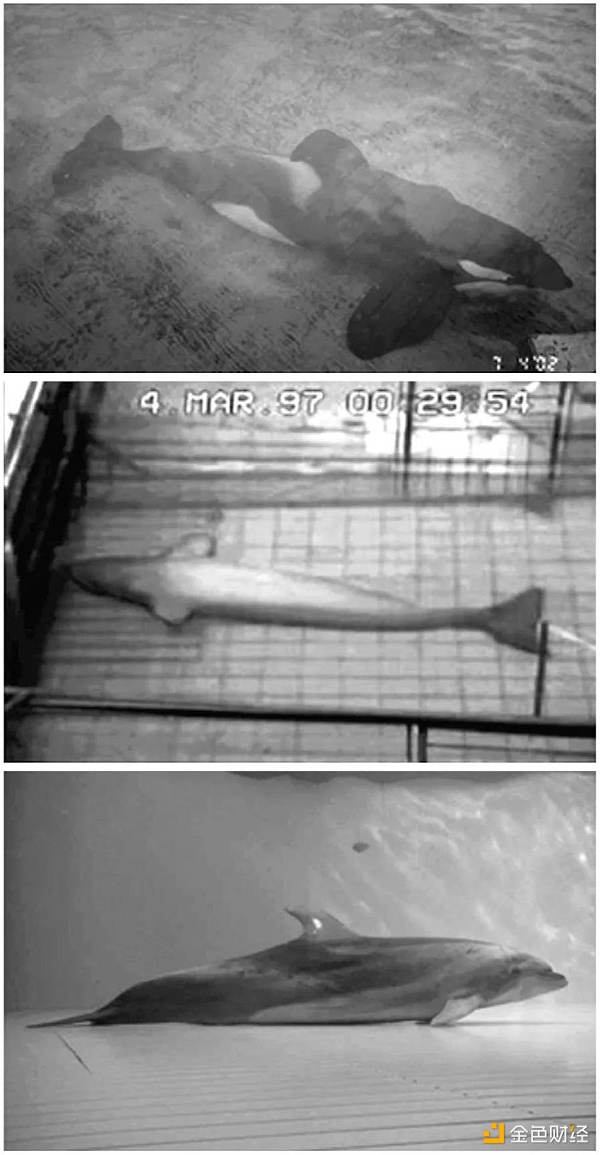
A scene of orcas, beluga whales, and bottlenose dolphins resting at the bottom of a pool | Image source: National Library of Medicine (United States)
The two systems face the same set of constraints: limited immediate processing capacity, but infinitely expanding historical experience.
Two answer sheets
There is a concept in biology called convergent evolution: species that are not closely related will independently evolve similar solutions because they face similar environmental pressures. The most classic example is the eye.
Octopuses and humans both have camera-like eyes, with a focusing lens concentrating light onto the retina and an iris controlling the amount of light entering; their overall structures are almost identical. However, octopuses are mollusks, while humans are vertebrates. Their common ancestor lived over 500 million years ago, when no complex visual organs existed on Earth. Two completely independent evolutionary paths led to almost the same endpoint. Because to efficiently convert light into a clear image, the physical laws allow almost only one path: the camera-like structure. A focusing lens, a photosensitive surface to receive the image, and an aperture to adjust the amount of light entering are all indispensable. The relationship between autoDream and human sleep might fall into this category—under similar constraints, the two systems might converge to similar structures. The requirement to be offline is their most similar commonality. autoDream cannot run while the user is working; it starts independently as a forked subprocess, completely isolated from the main thread, with strictly limited tool permissions. The human brain faces the same problem, but with a more thorough solution: moving memories from the hippocampus (temporary storage area) to the neocortex (long-term storage area) requires a set of brainwave rhythms that only appear during sleep. The most crucial element is the sharp wave ripples in the hippocampus, which are responsible for packaging and sending the encoded memory fragments of the day to the cerebral cortex; the slow oscillations of the cerebral cortex and the spindle waves of the thalamus provide precise temporal coordination for the entire process. This rhythm cannot be formed in a waking state; external stimuli will disrupt it. Therefore, you don't sleep because you're tired; rather, the brain must close the front door to open the back door. In other words, within the same time window, information intake and structural organization are competing resources, not complementary resources. Active system consolidation model during sleep. A (Data migration): During deep sleep (slow-wave sleep), memories recently written into the hippocampus (temporary storage area) are repeatedly replayed, thus gradually transferred and solidified into the neocortex (long-term storage area). B (Transmission protocol): This data transfer process relies on a highly synchronized "dialogue" between the two areas. The cerebral cortex emits slow brainwaves (red line) as the main control rhythm. Driven by the peaks, the hippocampus packages memory fragments into high-frequency signals (sharp ripples at the green line), perfectly coordinating with the carrier waves emitted by the thalamus (spindle waves at the blue line). This is like precisely embedding high-frequency memory data into the gaps in the transmission channel, ensuring that information is synchronously uploaded to the cerebral cortex. | Image source: National Library of Medicine (United States)
The other approach is not to memorize everything, but to edit it.
After autoDream starts, it does not retain all logs. It first reads existing memories to confirm known information, then scans KAIROS's daily logs, focusing on parts that deviate from previous understanding: those memories that are different from what was said yesterday, or more complex than previously thought, are prioritized for recording. The organized memories are stored in a three-layer index: a lightweight pointer layer is always loaded, the topic file is loaded on demand, and the complete history is never directly loaded. Facts that can be directly found in the project code (such as which file a function is defined in) are not written into memory at all. The human brain does almost the same thing during sleep. A study by Erin J. Wamsley, a lecturer at Harvard Medical School, shows that sleep prioritizes consolidating unusual information, such as what surprises you, what makes you emotionally affected, or what is related to unresolved problems. A large amount of repetitive, featureless daily details are discarded, leaving only abstract patterns—you might not remember exactly what you saw on your way to work yesterday, but you clearly remember how you got there. Interestingly, there is one area where the two systems make different choices. The memories generated by autoDream are explicitly labeled as "hints" rather than "truths" in the code. The agent must re-verify their validity before each use because it knows its own compilation might be inaccurate. The human brain lacks this mechanism. This is why eyewitnesses in court often give incorrect testimony. They don't intentionally lie, but because memories are pieced together from fragmented pieces of information in the brain, errors are the norm. Evolution probably doesn't need to label the human brain with uncertainty. In a primitive environment requiring rapid physical reactions, believing in a memory leads to immediate action, while doubting it leads to hesitation—and hesitation leads to defeat. But for an AI that repeatedly makes knowledge-based decisions, the cost of verification is low, and blind confidence is dangerous. Two scenarios lead to two different answers. Smarter Laziness In evolutionary biology, convergent evolution means two independent paths leading to the same endpoint without direct information exchange. Nature doesn't plagiarize, but engineers can read papers. When designing this sleep mechanism, did Anthropic encounter the same physical walls as the human brain, or did they reference neuroscience from the beginning? The leaked code doesn't cite any neuroscience literature, and the name autoDream sounds more like a programmer's joke. The more powerful driving force should be the engineering constraints themselves; the context has hard upper limits, long-term operation leads to noise accumulation, and online cleanup also pollutes the main thread's reasoning. They are solving an engineering problem; biomimicry is never the goal. What truly determines the shape of the answer is the compressibility of the constraints themselves. Over the past two years, the AI industry's definition of "stronger intelligence" has almost always pointed in the same direction—larger models, longer contexts, faster reasoning, and 24/7 operation. The direction is always "more." The existence of autoDream suggests a different proposition: intelligent agents may be lazier. An intelligent agent that never stops to organize itself will not become smarter, but only more chaotic. The human brain, through hundreds of millions of years of evolution, has reached a seemingly clumsy conclusion: intelligence must have rhythm. Awakeness is used to perceive the world, sleep is used to understand the world. When an AI company independently arrives at the same conclusion while solving an engineering problem, it may be suggesting that intelligence has some unavoidable basic overheads. Perhaps an AI that never sleeps isn't a stronger AI. It's just an AI that hasn't yet realized it needs to sleep.


 Weatherly


