Author: Matt Hougan, Chief Investment Officer, Bitwise; Translated by: Jinse Finance
Two key factors currently influencing the crypto market
I currently have two main concerns: the astonishing surge in gold prices and the uncertain prospects for the passage of the Clarity Act. Both of these events clearly foreshadow the future direction of cryptocurrencies.
Gold Surge
Gold's recent surge is astonishing. After a 65% increase in 2025, it rose another 16% in 2026, and is currently trading above $5,000. It's hard to believe that although gold has been used as currency for over 2,000 years, its value in US dollars has more than doubled in the past 20 months.
Daily Gold Price Movement
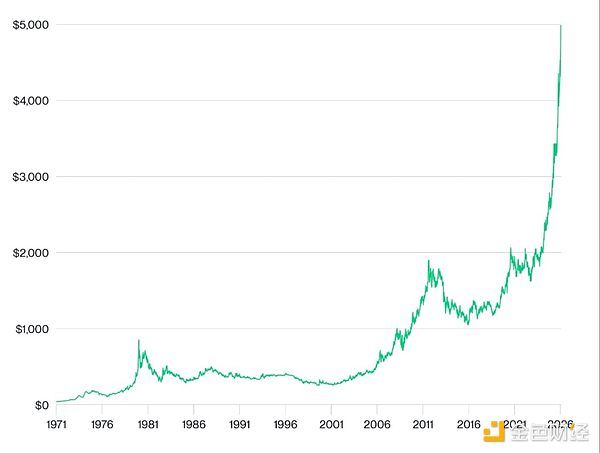
Data source: Bitwise Asset Management, Bloomberg data (January 1, 1971 to January 23, 2026)
In my opinion, the surge in gold prices reveals deep-seated problems in the world today.
In my opinion, the surge in gold prices reveals deep-seated problems in the world today.
Firstly, years of printing money, borrowing, and currency devaluation are taking a toll on fiat currencies. Secondly, people are no longer willing to entrust all their wealth to assets that depend on the goodwill of others. This second point is rarely mentioned, yet it is profoundly significant. As I wrote previously, the trigger for this round of gold price increases was the continued increase in gold holdings by governments worldwide. After Russia launched a special military operation against Ukraine in 2022, the United States froze Russia's overseas assets, and central banks' annual gold purchases doubled thereafter. This event served as a wake-up call for central banks: they must place their wealth in asset forms that cannot be frozen. This trend is now accelerating. Last week, German economists called on their government to withdraw and "repatriate" its gold reserves held at the Federal Reserve Bank of New York to Germany—they no longer trust the United States' ability to safeguard their gold. And today, a Norwegian government committee issued a formal warning to its massive sovereign wealth fund, stating that in the current geopolitical environment, the fund may face risks of "increased taxation, regulatory intervention, and even asset confiscation." Globally, trust between institutions is crumbling, and this process is accelerating. Cryptocurrencies possess a truly unique, yet under-discussed, characteristic: **The system they build upon does not rely on centralized institutions.** Holding Bitcoin or other crypto assets requires no trust in any entity; simultaneously, no individual can unilaterally change the operating rules of platforms like Ethereum and Solana. In the crypto world, we use popular terms to describe this characteristic, such as "self-custody," "censorship resistant," and "trustless." The value of these qualities often seems abstract, but in the current climate of rapidly collapsing credibility of centralized institutions, the meaning these terms represent is becoming incredibly real, and their value is increasing daily.
The Uncertainty of the Bill
Let's move on to my second concern.
I previously wrote about the importance of Congress passing the Clarity Act, for a simple reason: This act will solidify the current cryptocurrency-friendly regulatory environment in legal form. If the act fails to pass, the next administration may overturn current support policies for the crypto industry (imagine if Senator Elizabeth Warren becomes the next chair of the SEC—the consequences would be unimaginable).
At the beginning of this year, the prediction market was optimistic about the passage of the Clarity Act. In early January, the Politico market gave it an 80% probability of passage.
However, due to a series of recent setbacks—including Coinbase CEO Brian Armstrong's statement that the current version of the bill is not workable—this probability has now dropped to about 50%. Given this sudden change in the situation, I want to discuss where the market will go if the Clarity Act fails to pass. A Future Without "Clarity" If the bill fails, I believe the crypto industry will enter a phase of "proving with results." This means the industry needs to make cryptocurrency an integral part of everyday life for ordinary Americans and an indispensable part of the traditional financial industry within three years. If this is achieved, regulatory issues will be resolved; otherwise, the industry will face severe challenges. History is replete with examples of disruptive technologies forcing regulatory adjustments to adapt to their development. Take Uber, for instance; for years it operated on the fringes of regulation, but its extremely high public acceptance forced legislators to amend the rules to accommodate it, whether they liked it or not. Airbnb's development trajectory follows a similar pattern. If, three years from now, stablecoins become a universally accepted payment tool and tokenized stock trading becomes commonplace, then regardless of who is in power in the US, legislation favorable to the crypto industry will be implemented. However, if the crypto industry remains on the fringes of regulation at that time, a change of government in Washington will deal a heavy blow to the industry. If my judgment is correct, this will have a significant impact on the short-term price returns of crypto assets. If the Clarity Act passes smoothly—especially with a version recognized by the crypto industry—I expect the market to see a significant rebound. After the bill is implemented, investors will believe that the growth of stablecoins, asset tokenization, and other areas is a foregone conclusion, and will reflect this future expectation in current asset prices in advance. If the bill fails to pass, the future growth of the industry will depend on the actual progress of its implementation. Investors will demand that the crypto industry demonstrate its real-world effectiveness before they are willing to push up asset prices—because an industry lacking practical implementation has a fragmented regulatory foundation. These two outcomes will lead the crypto market down two drastically different paths: one is a bull market arriving ahead of schedule, driven by strong market expectations; the other is a "wait-and-see" mode, where any market optimism must contend with prolonged regulatory back-and-forth and market skepticism. The Clarity Act: Two Potential Market Paths
The Clarity Act's Turning Point: Two Potential Market Paths

I remain optimistic about the Clarity Act's passage. To date, this administration has delivered on its campaign promises to the crypto industry, and this bill is one of them. However, if the bill ultimately fails to pass, we need to prepare for a slow upward trend in the industry.


 Alex
Alex

