Deng Tong, Golden Finance
On July 31, 2025, the collaborative design platform Figma officially listed on the New York Stock Exchange. According to Rockflow data, Figma's closing price on its first day of listing was $115.50, a 250% increase from its opening price, bringing its market capitalization to $56 billion, or approximately 400 billion RMB. This set a new record for global tech IPOs in 2025.
Figma stated in its prospectus that it had been authorized to issue blockchain common stock. Furthermore, in early July, Figma disclosed that it held nearly $70 million in a Bitcoin ETF and had received approval to purchase an additional $30 million in Bitcoin.
What is Figma's main business? Who are its founders? How much has the CEO earned? What will be Figma's valuation after its IPO? What are the opportunities and risks? Why did Figma choose to invest in cryptocurrency? This article will provide some insights.
1. What is Figma's main business? Founded in 2012 and headquartered in San Francisco, California, Figma is a platform for collaborative design teams. Born in the browser, Figma helps product teams create, test, and deliver higher-quality designs faster. By moving from desktop tools to real-time browser collaboration, Figma revolutionized digital design and directly challenged Adobe's dominance in creative software. As of 2025, Figma has exceeded 13 million monthly active users, approximately two-thirds of whom are non-designers. Clients include Netflix, Airbnb, BMW, Zoom, and Duolingo, and 95% of the Fortune 500 rely on its platform for product design. Dylan Field co-founded Figma in 2012 with college classmate Evan Wallace. In 2015, Figma launched its beta version, capturing the market with its real-time collaboration, cloud-based synchronization, and free strategy. In 2017, Figma began offering paid services. In 2021, it launched its second product, FigJam, an online whiteboard tool for team brainstorming. In 2022, Adobe announced its $20 billion acquisition of Figma, but the acquisition was terminated in 2023 due to antitrust review and other reasons, with Figma receiving a $1 billion "breakup fee." In 2023, it launched Dev Mode, a dedicated space to help designers transform concepts into code. In 2024, it launched Figma Slides, a collaborative slideshow tool; in July, it completed a new round of financing, bringing its valuation back to $12.5 billion. On July 1, 2025, Figma submitted its prospectus to the SEC and planned to list on the New York Stock Exchange under the ticker symbol "FIG." On July 31, Figma officially went public, opening at $83 and closing at $115.50, a 250% surge on its first day, bringing its market capitalization to $67.6 billion. According to Figma's official website, Dylan Field is co-founder and CEO, and Evan Wallace is co-founder and CTO. They went to college together. Field was a computer science student at the time, and Wallace was his friend and teaching assistant. Field interned at LinkedIn in 2010 and at Flipboard in 2011 and 2012, working on data analysis, product design, and software engineering projects. He also led a group of undergraduate computer science students at Brown University. Wallace previously held engineering positions at Pixar and Microsoft. In 2012, Field dropped out of Brown and applied for the Thiel Fellowship, which supports students in starting a business after graduation. Despite lacking a mechanical engineering background, his initial idea for the application was to start a drone company. Wallace, who had previously built and programmed drones, persuaded Field to abandon that plan and instead develop products related to WebQL. The two founded Figma. Their vision was to bring collaborative design tools to the internet. Co-founder and CTO Evan Wallace (left), Co-founder and CEO Dylan Field (right) Dylan Field, whose fortune has reached $1 billion with this week's initial public offering (IPO), owns about 11% of Figma. He could see another ten-digit increase thanks to a phased compensation plan similar to Musk's. At $30 per share, that stake is worth $1.6 billion, according to the Bloomberg Billionaires Index, the low end of the price range given in Monday's filing. He also controls all voting power of co-founder Evan Wallace's 27 million shares, which are worth about $800 million at $30 per share. According to the company's filing, Field expects to complete and vest all 7.9 million shares remaining in his service-based equity incentive plan (valued at more than $230 million before taxes) at the time of the IPO. Field may also unlock 11.25 million shares in a market-based bonus, pegged to valuation thresholds of $15 billion, $20 billion, and $25 billion, depending on the company's stock performance after the IPO. Figma's IPO valuation (fully diluted) is approximately $18 billion. Bloomberg Intelligence analyst Anurag Rana said Figma's post-IPO valuation could be between $19.1 billion and $23.2 billion, based on its growth prospects. He said Figma's recent price increase, combined with increased sales after the IPO, would increase its revenue to $1.6 billion by 2026. This could bring Field's net worth back to $2 billion, as Adobe calculated when it attempted to acquire Figma in 2022. At the time, Field said he was not interested in a financial stake in the deal. “For a long time, my focus has not been on money.”IV. Opportunities and Risks of Figma
Main Opportunities:
Market leadership in the fast-growing collaborative design space;
AI integration drives feature adoption to 51% (up from 21% last year);
Expand from design to broader enterprise collaboration (a $47 billion market);
Network effects strengthen as teams standardize on the platform;
A recession-proof business model with high switching costs;
Main Risks:
A high valuation of 20x expected revenue is susceptible to multiple compression;
Combined competition from Adobe, Microsoft and emerging AI Intense competition from native tools;
Substantial AI investments could impact short-term profit margins;
The dual-class share structure concentrates control in the hands of CEO Dylan Field (73.6% of voting rights);
A recession could put pressure on enterprise software spending.
V. Why Did Figma Choose Crypto?
While Figma is not a cryptocurrency company, its Bitcoin holdings could set a trend for other Silicon Valley companies.
In 2021, Field sold a blue-chip NFT, CryptoPunks—a blue-green alien head with a pipe, hat, and sunglasses—for $7.5 million in ETH. The sale set a record for CryptoPunks.
Field has previously been interested in cryptocurrencies, particularly Ethereum. He is a keen supporter of Ethereum activity, particularly digital artists exploring the blockchain. At the time, Field also addressed the issue of energy consumption in mining: "I believe it's critical that cryptocurrency mining creates a return on higher-quality, more efficient energy." Perhaps Field's previous fascination with NFTs ultimately led Figma to cryptocurrency. Instead of purchasing physical Bitcoin, Figma chose to invest in a Bitcoin ETF (an exchange-traded fund that tracks the price of BTC). This is a more cautious strategy designed to comply with regulations while still capturing the upside of the cryptocurrency. According to documents filed by Figma with the US Securities and Exchange Commission, the company holds approximately $70 million worth of Bitcoin ETFs and plans to increase its allocation.
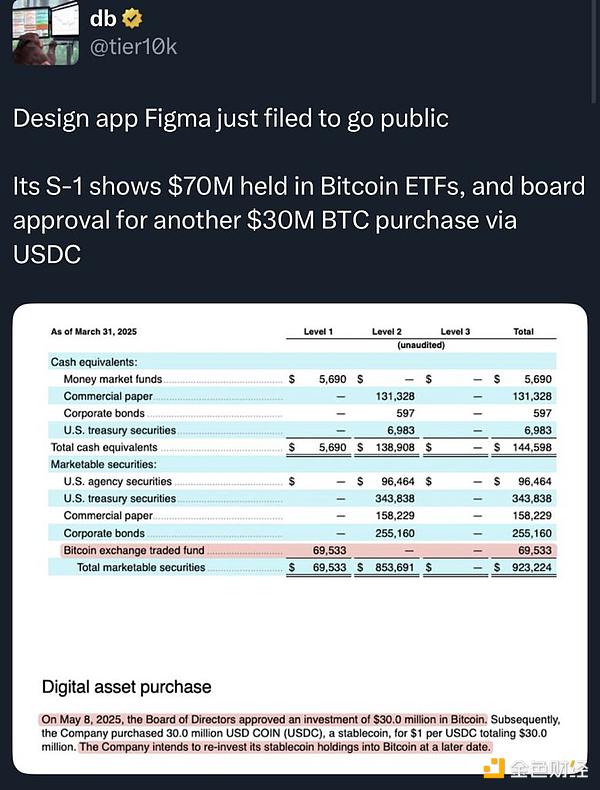
In addition, the board approved an additional $30 million to be converted into Bitcoin at a later date, currently held in USDC.
At the time of disclosure, this made Figma one of the first major tech companies to publicly include Bitcoin exposure before its IPO.
This demonstrates that Figma is implementing a compliance-first, investor-friendly approach. This gives them access to Bitcoin without alerting regulators or alienating IPO investors who may be wary of volatility.
Figma’s move opens the door to possible future developments: tokenized equity, programmable shares, and even DAO-like governance structures.


 Kikyo
Kikyo

