The struggle for future financial control behind stablecoin yields
On the evening of March 3, 2026, Trump tweeted on Truth Social with just four words: "Unacceptable."
 JinseFinance

Author: Turbo & James @Surf
Stablecoin-based fixed-income products are more favored in bear markets
During bull markets, the TVL of all products increases, but in bear markets, their performance varies significantly.
In bull markets, the TVL of all products increases, but in bear markets, their performance is significantly differentiated.
In a bear market, investors tend to favor more stable returns and lower underlying risks, which drives the growth of interest-bearing stablecoins. Protocols are evolving towards front-end and back-end development. Large DeFi protocols are starting to build their own wallets and mobile applications to control traffic entry points. The crypto industry is entering an application era, with retail users able to access financial services through mobile applications. The demand for proprietary stablecoins from new L1/L2 and DeFi projects will drive yield-generating protocols towards a "back-end" model, creating significant demand. Interest rate cuts, declining Treasury yields, and the rise of alternative RWA yield sources will lead to lower Treasury yields. This will prompt stablecoins to incorporate a wider range of RWA assets into their underlying assets. Real-world businesses and financial products can provide a stable source of yield, becoming a unique advantage for yield-generating protocols even in situations where the front end is weak.
We studied 18 on-chain yield products, covering multiple yield sources. These include tokenized government bonds and their derivatives, native staking (ETH/SOL), liquidity staking tokens (LST) such as Lido and Jito, interest-bearing stablecoins (sUSDe, SyrupUSD), protocol revenue sharing models (JLP, SKY), DeFi strategies and ecosystem incentives (Lido GGV, SIUSD/LIUSD, asBNB), DEX LP (Uniswap), market making (HLP), and RWA products (PRIME, USDai, USP). For each product, this article evaluates it from dimensions such as APY, liquidity, withdrawal time, and major risks.
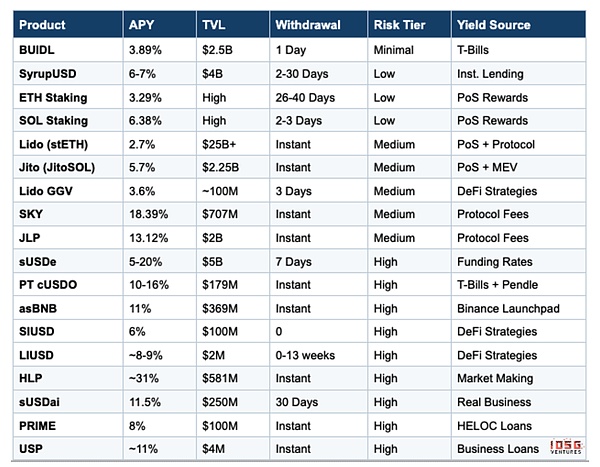
▲ Source: IOSG; Data as of November 2025, USP, SIUSD, and LIUSD data as of January 2026
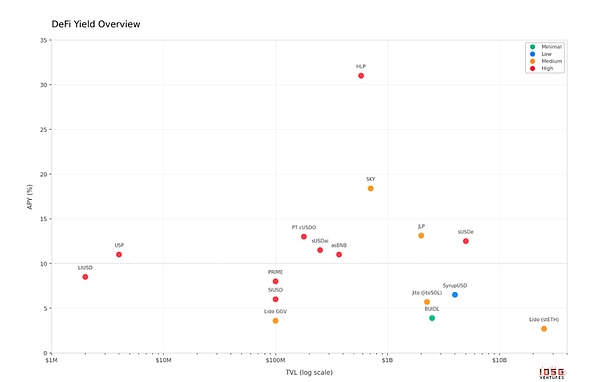
▲ Source: Surf
Revenue Models
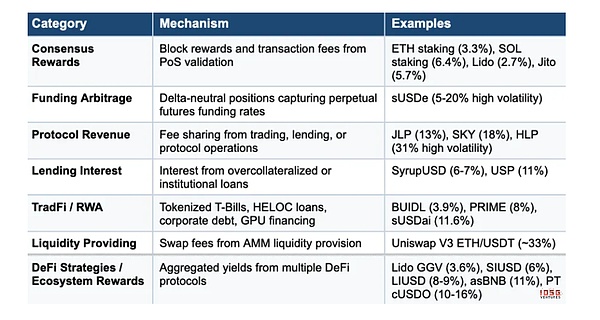
There are eight different on-chain revenue mechanisms, each with different returns, risks, and sensitivity to market influences:
Consensus rewards (ETH/SOL staking, LST) provide stable, protocol-level guaranteed returns. Funding rate arbitrage and protocol revenue are affected by market cycles, strong in bull markets and compressed in bear markets. Lending and RWA revenue introduce counterparty risk but are also relatively stable. LPs can capture transaction fees.
DeFi strategies and ecosystem incentives aggregate returns from multiple protocols, but also carry smart contract risks.
Risk Layering
The product mainly has the following four dimensions of risk:
Protocol Risk: Technical risks, including smart contract risks
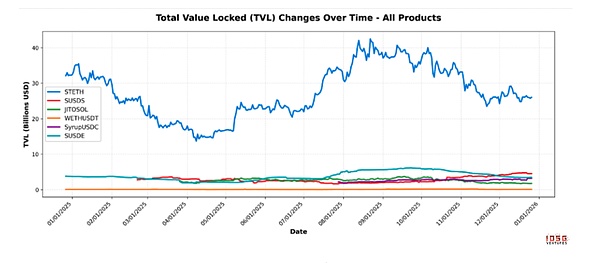
▲ Source: DeFiLlama
Looking at TVL data, the TVL of all products increased during the bull market. However, during the bear market, the TVL of stETH, sUSDE, and JitoSOL decreased, while the TVL of sUSDS and SyrupUSDC increased.
From the TVL data, the TVL of all products increased during the bull market.
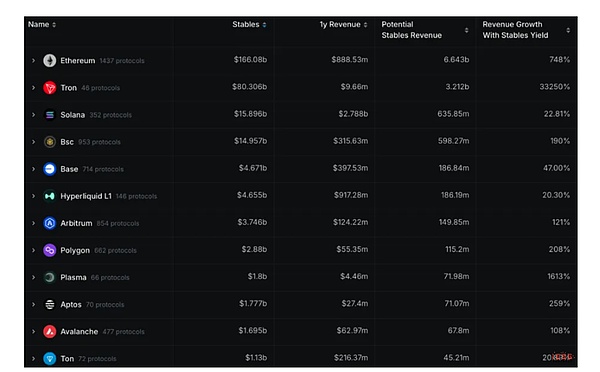
▲ Source: DeFiLlama
Interest rate cuts, declining Treasury yields and the rise of alternative RWA yield sources
The on-chain yield landscape will also change due to the influence of US monetary policy.
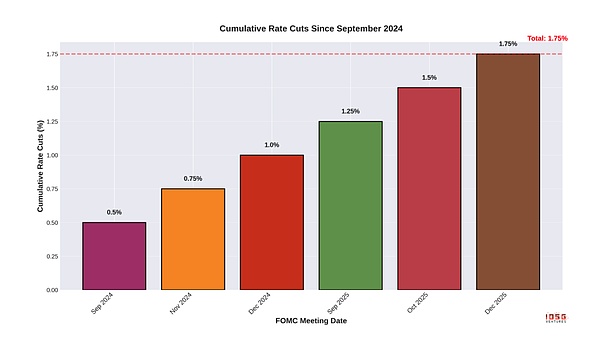
▲ Source: FOMC
President Trump nominated Kevin Warsh to succeed Jerome Powell as Chairman of the Federal Reserve. If approved, the transition is expected to take place in May 2026.
The nomination of the new Federal Reserve Chairman is expected to accelerate the process of interest rate cuts, leading to a decline in the yield of U.S. Treasury bonds (T-Bill).
The nomination of the new Federal Reserve Chairman is expected to accelerate the process of interest rate cuts, leading to a decline in the yield of U.S. Treasury bonds (T-Bill).
This will encourage stablecoins to incorporate a wider range of RWAs assets into their underlying assets, thereby diversifying their underlying assets. Figure's PRIME is a typical example of putting HELOC yields on-chain. HELOC (Home Equity Line of Credit) is a type of loan that allows homeowners to borrow, consume, and repay on demand using their homes as collateral. PRIME token holders fund HELOC loans with a fixed yield of 8%. Another type involves bringing real-world business activities onto the blockchain as a source of revenue. USDai is a method of financing GPUs onto the blockchain. USDai's yield comes from loan repayments by borrowers, specifically monthly repayments from GPU infrastructure operators who obtain financing by pledging GPU hardware. Private lending is also gaining attention as an attractive and stable source of APY yields. Projects like Craftt and Pareto allow on-chain users to earn yields by lending assets to institutions and businesses. These yields are also backed by solid real-world business practices. These examples demonstrate that real-world businesses and financial products can be stable sources of yield. Even with a weaker front end, this can be a unique advantage for yield-generating protocols. Crypto-native yield sources are also becoming increasingly important in a competitive market. Products offering exclusive revenue streams have unique value. For example, asBNB offers Binance Launchpad revenue exposure, a revenue source available only within the BSC ecosystem. Similarly, revenue-sharing models are attractive when supported by transparent revenue fundamentals. The success of JLP and HLP demonstrates that users are willing to invest in products that directly share in real protocol revenue. Institutional Adoption of On-Chain Revenue: End-to-End Services and Crypto Credit Products (Preferred Stock) With the wave of institutional adoption, many institutions are likely to attempt to capture on-chain or crypto revenue. The key is providing end-to-end services. End-to-End Services of DeFi Protocols For example, Ether.fi provides institutional staking services, with end-to-end asset management at its core. They offer both non-custodial and custodial staking options, as well as a service called "white-glove," an end-to-end staking service that provides a controlled environment including annual audits, KYC compliance, and monthly reports. The ETH fund is also a CIMA-registered fund. Beyond staking, institutions can also participate in DeFi lending and other protocols' fixed-income offerings. Preferred stock is a type of "government bond" based on crypto, and an important way to distribute crypto yields to institutions. DAT's preferred stock as a way for institutions to obtain on-chain yields is actually underestimated. Essentially, it's a credit debt asset based on crypto, similar to government bonds. Government bonds are debt created based on a nation's credit and capacity, while DAT has created a credit market based on crypto assets. Preferred stock is a credit debt product created based on that credit market. Preferred stock provides crypto yields to traditional institutions through dividends. There are two main types of yields: long-term CAGR and DeFi yields, including staking. Strategy's STRC offers an annualized dividend of 11.5%, payable monthly in cash, and is tradable on most major brokerage platforms. Strategy's strategy is based on Bitcoin's CAGR. It assumes BTC is an inflation hedge and estimates the actual inflation rate to be around 8%. STRF and other similar preferred stock products such as STRD and STRK deliver the inflation-hedging portion of the returns to investors. Investors can also opt for the 8% return STRK, which has the potential to be converted into MSTR to capture more of Bitcoin's upside potential.
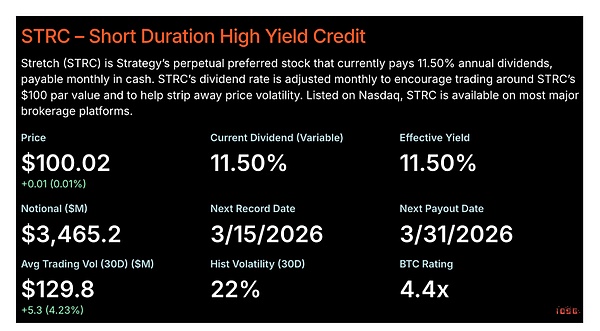
▲ Base information about STRC; Source: Strategy
Traditional finance has similar inflation-hedging products, such as TIPS (government-issued inflation-protected bonds). TIPS rise with inflation and fall with deflation. They adjust TIPS using the CPI (Consumer Price Index) compiled by the U.S. Bureau of Labor Statistics. Although the TIPS interest rate is lower than the inflation rate (2.7%), this is the real return after deducting inflation, because the principal is adjusted according to the inflation rate, and the real return is about 4%.
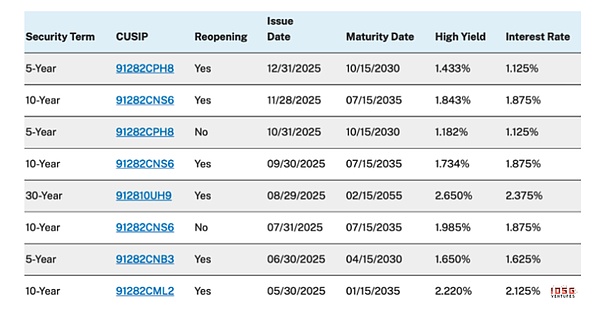
▲ Interest rate of TIPS; Source: Treasurydirect.gov
Interestingly, stablecoin projects like Saturn Labs are using the stable yield of DAT on-chain as a source of stablecoin returns. In the era of digital assets and during the Fed's interest rate cut cycle, this could be a substitute for on-chain government bonds.
Preferred stock dividends can also be a way to distribute aggregated on-chain returns to stock investors.
Preferred stock dividends can also be a way to distribute aggregated on-chain returns to stock investors.
Solana DAT Forward Industries has staked almost all of its SOL holdings (over 6.87 million SOL) for approximately 7% staking yield. They have also converted about 25% of their SOL into fwdSOL (LST) to gain greater DeFi liquidity and yield opportunities. While they haven't announced that these yields will be distributed to investors through preferred stock, they are capable of providing approximately 7% yield and generating higher yields using on-chain protocols. The DeFi Development Company offers Series C perpetual preferred stock with an annualized dividend yield of 10%. Based on current on-chain yields and SOL staking rates, they are able to afford these dividends.On the evening of March 3, 2026, Trump tweeted on Truth Social with just four words: "Unacceptable."
JinseFinanceThe battle over digital dollars, bank deposits, and who can obtain risk-free interest rate returns.
JinseFinanceJinse Finance launches its daily cryptocurrency and blockchain news bulletin, "Jinse at 8 AM," issue 2936, providing you with the latest and fastest news on the digital currency and blockchain industry.
JinseFinanceStablecoins, the collapse of stablecoin yields: Is the era of easily earning cryptocurrency yields really over? (Jinse Finance)
JinseFinanceThe Yield Basis of traditional finance is the U.S. Treasury yield. Will the Yield Basis on the chain be BTC/crvUSD?
JinseFinanceAs stablecoin yield strategies become increasingly diverse but user energy and execution efficiency are limited, AgentFi, as the next stage paradigm of the "AI + DeFi" integration, provides DeFi users with intelligent agency solutions that do not require monitoring and are automatically optimized.
JinseFinanceAn article published on the financial media Forbes website stated: Stablecoin has become one of the most successful asset use cases in the crypto field, relying on blockchains such as Ethereum, Solana and Tron to significantly promote cross-chain transactions.
JinseFinanceCKB stablecoin payment is a decentralized stablecoin payment solution based on the CKB network, allowing users to use the joint network of CKB and Bitcoin.
JinseFinance Coinlive
 Although USDC is the second largest Stablecoin, it is the most used on-chain Stablecoin in the Crypto space.
 链向资讯
链向资讯