Author: Anthony Pompliano, Founder and CEO of Professional Capital Management; Translated by Shaw Jinse Finance
The US economy is simultaneously impacted by multiple deflationary factors. These intertwined trends have forced the Federal Reserve to lower interest rates and increase the money supply.
First, we know that artificial intelligence and robotics are greatly improving the efficiency of various parts of the system. Today, businesses can generate more profit with fewer employees, which is often referred to as **benign deflation**. **Benevolent deflation refers to the rate of supply growth exceeding the rate of demand growth.
So, where can we see this in today's economy? We see countless examples of surging productivity, cost reductions, and quality improvements.
This has fueled a “deflationary boom,” where prices for goods and services fall, boosting consumer purchasing power and supporting GDP growth without causing the economy to overheat. Artificial intelligence is not only increasing business productivity, but we are also approaching the stage where AI can write its own software. Technology experts promise that eventually, humanoid robots will take on many jobs in society, including manufacturing and assembling more humanoid robots. This exponential growth in productivity is difficult to comprehend today. But it may be the most important trend influencing deflation. Elon Musk, the founder of several multi-billion dollar companies at the intersection of artificial intelligence and robotics, recently discussed how these technologies could trigger deflation and help resolve the national debt crisis. When Elon articulated his views on these technologies, combined with the growth of the US money supply, deflation seemed like an obvious end result. But Elon understands that the impact of artificial intelligence and robotics on the economy is not yet sufficient to cause deflation. Part of the reason for this discrepancy is the massive amount of money printed by the US government, but another part is because artificial intelligence and robotics are still in a relatively early stage. Elon estimates that the US economy will enter a period of deflation within three years. Elon Musk is known for his aggressive timelines, and many critics believe his estimates are at least a decade off track. However, I disagree. The pace of innovation, and the accelerated adoption of artificial intelligence and robotics, makes me feel that this deflationary effect is much closer than most people realize. These technological trends are not happening in isolation. The second major trend we need to pay attention to is **demographic changes and proposed policy adjustments**. Both are suppressing consumer demand and shrinking the labor supply, potentially creating a "deflationary shock." Economist David Rosenberg highlights three intertwined forces: **Aging workforce**: The median age of the U.S. population is 42.3 years (36 years in 2000), and by 2035, the dependency ratio (the ratio of the non-working-age population to the working-age population) will rise to 37%, which will reduce spending on non-essential goods. Immigration restrictions: Stricter policies limit population growth and the influx of low-wage labor, suppressing household formation and demand for services. Tariffs: Widespread tariffs (such as those imposed on imported goods) can significantly reduce consumer spending by increasing costs, leading to a precipitous drop in demand. These three factors can weaken aggregate demand, causing businesses to face oversupply and lower prices to clear inventory, thus triggering price declines. On the positive side, a drop in demand might stabilize inflation in the housing and services sectors, but it could also trigger a vicious cycle of delayed consumption and increased unemployment, particularly in the retail and construction sectors. Finding this balance is crucial. What we want is deflation, not recession. This can only be achieved by creating positive supply-side factors, not a collapse in demand. This is often referred to as “benign deflation” or “growth deflation,” in which price declines are due to increased productivity, technological advancements, or efficiency improvements that boost output and real income. For example, the decline in energy costs over the past year exemplifies this “benign deflation.” This decline is attributed to increased domestic production, weak global demand, and efficiency improvements from renewable energy sources and AI-driven grid optimization. U.S. gasoline prices are projected to be 3% lower in 2025 than in 2024 (11 cents per gallon), and energy inflation is expected to be 1.6% lower year-over-year by July 2025. The drop in energy prices has had a broad-based effect in curbing inflation, including lower input costs in manufacturing and transportation. This increases household disposable income (e.g., saving the average driver about $150 per year on fuel costs) and supports profit margins in energy-intensive industries. However, a sustained decline in energy prices could hurt oil/gas producers (e.g., layoffs in Texas) and lead to a regional economic slowdown. Nationally, this strengthens the Fed's path to achieving its 2% inflation target, but could exacerbate the risk of deflation if demand weakens in other regions. Regarding energy costs, these drivers are primarily from the supply side (artificial intelligence and increased energy production) or demand constraints (demographics/policies). This combination fosters sustainable growth, but if aggravated, it can also increase the risk of a sharp economic downturn. Again, striking a balance between deflation and recession is crucial. The United States has historically succeeded in doing so many times. Here are some examples from different periods:
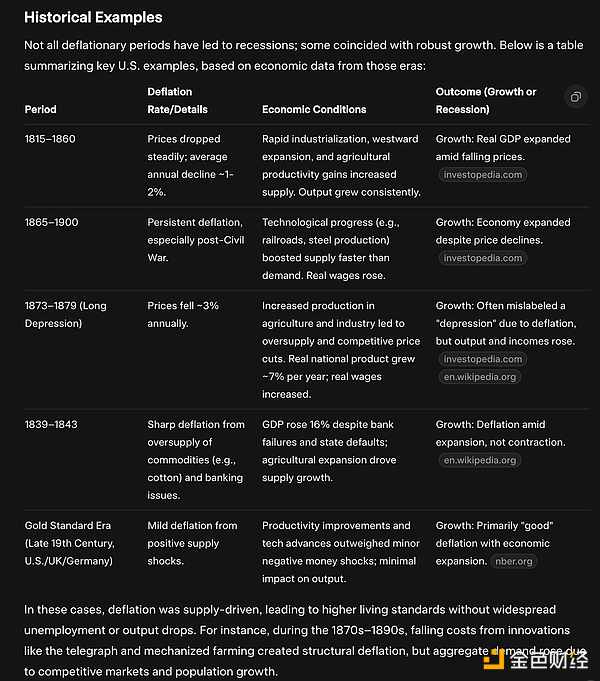
We've done it before, which means we can do it again. Technology, demographics, and policies can all lower prices and create economic prosperity.
Elon Musk knows this is possible. He is genuinely working to create such a future. But people are talking about inflation, and many investors still don't seem prepared for a world where deflation dominates the economy.
As Stanley Druckenmiller once said, "Every severe deflation I have observed has been accompanied by an asset bubble, and then the bubble bursts." Given current price levels, many are loudly proclaiming the existence of asset bubbles. So the question now is: "Will asset bubbles burst and trigger deflation?" Let each of you answer that question yourselves.


 Anais
Anais

