Author: TokenInsight Research, Translator: Shaw, Jinse Finance
In the ever-evolving digital asset space, a common point of contention is whether Circle's USDC (widely regarded as a model of regulated and transparent stablecoins) will eventually surpass Tether (USDT). While USDC is undoubtedly the preferred choice for institutions and the regulated "on-chain" economy, it is too early to assert that it will surpass Tether.
Tether's dominance is due to its strong network effects and a decade-long first-mover advantage. Since its launch in 2014, USDT has become the "reserve currency" of the cryptocurrency market. It is the primary liquid trading pair on global exchanges and a functional unit of account for traders. However, its real advantage lies in its widespread adoption in emerging markets.
USDT and USDC Trading Volume on Centralized Exchanges

Source: Dune Dashboard
In Southeast Asia, Africa, the Middle East, and Latin America, a large number of users now use USDT for peer-to-peer transfers, remittances, merchant payments, and simple dollar savings.
In regions such as Southeast Asia, Africa, the Middle East, and Latin America, a large number of users now use USDT for peer-to-peer transfers, remittances, merchant payments, and simple dollar savings.
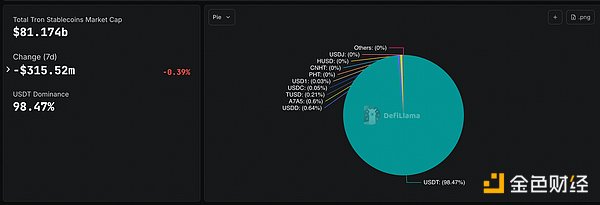
... On-chain data shared by Tether shows a massive number of small transfers (≤ $1,000), which fall more in line with everyday payments and household financial management than speculative trading. This trading pattern aligns with Tether's claim that **most USDT liquidity is related to real-world economic activity, not speculative trading**. This widespread, "street-level" adoption has created a moat that regulatory compliance alone cannot overcome. This has resulted in a differentiated structure: **USDC dominates among regulated institutional users, deeply integrated into decentralized finance (DeFi) and enterprise workflows**; while **USDT, despite relatively weaker regulation, remains the default "dollar" for millions of retail users globally**. Given its massive user base and widespread use in high-frequency, essential transactions, USDT's position among global retail users is unlikely to be shaken in the medium term. Tether's Ambitions: Tokenization and a USDT-Centric Blockchain Network Because Tether is a privately held company, retail investors cannot currently directly purchase "Tether stock." Recent reports indicate that Tether is considering a large-scale equity financing round with a target valuation of approximately $500 billion and is considering tokenizing its shares after the financing. If implemented, this could ultimately create a highly liquid on-chain representation of Tether equity—but there is currently no detailed architecture or timeline, nor is it clear whether such tokens will function like traditional publicly traded equity or primarily provide liquidity for existing shareholders. Clearly, Tether's profitability is extremely strong. 2025 earnings forecasts show that Tether's net profit exceeded $10 billion in the first three quarters alone, primarily due to returns from US Treasury bonds and other reserve assets backing USDT. This naturally prompts market participants to seek indirect ways to obtain USDT-related economic growth benefits. **An emerging approach is through projects whose economic benefits are closely tied to USDT liquidity.** Plasma and Stable are two prominent examples: both are new Layer-1 blockchains that use USDT as their primary trading asset, and both are backed by entities closely associated with Tether, including Bitfinex (Tether's sister company, both part of the iFinex Group) and Tether executives. Their core idea is simple: currently, most USDT trading activity occurs on public chains such as Ethereum and Tron. Users pay transaction fees using the native tokens of these public chains (ETH, TRX, etc.), so a portion of the economic value generated by USDT transactions flows into these public chain networks, rather than the "USDT ecosystem" itself. Plasma and Stable, by building native USDT blockchain networks, allow transaction fees to be paid directly in USDT (or USDT-derived tokens, such as gUSDT or USDT0), attempting to transfer a portion of the value—transaction fees, MEV, and related economic gains—to a dedicated, USDT-centric environment. However, distinguishing between economic ties and equity ownership is crucial. Tether's profits primarily come from investment returns on USDT reserve assets; these profits belong to Tether's shareholders. Holders of XPL (Plasma tokens) or STABLE (Stable tokens) do not own these reserves and have no legal ownership of Tether's profits. Their profits, if possible, must come from: the growth and stickiness of the network itself (transaction volume, TVL, developer activity). **Protocol-level fee capture and MEV.** **Specific token economic models (staking rewards, validator incentives, and governance value) reward a portion of activity to tokens.** In other words, these chains can be a way to access the infrastructure associated with USDT growth, but they are fundamentally different from owning Tether equity. **From Tron to Plasma and Stable** Currently, most of USDT's supply and trading activity is concentrated on Ethereum and Tron, especially Tron, which has become the primary channel for stablecoin transfers. Multiple datasets show that **Tron carries more than half of the circulating USDT, and USDT accounts for approximately 98% to 99% of all stablecoins on Tron.** This has effectively made TRON a USDT-centric blockchain network. TRON's value proposition is very clear: **low fees and high throughput**. These characteristics make it highly attractive to exchanges, OTC trading platforms, and users who need low-cost, fast USDT transfers. Many centralized exchanges now use TRON as the default network for USDT withdrawals, especially for retail users and cross-border transactions. This is why USDT remittances and peer-to-peer trading activity so heavily favors the TRC-20 version. From a broader ecosystem perspective, TRON differs significantly from Ethereum. Ethereum supports thousands of decentralized applications (DApps) covering DeFi, NFTs, games, and more, and is widely considered more decentralized with a large number of validator nodes. In contrast, TRON uses a Delegated Proof-of-Stake (DPoS) model, consisting of 27 "super delegates." While this design enables high throughput and low costs, it has been criticized for its centralization risks. Its on-chain activity is primarily focused on stablecoin transfers, rather than a wide range of independent DeFi protocols. Despite these concerns, TRON has evolved into one of the largest Layer-1 networks by market capitalization, handling massive amounts of USDT transfers. This provides a useful benchmark: it demonstrates the valuation a blockchain network can support when it becomes the primary settlement layer for USDT, even if its broader ecosystem is relatively centralized. This context is crucial for Plasma and Stable. Winning over Ethereum's DeFi user base can be challenging, as Ethereum remains the platform of choice for institutional-grade security, composability, and decentralization. However, TRON's role as a USDT payment gateway—especially for high-frequency, small-amount transfers—is more competitive. If new USDT-native chains can offer a better user experience (near-zero fees, clearer fee structures, and enterprise-oriented tools) without compromising reliability, they are likely to siphon some transaction traffic away from TRON.
USDT supply in different supply chains

Total market capitalization of TRON stablecoins (USDT accounts for 98.47%)
Source: Defillama
Conclusion
USDT has established a firm foothold in the global dollar system's retail and capital control environment, especially in regions where banks, foreign exchange markets, or stable local currency channels are limited. Even as USDC continues to expand its share in the regulated on-chain economy, this demand-based existing user base is unlikely to be shaken in the next 3-5 years. On the capital side, Tether's outstanding profitability and potential tokenization plans highlight the enormous value accumulated in the reserve layer. In the blockchain arena, the economic viability of its next-generation USDT native chains (such as Plasma and Stable) depends on its ability to attract and retain funds flowing out of existing channels like Tron or Ethereum.