Author: Arthur Hayes
Editor's Note: This article has been slightly abridged
Any views expressed here are the author's personal opinions and should not be used as investment advice or trading recommendations.
When a fire alarm sounds in an apartment or office building, you usually ignore it. But for those who ignore obvious warning signs, death can sometimes strike unexpectedly. In this daily life filled with all sorts of noise, knowing which alarms to listen to can not only save your life but also your wallet.
If consumers can't afford their credit card payments, the next to suffer will be stocks in the non-essential consumer goods sector.
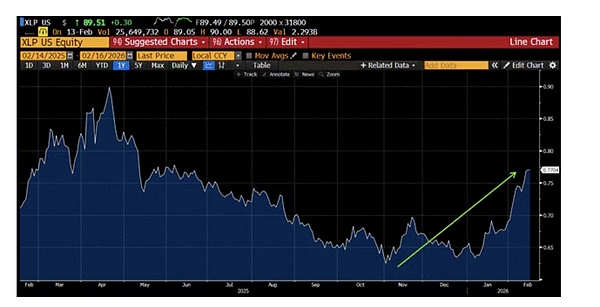
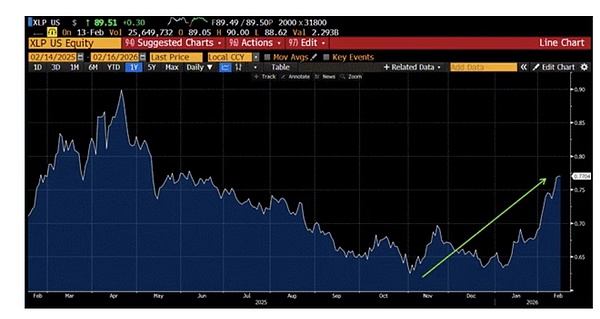
Financial institutions that specialize in serving white-collar workers facing bankruptcy, such as American Express (AXP US, white), can barely hold on when borrowers' employers (IGV US, gold) are battered by the market. However, as the market fully prices the future fate of knowledge workers, this resilience of lending institutions will be unsustainable.
When unsure about the adequacy of dollar liquidity, look at Bitcoin.
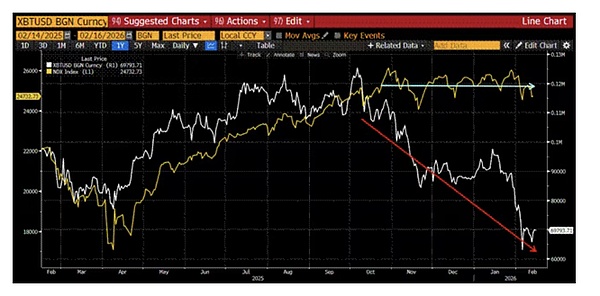
Nasdaq (gold) is consolidating, while Bitcoin (white) has plummeted since hitting an all-time high in October 2025.
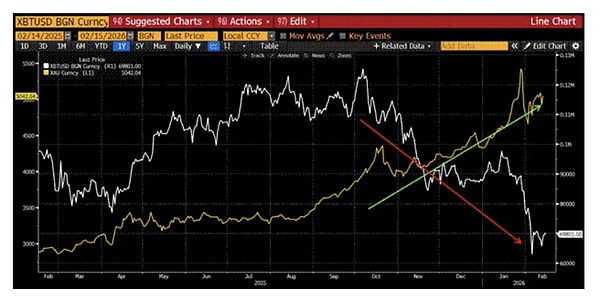
Gold (gold) is surging while Bitcoin (white) is plunging. This divergence clearly tells us: A deflationary credit crisis is brewing within the United States. Since experience tells us that the Federal Reserve will eventually print money to rescue the banking system from deflation caused by credit losses, why didn't Bitcoin surge when AI-related unemployment accelerated? Because the Federal Reserve always needs a crisis to force it to take drastic action. Before the 2008 crisis, the market mantra was "US housing prices will never fall." If they never fell, then the collapse of two little-known Bear Stearns hedge funds in 2007 due to subprime mortgage losses would be insignificant. Similarly, today's mantra is "AI will bring the highest productivity growth in history." To reiterate, if some dubious internet token collapses, or a few shadow banks with terrible risk control suffer the consequences, why should the Federal Reserve intervene? Adding to the Fed's inertia of inaction is its deep-seated political crisis. US President Trump has crossed the Rubicon, launching a criminal investigation into Fed Chairman Powell, the weak, cuckolded, and towel-handing-only figure. Like any institution composed of people, they band together when you threaten the ideological ties that bind them and their so-called lofty mission. Those within the Fed genuinely believe they are independent and above politics, even though history clearly shows that the Fed ultimately always conforms to the president's desired monetary policy. Trump's apparent investigation of Powell for refusing to cut interest rates and print money quickly may provoke Powell's pride, forcing him to remain on the board after his term ends in May. At that time, assuming Trump's new chairman can pass the Senate... (This isn't necessarily true.) Kevin Warsh will face a hostile Federal Reserve. It's said that Warsh supports shrinking the Fed's balance sheet and wants many "radical" reforms to the Fed's operations and bank regulation. Whether other governors think these policies are reasonable is irrelevant; what matters is that Warsh is Trump's man. If Powell remains in office and wins over at least five voting governors, he can defend the Fed's political independence by "doing nothing" to obstruct Trump's agenda. While the Fed is still battling windmills, AI-related unemployment will destroy the balance sheets of American banks. Ultimately, non-TBTF bank stocks will begin to collapse, depositors will flee to the safe haven of JPMorgan Chase CEO Jamie Dimon, and the credit market will freeze. The market will be frantically asking: Which credit sector will be next to suffer a devastating blow from AI optimization? Because panicked traders only care about immediate liquidity, they will sell everything. The stock market will crash, Bitcoin will trade sideways, or Bitcoin will fall below $60,000 and continue its downward spiral until the Federal Reserve starts printing money. Does the discount window work? Theoretically, if a regulated bank is in trouble and needs to quickly sell assets to meet withdrawals, it can turn to the Federal Reserve's discount window. But the problem is that the discount window assumes the problem is only maturity mismatch and liquidity. However, this time, the loan value on the balance sheet is zero because borrowers simply cannot repay. Once AI takes away your accounting, legal, or investment banking jobs, those jobs will be gone forever. Perhaps after a few years of retraining, you can find work in new AI-driven industries, but that will take many years, and there's no guarantee of success. During this time, if you can't repay your debts, the market will price your car loan debt at zero. This violates the Federal Reserve's collateral standards. To provide banks with unlimited ammunition (printing money) and force them to re-lend to these former "masters of the universe" who are now defaulters, the discount window must be completely overhauled. Unfortunately, this change requires a vote by the governors to approve new policies. Print, baby, print as much as you can! Everyone knows that AI is the most transformative general-purpose technology in human history. The consensus also believes that... Once AI targets arrogant, highly educated lawyers who spend their days piling on paperwork, Lord Elon Musk (or more likely his Chinese rival) will unleash AI robots that will drive labor costs to near zero. Faced with these "truths," the Federal Reserve will have to unleash an unprecedented massive amount of liquidity. Ironically, politicians, terrified of the credit deflation triggered by AI, will gleefully support a new round of "unlimited quantitative easing." There are many ways to print money; I won't guess the specifics. But like the Sunday after Signature Bank collapsed on March 12, 2023, there will be an emergency announcement. "Buffalo Bill" Bessant and the then-Federal Reserve Chairman will announce a joint plan, essentially printing money. Then, "bang," thank goodness, we can back in that damn truck to load up again. The buying frenzy for Bitcoin and altcoins is reminiscent of 2020. Stay flexible. Because AI models are iterating, progress is non-linear. This means that if you thought AI wasn't precise enough for certain knowledge-based tasks last year and assume it won't be now, you're out of touch. This time it's serious; millions of knowledge workers will have to swallow their pride and apply for government assistance like "welfare lazybones" in the slums. I don't think Bitcoin traders could have predicted the Fed's eventual bailout before consumer credit-sensitive stocks were hit hard. I won't short the market, but if you haven't raised cash yet, selling some long positions might be wise. If an asset price falls from 10 to 5, shorting yields a 50% profit; however, if the price rebounds from 5 back to 10, going long can double the return. Therefore, the essence of the game lies in maintaining liquidity, being agile, and specializing in betting on rebounds. Shorting is a game for fools. Always go long on convexity! Once the Fed backs down, Maelstrom will invest its surplus stablecoins in two major altcoins: $ZEC (Zcash) and $HYPE (Hyperliquid). In the next article, I will demonstrate the model to explain why $HYPE rose to $150 in July, about five times higher than its current price. Obviously, we are already long on $ZEC and $HYPE, but I want more. If my AI financial crisis logic holds true, we will have another great opportunity to buy these high-quality altcoins at low prices.


 JinseFinance
