Can the White House protect DeFi?
The promise and power of cryptocurrencies cannot be separated from their principle of decentralization.
 JinseFinance

Author: Nishil Jain Source: thetokendispatch Translation: Shan Ouba, Jinse Finance
According to Defillama data, the scale of crypto asset-backed lending reached a record high of $90 billion in the fourth quarter of 2025. On-chain lending currently accounts for about two-thirds of the total, compared to less than half at the peak of the 2021 bull market. On the other hand, the private lending market has doubled in value over the past year, from $10 billion in February 2025 to $25 billion today.
DeFi has grown into a credible lending market, but institutional funds from asset management companies, pension funds, endowments, and sovereign wealth funds account for only 11.5% of the total value locked in DeFi.
DeFi has grown into a credible lending market, but institutional funds from asset management companies, pension funds, endowments, and sovereign wealth funds account for only 11.5% of the total value locked in DeFi.
The gap between the maturity of DeFi infrastructure and institutional adoption is the core contradiction of the current cycle. In the previous article, we explored how the DeFi vault ecosystem can expand through open and verifiable infrastructure—the blockchain's trust layer replaces the high costs of manual verification in traditional asset management, making business decomposition feasible. This characteristic lays the foundation for the next stage of evolution. When risk parameters, manager behavior, and liquidation logic are all on-chain and auditable, it becomes possible to build a risk management infrastructure that is impossible in traditional finance due to its lack of transparency and high coordination costs. Selected vaults are the first practical application of this approach. However, institutions need more than just selected assets; they also need cross-market risk isolation, fixed-income instruments, and structured credit. This article will delve into the more complete risk system currently emerging across the entire DeFi industry. Sygnum Bank, one of the few regulated digital asset banks, provided a straightforward assessment in mid-2025: Despite the fact that DeFi protocols are functional, permissioned pools exist, KYC frameworks are in place, and tokenized RWA is available, institutional decision-makers believe that no large institutions will allocate to crypto assets until legal enforceability and regulatory risks are fully resolved. Sygnum added that almost all inflows still come from asset management firms, hedge funds, or crypto-native institutions with higher risk tolerance. Even though KYC access vaults and permissioned lending pools are often touted as institutional breakthroughs, they haven't truly attracted large-scale institutional funding. The demand for DeFi exposure is real. A January 2025 survey of 352 institutional investors by EY-Parthenon and Coinbase revealed that 83% planned to increase their holdings of crypto assets, with 59% intending to allocate more than 5% of their managed funds to this area. However, only 24% are currently actively involved in DeFi. These concerns are valid. When asked about their reasons for not participating, regulatory uncertainty topped the list at 57%. This is a real barrier, but it is being gradually dismantled: the GENIUS Act has been passed, MiCA regulations have been fully implemented in Europe, and the SEC has ended its investigations into projects such as Aave, Uniswap, and Ondo without taking enforcement action. More noteworthy are other obstacles revealed by the survey: compliance risk (55%) and insufficient internal expertise (51%). These issues are not about the legality of DeFi, but rather whether institutions can manage their DeFi exposure within existing risk control frameworks: can compliance teams map lending positions to internal authorization requirements? Can risk officers isolate exposure to certain types of collateral? Can portfolio managers entrust fund allocation to professional managers with clearly defined parameters? In most current DeFi scenarios, the answer remains: no. However, on-chain risk mechanisms are changing. The missing layer is due to structural problems within the crypto industry. According to Fidelity research, institutional investors allocate approximately 41% of their assets to fixed income. Insurance companies, pension funds, and endowments do this not because of low risk appetite, but because their funding mission requires predictable cash flow to match long-term liabilities. The infrastructure supporting all of this—with nominal open interest in interest rate swaps alone reaching $469 trillion (Bank for International Settlements data)—essentially revolves around a fundamental function: risk segregation—breaking down exposure into fixed and floating portions, allowing different participants to choose the side that suits their needs. The previous DeFi cycle lacked this fundamental component of risk separation. The design philosophy of 2020–2021 focused on shared liquidity pools, unified risk parameters, governance voting to determine collateral, and floating interest rates. All depositors bore the exact same exposure. For crypto-native funds, such as basis trading hedge funds and incentive-driven yield farmers—this model worked. DeFi lending grew from hundreds of millions of dollars to tens of billions of dollars. But this architecture has its limitations: without risk isolation mechanisms, the inability to isolate specific collateral exposures, and the inability to delegate risk decisions to professional managers, there are virtually no entry points for funds managing over $130 trillion in fixed-income assets globally. Changes in Progress: Several major protocols are undergoing structural transformations. Their common thread is the introduction of risk management tools, allowing institutions to customize the experience based on compliance requirements and risk appetite. Risk Isolation: In Aave V3, each lending market is an independent liquidity pool—with its own liquidity, its own assets, and its own risk parameters. Creating new markets for different risk levels requires starting liquidity from scratch, which is costly, results in thin pools, and high interest rates. Aave V4, currently on its public testnet and planned for mainnet launch in early 2026, splits the system into two layers: A Central Liquidity Hub holds all assets across all networks. A User-facing Spokes Layer allows for customized risk rules, collateral types, and access controls. The Spokes Layer draws liquidity from the Hub, rather than maintaining it itself. In this new model, liquidity is shared, but risk is isolated. An institution using tokenized government bonds as collateral to borrow stablecoins in its RWA Spokes Layer can set independent LTV, liquidation parameters, and access permissions—completely unaffected by the neighboring high-volatility crypto asset Spokes Layer.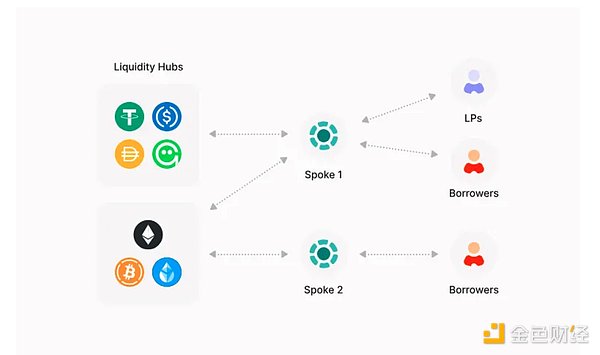
Both share the same deep stablecoin pool, but a liquidation cascade on one side will not affect the other.
Aave's Horizon platform operates a similar permissioned RWA marketplace, with net deposits exceeding $550 million. Founder Kulechov aims to reach $1 billion by 2026 through partnerships with Circle, Ripple, Franklin Templeton, VanEck, and others.
Morpho may offer the optimal solution for institutions entering DeFi lending in terms of experience. Remember the "insufficient internal expertise" mentioned by institutions? Morpho Vault might be the answer. Its vault system separates liquidity provision from risk management, introducing a professional management team to be responsible for formulating collateral policies, setting exposure limits, and allocating capital on behalf of funders in various lending markets. Currently, over 30 managers operate on Morpho, with total deposits increasing from $5 billion to $11 billion and active loans reaching $4.5 billion. Morpho has achieved an optimal balance between passive returns and risk management, and institutions are beginning to recognize its value. In January 2026, Bitwise, a licensed asset management firm managing over $15 billion in client assets, launched its first non-custodial vault on Morpho, with dedicated portfolio managers responsible for strategy and risk control. Anchorage Digital, the first federally regulated digital asset bank in the United States, now offers institutional clients direct access to Morpho vaults and custody of vault tokens. Coinbase has integrated Morpho to power its crypto-collateralized lending product, supporting over $960 million in active loans. Societe Generale's Forge, Gemini, and Crypto.com have also completed similar integrations. To gain a deeper understanding of the disassembled architecture of the vault system—protocol, administrator, and distributor—and how blockchain can reduce trust costs for expansion, read my article from last week, "DeFi’s Capital Aggregator." One of the most fundamental mismatches between DeFi and institutional funding is interest rate structure. DeFi lending rates are floating by default, fluctuating with pool utilization, sometimes dropping from double digits to single digits within days. This is completely impractical for pension funds or insurance companies that need to match long-term liabilities with predictable cash flows: if your source of income might plummet by 5% next month, you cannot promise to pay a fixed 7% return to your beneficiaries. Pendle solves this problem by splitting the interest-bearing asset into two tradable tokens: Principal Token (PT): Represents the underlying asset and is redeemable at maturity. Yield Token (YT): Captures all floating returns generated before maturity. This split is directly analogous to traditional fixed-income instruments: PT is similar to a zero-coupon bond, and YT... This allows users who wish to speculate or hedge against interest rate fluctuations to separate their floating rate exposure. Institutions buying PT lock in fixed returns; traders buying YT amplify their floating rate exposure. Both parties get what they need from the same underlying position. In 2025, Pendle's fixed-income settlement volume reached $58 billion, a year-on-year increase of 161%, with annualized protocol revenue exceeding $40 million. Its Boros platform, launched in early 2026, extends this model to funding rate derivatives—allowing institutions to hedge or acquire perpetual contract funding rate exposure. This market, with a daily trading volume exceeding $150 billion, had previously lacked on-chain hedging tools. On-Chain Credit Diversification Most DeFi lending protocols rely on a single source of yield: overcollateralized, floating-rate crypto loans. When the market cools, utilization declines, interest rates compress, and yields drop accordingly. Maple Finance has been actively diversifying its yield sources. Its core product provides overcollateralized, fixed-rate loans to institutional borrowers (trading firms, market makers), with collateral visible on-chain in real time. Currently, its 30-day APY is 5.3%. In addition, it launched BTC yield products in early 2025, offering Bitcoin-denominated returns; it also launched a high-yield collateral pool, achieving a 9.2% return in the second quarter of 2025 through active credit underwriting. Its syrupUSDC token (a participation certificate in the lending pool) can be integrated into Aave, Morpho, Spark, and Pendle, allowing depositors to combine yields across protocols or lock in a fixed interest rate through Pendle yield tokenization. Ultimately, this forms a multi-strategy lending platform, rather than a single lending pool.
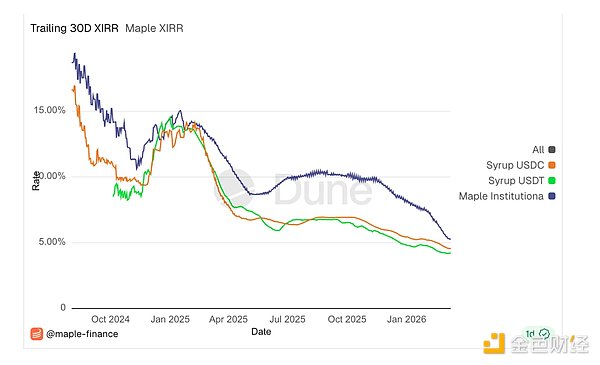
By 2025, Maple's assets under management will grow from $516 million to $4.59 billion, with outstanding loans increasing eightfold, and annualized revenue reaching $30 million in the fourth quarter.
CEO Sid Powell has clearly stated that Maple will enter the structured lending market—securitization and asset-backed products.
In practice, this means dividing a basket of on-chain loans into different tiers: **Priority Tier:** Priority repayment, lower risk. **Subordinate Tier:** Priority loss absorption, but higher returns. This is precisely the core mechanism by which the traditional credit market expanded from hundreds of billions to trillions: allowing the same loan pool to simultaneously meet the investment needs of conservative pension funds and high-yield hedge funds. These products are not yet online, but the direction indicates that on-chain lending will become more diversified, covering all risk appetites. **Core Model** Specific protocol details are far less important than the structural model they reveal. DeFi is reconstructing the risk management foundation of traditional finance in a programmable, transparent, and composable form—risk isolation, content management, tiering, fixed interest rates, and compliance thresholds. This distinction is crucial. Smart contracts are auditable. Settlement is done in real time. Vault allocations are visible on-chain. Curator actions are time-locked and observable. The opacity inherent in traditional risk infrastructure is completely unnecessary here. What's introduced is a functional architecture—separation of concerns—allowing different types of capital to coexist within a shared infrastructure. The vault ecosystem is the most obvious manifestation of this integration. Bitwise's 2026 outlook refers to on-chain vaults as "ETF 2.0" and predicts their assets under management will double this year. Morpho believes that vaults are the next savings account layer after the success of stablecoins (the demand account layer): stablecoins bring money on-chain, vaults make money work. As more and more institutions, fintech companies, and emerging banks embed vault-driven yield products into their services, end users may not even realize they are using DeFi infrastructure. The crypto-collateralized lending market is in its healthiest state ever. A Galaxy report points out that the current leverage cycle is built on a collateralized and transparent structure, replacing the opaque, uncollateralized lending model of 2021. However, to move beyond native crypto funding and achieve larger-scale expansion, a risk layer that matches the rules governing institutional funding is needed. The protocol built on this layer in the following directions will be best positioned to capture the next order of magnitude of funding: Modular Risk Isolation, Professional Management, Fixed-Rate Infrastructure, On-Chain Structured Credit. Their success depends less on TVL (Total Value Link) and more on whether institutions believe these on-chain risk management methods are as reliable as those within their existing systems. This question remains unresolved. But for the first time, the architecture needed to answer it exists. Until then, proceed with caution.
The promise and power of cryptocurrencies cannot be separated from their principle of decentralization.
JinseFinanceSygnum has partnered with Moomoo Singapore to launch a new digital asset fund for accredited investors, aiming to offer diversified strategies in the growing cryptocurrency market. The fund, available in 2025, focuses on active management to maximise returns and manage risks in this emerging asset class.
 Weatherly
Katalin Tischhauser, head of investment research at Signum Bank, joins other commentators in believing that spot Solana and Cardano ETFs are unlikely, although VanEck might disagree.
JinseFinanceSwiss crypto bank Sygnum secures $40M in funding, reaching a valuation of $900M. Eyeing expansion into new markets, the bank aims to navigate the evolving crypto landscape and sustain trust through regulation amid industry shifts.
 Huang Bo
EU Commissioner Yvo Volman said that the EU must get metaverse regulations "right from the start."
 Beincrypto
FSB has released a crypto regulation framework calling for the enactment of laws that equate to the risks posed by the sector.
 Finbold
Sygnum debuted cryptocurrency staking about two years ago with Tezos staking, eventually expanding the service to ICP and Et2.
 Cointelegraph
Digital art gallery DeviantArt will provide Web3 users with an extra layer of security. The platform announced a “groundbreaking communication ...
 Bitcoinist
Vitalik Buterin has called for relief for small UST holders lured by crypto influencers’ promises of high stablecoin yields.
CointelegraphAccording to reports, Sun Hung Kai will become the largest seller of new homes in Hong Kong in January 2022.
Cointelegraph