Nigeria's $246,153 Crypto Theft: Recovery Steps and Impact
Exploring the aftermath of Nigeria's $246,153 crypto theft: arrests, recovery efforts, and the broader implications in the digital sphere.
 Hui Xin

Author: Thejaswini M A Translator: Shan Ouba, Jinse Finance
A few days ago, I read about a concept in Japanese philosophy—basho (place). A rough translation is "place, location," but the meaning philosopher Keiji Nishitani gave it is far more difficult to define than simply a location: it's more like a circumstance, a field that allows everything to become itself.
Simply put: people don't appear in a place by chance, but are shaped by the place they are in. Nishitani is talking about consciousness and existence. To some, this might just be common sense packaged in sophisticated vocabulary, but sorry, today I'm going to use this theory to analyze Base.
Back to Base. Last month, its active address count hit an 18-month low. Upon reflection, I realized: Base only builds a location, but never creates a circumstance for things to grow and take shape.
When Coinbase launched Base in 2023, the crypto-native community achieved a rare consensus of trust. Everyone believed it could finally solve Ethereum's oldest problem: a complete infrastructure but a lack of users. Coinbase, with hundreds of millions of users and unparalleled distribution capabilities, had a unique advantage. Users had been waiting for this for a long time. At first glance, this confidence seemed reasonable. Base's growth rate surpassed any previous Layer 2, reaching a total value locked (TVL) of $5.6 billion in October 2025, with transaction fee revenue unmatched in the entire L2 space. Therefore, when the token was confirmed for listing in September 2025, it seemed like a successful experiment had been completed. A simple location was about to become a real "venue." Then, the users all left. Let's look at the specific data. The number of active addresses on Base has recovered to July levels. The token confirmation and distribution also perfectly met the needs of the airdrop farmers: a final reward, nothing more. Base's 2025 bet on the content creator economy also failed. Its mechanism is Zora, a protocol that tokenizes content by default. By the end of the year, 6.52 million creator and content tokens had been issued through Zora on Base. Of these, only 17,800 tokens remained active throughout the year, representing a mere 0.3%. The remaining 99.7% of tokens sold out before anyone even tried to acquire them. Base reached a peak of 1.72 million daily active addresses in June 2025. By March 2026, the number of daily active addresses had dropped to 458,000, a 73% decrease from the peak. After Armstrong announced in September 2025 that Base was exploring token issuance, Base's active addresses shrank by 54% in the following six months, indicating that the speculative frenzy had subsided. Sociologist Ray Oldenburg once studied: What makes people repeatedly return to a place regardless of reward? He calls them the third space—bars, barbershops, city squares. These places don't prioritize efficiency, but offer reasons to return, unrelated to incentives. The core idea is: the desire to stay cannot be manufactured; it can only grow naturally from the long-term potential nurtured by the place. The crypto industry designs spaces solely to extract value, then wonders why no one stays. This is what it looks like to have a location, but no place: people pass by, take what they need, and leave at no cost. No identity is formed here, no ability is built that cannot be replicated elsewhere in three weeks; leaving doesn't feel like a loss, just a change of scenery. Are there unique relationships on this chain? Clearly, we haven't built our products this way. Monetary incentives cannot create a place. You can use incentives to pull people in, but you can't make them stay. The desire to stay can only come from the long-term potential nurtured by the place itself. Xigu calls this the logic of place: the relational field shapes everything born within it. The crypto industry designed its environment for exploitation, only to discover, surprisingly, that it ultimately only created exploitation. Coinbase CEO Brian Armstrong publicly stated that the Base App has now transitioned to a non-custodial, transaction-centric version of the Coinbase app. The vision that once fostered social interaction, a creator economy, and on-chain identity—a vision that should have given users a sense of belonging and a willingness to protect their communities—has vanished. From a data perspective, this is a rational decision, but also an admission: the space was never truly established. Base had only one location, and now it can only optimize transient traffic, because that's all it has left. The entire L2 industry is cooling down. Base is not an isolated case, but a microcosm of the entire L2 space. Since June 2025, the usage rate of small and medium-sized L2 blockchains has plummeted by 61%. Most public chains outside the top three have become zombie chains, their activity level barely enough to keep them running but lacking any real influence. The daily active user ratio of L2 to L1 has dropped from 15 times in mid-2024 to 10-11 times today. The usage rate of the vast majority of new L2 blockchains collapsed immediately after the incentive cycle ended. The entire L2 blockchain sector is cooling down, not just the base blockchain. Previously, the roadmap theory centered on Rollups suggested: reducing entry costs → user influx → ecosystem formation → network effect compound growth. The Ethereum Foundation released a 38-page plan this year, but the top L2 blockchains have hit rock bottom in activity and exited the OP Stack, while the second-ranked blockchain's growth has stagnated. Lowering entry costs ≠ creating a mature ecosystem. The industry has solved the entry barrier, but has naively assumed that a sense of belonging will follow. This is not the case; a sense of belonging is not a feature that can be implemented immediately. Farcaster is the closest product in the crypto industry to creating a true community. This is because a specific group of people built a unique culture on it: developers share their work, debate Ethereum, and develop long-term perspectives. This takes time and cannot be replicated simply by offering higher rewards. Friend.tech attempted the same approach with an incentive mechanism, reaching the top in a week and disappearing in a month. The product mechanisms were similar, but the culture was lacking. The difference lies not in the product itself, but in whether people stay long enough for something to truly take shape. What truly retains users? Public chains that retain users through bear market cycles do not rely on more generous incentives. Arbitrum's peak daily active addresses in June 2024 were 740,000; now they are 157,000, a similar 79% drop. But the underlying logic is completely different.
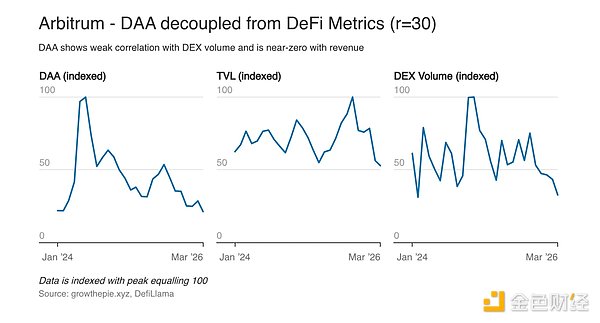
However, the mechanisms are different. Base users come for trading, and leave when trading slows down; the number of users is highly correlated with transaction fee revenue. Arbitrum users are not affected by fees, and the correlation between the number of users and revenue is almost zero. Base attracts tourists, while Arbitrum retains local users.
Hyperliquid is able to stand firm because its trading experience is unique, and the community has formed an identity that does not exist elsewhere. Token incentives are almost irrelevant; staying there is itself part of their behavior and identity. The venue shapes the users, and the users, in turn, shape the venue.
The crypto industry is still focused solely on optimizing user acquisition, only considering the "situation" after data collapses, never taking this into account in the initial design of public chains. Base possesses the strongest user distribution capabilities in history and could have solved this problem better than any other public chain. However, it is currently just a trading application. This is understandable, but there are already over 40 similar products on the market. Trading applications cannot create a place; they can only generate one-time sessions: users complete the transaction and leave. A true situation requires more continuous connection, making each subsequent visit feel like "coming home," not "the first arrival." Armstrong's strategic shift is largely based on data-driven conclusions. Social layers, the creator economy, and on-chain identity—these are what should transform Base from a "tool" into a "home," requiring patience, and short-term metrics cannot provide returns. Quarterly active addresses and TVL only measure location size, therefore "location" has never been a priority. The Ethereum ecosystem needs Base to be more than just a trading platform. The foundation of the entire L2 narrative lies in the fact that public chains can become the infrastructure for people's lives and development. If the most powerful L2 in crypto history in terms of distribution capabilities ultimately only aims to be a faster Coinbase, then this narrative collapses. Xigu believes that the deepest level of location is where the boundary between self and location begins to dissolve: you cannot completely separate yourself from the environment that shapes you. In the context of public chains, this means: users cannot imagine a financial life without this chain; all developer tools are natively adapted to a specific ecosystem; and identity is almost impossible to exist elsewhere. As far as I know, no L2 has ever achieved this. It might not even be built within the incentive cycle. My interpretation of the word "place" might be a bit excessive, but the core is simple: even with hundreds of millions of potential users, if there's nothing worth keeping, it's still an empty room. Base now understands this. It still hasn't found its true self.
Exploring the aftermath of Nigeria's $246,153 crypto theft: arrests, recovery efforts, and the broader implications in the digital sphere.
Hui XinAmidst escalating legal tensions, former Binance CEO Changpeng "CZ" Zhao fights against the US government's efforts to impede his return to the UAE.
Hui XinBRICS nations are spearheading a strategic de-dollarisation movement, challenging the long-standing dominance of the US dollar in global trade and signalling a transformative shift in the traditional financial order.
 Jasper
Former SEC Chair Jay Clayton's surprising endorsement of cryptocurrency, despite past legal clashes with Ripple, prompts Ripple CEO Brad Garlinghouse to question the sincerity of Clayton's newfound support, raising concerns about potential inconsistencies in his evolving stance.
JasperThe move follows the Japanese government's recent revision of the Payment Services Act on June 3, 2023, which aims to regulate stablecoins.
 Davin
DavinKimsuky, a North Korean hacking group, employs tactics to target South Korean officials in a cryptocurrency theft scheme, prompting a surge in cybersecurity measures.
Hui XinNorse Atlantic Airways takes a bold step towards greener skies, leveraging AI robots for aircraft maintenance to reduce fuel consumption, recycle glycol, and expedite inspections by 90%.
JasperThe Japanese National Tax Agency (NTA) reveals an increase in crypto tax violations, with 548 cases identified out of 615 inquiries in the fiscal year 2022. Although the average undeclared income per case dropped to $206,000, the cumulative value rose to $126.5 million, prompting calls for tax system reforms in Japan amid criticisms of the current structure's impact on firms holding coins.
 Jixu
JixuThe announcement comes as part of broader leadership changes, with economist Osvaldo Giordano heading the ANSES and engineer Horacio Marín taking charge of YPF from December 10.
DavinBNB Chain recently unveiled insights shedding light on its DappBay platform. At the forefront of the Red Alarm list is Genesis Universe, an NFT-based game on BNB Smart Chain. Despite its play-to-earn mechanism, caution is advised due to its presence on the Red Alarm list, highlighting operational uncertainties.
 Joy
Joy