On April 18, 2025, market maker Wintermute announced that its investment institution Wintermute Ventures has invested in the DeFi lending protocol Euler Finance.
Wintermute Ventures published an investment theme paper on Euler on the same day. The following is the full text of the paper:
In this investment paper, Wintermute Ventures believes that Euler Finance v2 has cracked the code and become a full set of DeFi liquidity layers, which is why Wintermute Ventures announced its investment in Euler.
Current situation
The current status of the on-chain currency market can be classified by three major architectural design frameworks: monolithic, isolated, and modular.
Monolithic lending protocols restrict lending by limiting asset selection, strict loan-to-value (LTV) requirements, and high liquidation penalties. Monolithic lending protocols help improve capital efficiency by aggregating collateral for different uses and allowing rehypothecation. However, they only allow the addition of new collateral types when economic conditions permit, and often only through governance measures.
Isolated lending markets provide greater flexibility, but also fragment liquidity and hinder rehypothecation, which reduces capital efficiency. In addition, traders often have to navigate multiple protocols, governance systems, and interfaces, incurring additional costs. Isolated lending protocols like Compound Finance v3 or Morpho Blue allow for greater flexibility in collateral use, but also fragment collateral and hinder rehypothecation, which reduces capital efficiency. These inefficiencies drive traders to centralized finance (CeFi) and perpetual contracts instead of decentralized spot markets, reducing returns for DeFi borrowers and reducing DeFi's overall liquidity and efficiency.
Euler v2 is a modular lending platform that aims to solve these problems and become the main liquidity layer for DeFi.
Euler's Core Concepts
In short, Euler v2 is a highly modular DeFi money market infrastructure. It streamlines the DeFi lending market to its core components and modularizes them, allowing the creation of almost any type of DeFi money market to meet a variety of risk preferences, from conservative borrowers seeking high-quality collateral to high-yield investors willing to participate in high-risk markets. We believe that it is this modular framework that makes Euler v2 an extremely attractive foundation for money markets, because it is this enhanced flexibility that enables it to attract a wide range of borrowers and asset managers with different risk preferences. Unlike traditional monolithic lending protocols that impose strict collateral requirements, Euler v2 introduces a highly flexible ERC-4626 vault-based system that significantly improves funding efficiency and liquidity utilization. Euler v2 is based on two core concepts: Ethereum Vault Connector (EVC) and Euler Vault Kit (EVK). EVK supports permissionless vault deployment, which can be interconnected through EVC to recognize existing vault deposits as collateral. Creators define all risk/reward parameters and choose whether to maintain governance for active management or permanently revoke governance control, allowing lenders to manage risk themselves.
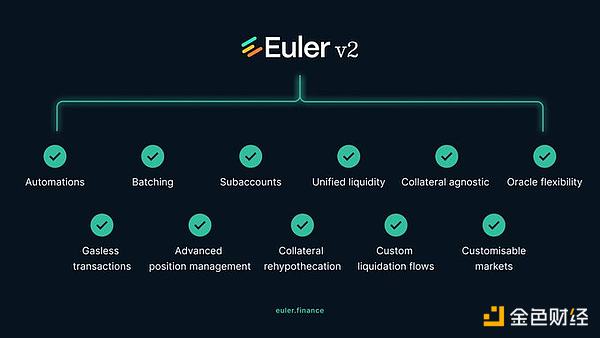
Source: Euler
Flywheel Effect
Euler vaults can identify deposits in other vaults as collateral, thereby solving the bootstrapping problem and enhancing liquidity. In this context, we are particularly excited that when new vaults accept deposits from existing vaults as collateral, existing vaults gain additional utility, while new vaults can leverage existing TVL, accelerating adoption. This creates a flywheel effect: more use cases increase utility, which attracts more deposits. In turn, increased deposits lead to broader adoption of vaults as collateral, further enhancing TVL growth and improving capital efficiency for the entire ecosystem. Since launch, Euler has demonstrated that this theoretical approach translates well into real data: with an average utilization rate of ~47% across all vaults, Euler is far more capital efficient than other market participants.
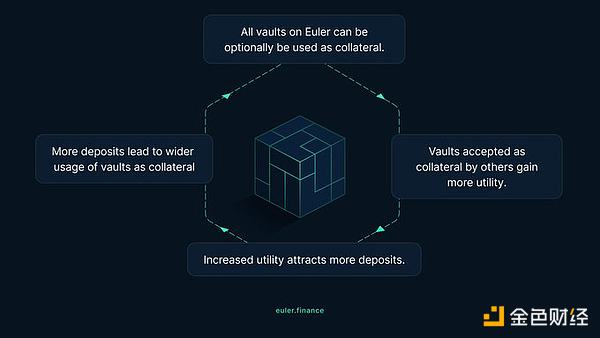 Source: Euler
Liquidation Mechanism
Another compelling feature of Euler v2 is its liquidation mechanism, which is one of the most efficient liquidation mechanisms in DeFi (if not the most efficient) and allows vault creators to customize the liquidation process. By default, it adopts the reverse Dutch auction mechanism of Euler v1, which minimizes liquidation costs and protects borrowers and lenders. The reverse Dutch auction mechanism allows liquidations to occur typically close to the marginal cost of execution. As a result, small positions tend to pay relatively high liquidation fees, while large positions can enjoy significantly reduced fees proportional to their size. This is because there is usually a fixed cost for liquidation, which decreases as the size of the position increases. This mechanism ensures that liquidators are paid fairly without generating unnecessary MEV or penalizing borrowers with excessive fees, which is often the case with fixed liquidation fees. In addition, Euler does not charge additional liquidation fees that many other lending protocols set for additional revenue.
On the front end, Euler provides a comprehensive set of product features tailored for passive users and advanced traders. In addition to standard lending protocol features, its standout features include:
Multiplication: Facilitates leveraged trading and revenue recycling. Users can create leveraged positions by providing collateral, borrowing, swapping, and resupplying.
Trade batching: Execute multiple operations in a single transaction through EVC. Built-in delayed status checks allow for flexible sequencing of operations, while simulation mode allows previewing results before execution to reduce risk.
Portfolio management: Helps users monitor and manage their positions. Health scores indicate the degree of impending liquidation, while quick actions allow users to replenish collateral or repay debt. Advanced analytics provide insights to optimize positions and maximize returns.
Euler Vault Explorer: Euler models the complexity of real-world credit markets, but provides a transparent way to view risk. You can analyze vault risk through Euler's Vault Explorer or other third-party dashboards.
Growth Momentum
Since its launch, Euler v2 has gained significant traction, with its TVL soaring more than 250 times, making it the fastest growing lending protocol in the DeFi space. Monthly active users have grown from less than 1,000 to 10,000 in April 2025, steadily setting new all-time highs. In addition, active loan volume has grown from $88 million to $510 million so far this year, an increase of approximately 480%. Notably, this growth was achieved with only about $2 million in protocol incentives deployed. To us, these metrics mean a lot. While liquidity mining activities often attract only short-term, mercenary capital, resulting in little focus on data, Euler has proven that real organic growth with real users can be achieved with minimal financial incentives - provided the product experience is truly excellent like Euler.
Since launch, Euler's market cap has remained relatively stable, while daily fees and TVL have increased rapidly.
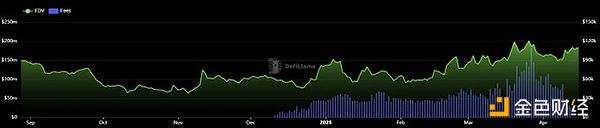
Source: DefiLlama
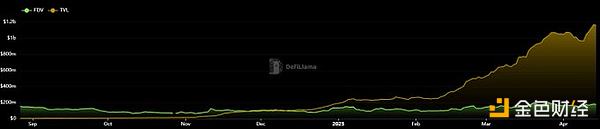
Source: DefiLlama
Multi-chain Expansion
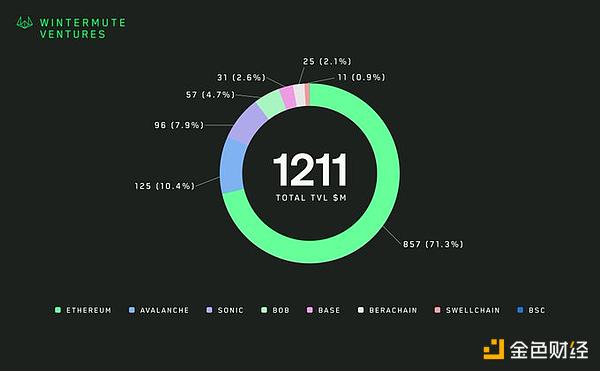
There are many factors driving Euler's recent TVL growth: Euler focuses on multi-chain expansion, has been rapidly deployed on emerging EVM chains in the past six months, attracted a large amount of TVL, and established its dominance as the leading money market on emerging networks. In 2025, Euler v2 expanded to fast-growing blockchains such as Base, Sonic, Berachain, Bob, and BNBCHAIN to gain substantial attention, and steadily announced new chain expansions such as Optimism.
Euler’s blockchain scaling has been successful so far, with smaller blockchains currently accounting for approximately 27% of total TVL.
Source: DefiLlama
EulerSwap
Finally, and of critical importance to us at Wintermute Ventures, is Euler’s upcoming EulerSwap product, an automated market maker that integrates directly with its money market. Euler is the first blockchain protocol to be built on the back of a decentralized AMM (AMM) to solve liquidity fragmentation and increase returns. Not only is this swap product uniquely designed and efficient, but by integrating the Swap market, Euler has also established itself as a one-stop service platform for DeFi liquidity, making the protocol a complete ecosystem. We are excited about this vision and look forward to using our expertise to support it.
Summary
Wintermute Ventures is very excited to invest in what we believe to be one of the most promising protocols in the DeFi space. Since the release of v2, Euler has become the fastest growing lending protocol, and its fully diluted valuation has remained largely stable. Its modular architecture can serve as DeFi money market infrastructure, meeting a variety of risk preferences from conservative institutional strategies to experimental retail products. This marks the beginning of unlimited possibilities for Euler, and also marks the beginning of an exciting journey for Wintermute Ventures as a partner and investor in Euler.


 Kikyo
Kikyo

