Author:Nishil Jain,Translator::Block unicorn
Foreword
I often visit the Polymarket website to check the latest developments in global hot news. For example, how likely is it that the United States will occupy Greenland? Or, what will the final pricing (FDV) of Monad be at the time of release?
Vitalik also uses the market as a news tool, and perhaps many other analysts and people around the world have already made this shift.
Vitalik also uses the market as a news tool, and perhaps many other analysts and people around the world have now made this shift.
Soon, we'll see these markets integrated into our existing news feeds and social apps. In fact, we haven't heard any updates on X's partnership with Polymarket since last year. Just last October, as part of its $2 billion strategic investment, Intercontinental Exchange (ICE, the parent company of the New York Stock Exchange) announced plans to explore commercial applications of Polymarket data. While these feed integrations are still in progress, prediction markets have already successfully integrated into financial apps like Coinbase and Robinhood. Kalshi is entering the web3 app market through the Jupiter super app and Phantom Wallet, while Polymarket has partnered with MetaMask and Rabby Wallet. Prediction market trading volume has remained strong even after the election peak. Currently, daily trading volume on prediction markets exceeds $800 million—more than Pumpfun's $775 million as of this writing.
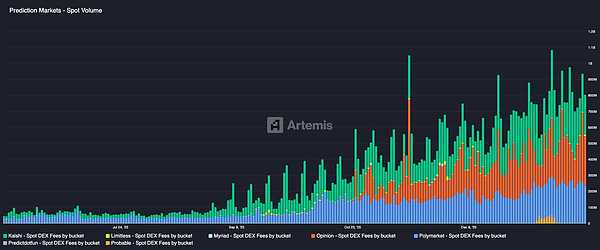
But today, we're not going to discuss the obvious phenomenon of the rise of prediction markets (which is now a widely accepted fact). We'll explore the trends to come.
The rise of pump.fun spawned an ecosystem of Telegram bots, trading terminals, and DeFi ecosystems that power these tokens. Similarly, we're now seeing the rise of applications that expand the concept of prediction markets beyond its existing forms—for example, lending and borrowing prediction market positions, leveraged trading of your predictions, opinion markets, decision markets, and so on.
DeFi Expansion
When a platform gathers people with different risk appetites and trading habits, it becomes very challenging to meet everyone's needs on a single platform. For example, users who want to exchange ETH for USDT cannot do so on Uniswap. This is where Aave or Hyperliquid come in handy.
Gondor is building a lending platform for prediction market traders. After depositing funds, traders can borrow up to 50% USDC as collateral with their holdings. The borrowed funds will be directly returned to Polymarket and displayed as the trader's "cash balance".
Through Gondor, traders can free up previously idle funds, reinvesting them in new trades while maintaining investment exposure.
Of course, all of this follows certain rules. The Gondor team manually screens specific market positions that meet the collateral requirements. These rules ensure that illiquid and easily manipulated markets are excluded from the platform. Many factors determine which markets are whitelisted: order book depth, clarity of solution standards, and solution completion time. The team recently raised $2.5 million in seed funding, with participation from Castle Island Ventures, Maven 11, and Prelude. Gondor's purpose is to bet that predicted market share will become a standardized collateral asset class. Then there's Space, which allows users to gain leveraged exposure to event outcomes. Suppose there's a market for "Will Monad FDV's market capitalization exceed $8 billion when it goes public?", where the price for "yes" is $0.15 (meaning a 15% probability). A trader buys 1000 "yes" shares—normally this would require $150, but with 5x leverage, only $30 is needed as margin. If the probability rises to 30%, the position will be worth $300, and the $30 margin will yield a 500% return on equity ($150 profit). If the probability drops to 13.33% ($0.13), the trader will be forced to liquidate and lose the $30 margin. Space allows traders to profit even from small changes in probability. For example, someone anticipating an overall rise in the cryptocurrency market could bet on the Monad FDV market and profit from a slight increase in its probability. Furthermore, many cryptocurrency users from the memecoin ecosystem, AI coin projects, and more trade with the goal of turning $10 into $1000. For them, and for users with extensive market knowledge but limited funds, these markets can be an attractive investment channel.
AI and Prediction Markets
Vitalik, in his blog "Info Finance," offers some insights into the application of artificial intelligence in prediction markets.
One of his points is to leverage AI to achieve high-quality participation in all micro-markets, which are otherwise too small to attract skilled human traders.
Many of the most interesting prediction markets help us obtain information; they all target "micro" problems: millions of micro-markets, each with relatively small consequences for decisions.
Importantly, the motivation for operating these agencies is not solely based on trading profits. In many cases, the agent's funding may come from organizations or individuals who prioritize market information output; trading activity here serves merely as a signal aggregation mechanism rather than an independent source of revenue. In these micro-markets, human attention is scarce, while AI's attention is abundant. Here, prediction markets no longer resemble gambling products but rather information engines. AI reduces participation costs to near zero, allowing the market to generate meaningful signals even with small trading volumes. Imagine thousands of small markets operating in parallel, each efficiently priced by AI agents. A second use of AI is as the default interface layer for prediction markets. As the number of markets increases, tracking them across multiple platforms becomes a significant cognitive burden for any trader. AI can translate a user's natural language input into tradable positions. For example, a user could tell AI that they believe silver prices will break $100 per ounce by the end of February—AI can then identify potential trading opportunities where the user can profit from this insight—whether in silver options or silver price prediction markets.
Evolutionary Prediction Market Design
Impact Markets
There's a strange gap in how markets work today: you can bet on whether something will happen, and you can see the current price of an asset, but it's difficult to know what the market believes that asset will be worth if a particular event occurs.
Prediction markets show a 60% chance that Trump will raise tariffs on China. The spot market might show Bitcoin trading at $100,000, but you can't know what the market generally believes Bitcoin will trade if the tariffs are actually implemented.
Impact Markets solve this problem. Instead of making "yes/no" bets on events through synthetic tokens, it trades real assets with conditional states.
Impact Markets solve this problem.
You're essentially saying, "I'd only be willing to buy Bitcoin for $90,000 (10% below the current market price) if tariffs are imposed." This applies to any asset-event combination. "If Robinhood launches cryptocurrency trading, use COIN as the underlying asset," "If asteroid mining becomes a reality by 2030, use gold as the underlying asset." You get my point. Events and their impacts are fundamentally different. Prediction markets answer "Will this happen?", while impact markets answer "If this happens, what will happen to this asset?" Decision Markets go a step further, from information transmission to action. They not only reveal the market's thoughts but also allow the market to determine the organization's actual actions. This functionality has already been achieved through Futarchy DAOs on platforms like MetaDAO. Here's how it works: An organization proposes a decision, such as firing its Chief Technology Officer (CTO). The market trades in two conditional states: Pass and Fail. Each state prices the organization's token differently. If the token price rises in the Pass state, the proposal is executed; if the token price rises in the Fail state, the proposal is rejected. The market decides which action maximizes expected value. Transactions are settled only based on the winning outcome. Opinion Markets Not all important questions have clear answers. Prediction markets require objective results—"Did X happen?" These results are easily verifiable. But many economically relevant questions are not. Which prediction market is currently receiving the most attention? Has market sentiment become more optimistic after Powell's last speech? These questions influence capital allocation but cannot be answered with simple "yes" or "no." This is where opinion markets come into play. Platforms like Noise.xyz allow you to speculate on various narratives themselves. These narratives are not determined by deterministic predictions or binary rules but function as a continuous emotional tool. Prices reflect the market's collective opinion at any given moment, not the eventual "correct" outcome. If the price of your bet goes up, you make money; if it goes down, you lose money. It's that simple. Traditional prediction markets are constrained by adjudication requirements: the questions must be objectively verifiable, unambiguous, and answerable with credible data. Opinion markets, however, trade emotions, which tend to be constantly changing. Points to Consider: Prediction markets are still in their early stages, and most markets have low liquidity. A few thousand dollars can cause share prices to fluctuate by more than 10%. In this situation, the probability displayed on the screen is less a "market consensus" and more a "view of the last person to invest $5,000." Only the most liquid markets, such as presidential elections or major sporting events, can provide reliable price signals. Everything else is easily manipulated. People with enough capital and strong conviction can artificially create consensus. Once involved, they can achieve this through persistent price fluctuations in obscure markets. Oracles are another potential point of failure. Blockchains cannot perceive the workings of the real world. They require external infrastructure to input information. Who controls this infrastructure? How do they make decisions? What happens when the flow of funds depends on their judgment? This question arose in Polymarket's trading regarding "Zelensky wearing a suit." Despite multiple news outlets reporting that he was wearing a suit, market authorities ruled that he wasn't, sparking intense controversy in the market. The crux of the controversy lies in the style of his suit, a point for which there is clearly no definitive answer. Those who run oracles are driven by economic interests. Sometimes these interests motivate them to provide accurate information. Sometimes they don't. Or most of the time, the information itself may be ambiguous. As these markets develop and become mainstream, we will see change, and platforms will mature to address these issues. Let's see how things go in a few months.


 XingChi

